

A remodeling project manager is defined as the central coordinator responsible for overseeing every phase of a renovation, from initial planning through final closeout. The role of project manager in remodeling covers scheduling, budgeting, subcontractor coordination, permit tracking, and quality control. Without this function, even well-funded projects in Connecticut routinely run over budget, miss deadlines, and produce work that fails inspection. Jsignorexteriors has seen firsthand how proper project management separates a smooth renovation from a costly ordeal. Understanding what this role actually involves helps you make smarter decisions before the first nail is driven.
What are the core responsibilities of a remodeling project manager?
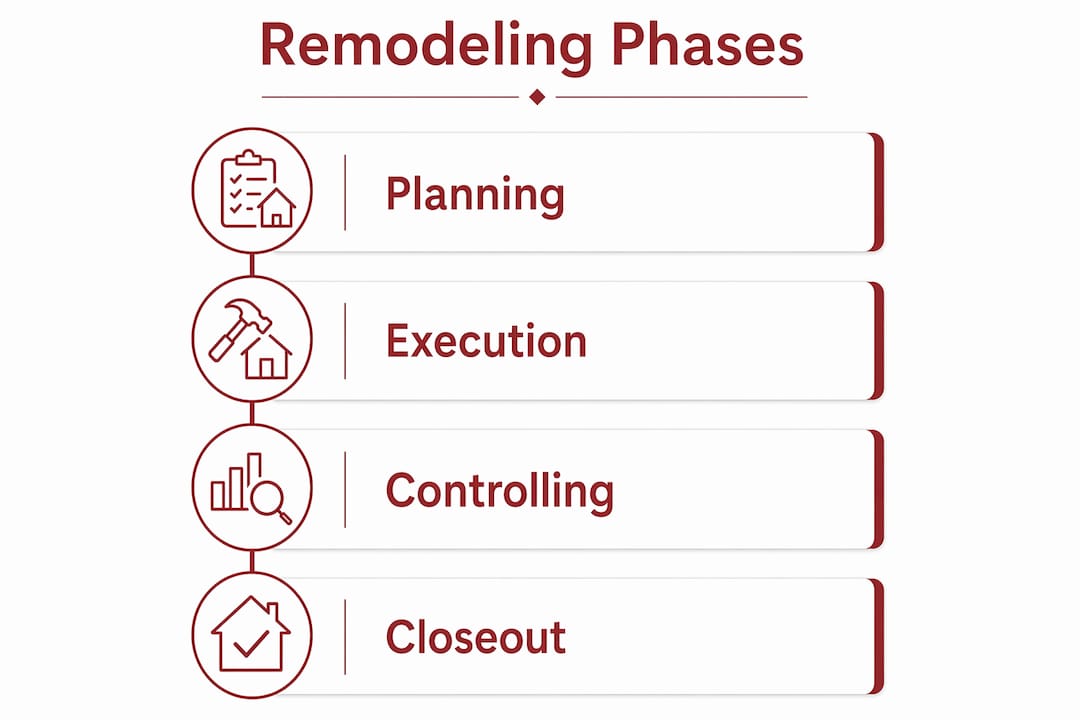
A remodeling project manager carries four distinct categories of responsibility: planning, execution, controlling, and closeout. Research shows that project managers allocate roughly 41% of their time to planning, 25% to execution, 22% to controlling, and 5% to closing activities. That distribution tells you something important: the bulk of the work happens before a single tool touches your home.
Planning phase
During planning, the project manager builds the full schedule, identifies permit requirements, and maps out material lead times. In Connecticut, permit timelines vary significantly by municipality. A project manager who knows Farmington’s building department moves faster than one who treats every town the same. Remodeling project timelines depend heavily on this upfront groundwork. Spending at least 10 extra hours in pre-construction planning prevents delays that could otherwise add 10 or more weeks to the total timeline.
Execution and trade coordination
During execution, the project manager coordinates between 8 and 12 subcontractors to maintain sequential workflow and avoid workspace conflicts. Framing must finish before electrical rough-in begins. Electrical rough-in must pass inspection before insulation goes in. One trade arriving out of sequence can stall the entire job for days. The project manager tracks all of this simultaneously.

A common point of confusion is the difference between a project manager and a site foreman. A foreman supervises daily labor on the ground. A project manager handles budget, schedule sequencing, material procurement, and overall coordination across all trades. They are not interchangeable roles, and treating them as such creates communication gaps that cost money.
The project manager also handles change order management during execution. When a homeowner requests a scope change mid-project, the project manager documents it, prices it, and gets written approval before any work proceeds. This single practice prevents the majority of budget disputes.
Pro Tip: Ask your project manager to show you a written change order log at every weekly update meeting. If one does not exist, that is a red flag.
Controlling and closeout
During the controlling phase, the project manager tracks actual spending against the budget, conducts quality inspections, and coordinates permit inspections with the contractor of record. The building permit is legally held by the contractor, not the project manager or the homeowner. This matters because scheduling inspections at the wrong time causes delays. A skilled project manager coordinates closely with the permit holder to keep inspections on schedule.
Closeout involves a formal punch list: a written record of every incomplete or deficient item that must be resolved before final payment. The project manager also manages warranty documentation and hands off all relevant records to the homeowner.
Why is a project manager important for remodeling projects in Connecticut?
The importance of a project manager becomes clearest when you look at what goes wrong without one. Cost overruns, scheduling conflicts, and failed inspections are the three most common remodeling problems in Connecticut, and all three trace back to coordination failures.
Proper trade sequencing coordinated by a project manager can prevent 35% of common remodeling cost overruns. That is not a small number on a $60,000 kitchen remodel. A project manager also recommends building in a 20–30% budget buffer to handle unforeseen conditions, which is standard practice on any project involving demolition.
Connecticut homeowners face specific challenges that make project management especially valuable:
- Permit complexity: Towns like Hartford, West Hartford, and Farmington each have distinct permitting processes and inspection schedules. A project manager who knows these systems avoids the delays that catch out-of-state contractors.
- Seasonal scheduling: Connecticut winters compress the outdoor construction season. A project manager plans material deliveries and trade schedules around weather windows to protect your timeline.
- Subcontractor availability: Demand for licensed trades in Connecticut is high. A project manager with established relationships books subcontractors earlier and gets better scheduling priority.
- Code compliance: Connecticut follows the International Building Code with state amendments. A project manager tracks these requirements and catches non-compliant work before it reaches inspection.
Homeowners experience less stress when a project manager acts as a single, consistent point of communication. Instead of fielding calls from five different trades, you get one update from one person. That alone reduces the anxiety that makes remodeling feel unmanageable for most homeowners.
What skills and qualities make an effective remodeling project manager?
An effective remodeling project manager combines construction knowledge with financial discipline and communication ability. Technical skill alone is not enough. Neither is organizational ability without field experience. The best project managers bring both.
The core skills that separate effective project managers from average ones include:
- Budget management: Reading a cost report, tracking committed costs versus actual spend, and flagging variances before they become problems.
- Schedule literacy: Building and maintaining a critical path schedule, understanding which tasks are sequential and which can run in parallel.
- Technical construction knowledge: Enough understanding of framing, MEP (mechanical, electrical, plumbing), and finishing work to catch errors during daily site walks.
- Communication: Clear, written updates to homeowners and verbal direction to trades. Ambiguity on a job site costs money.
- Problem-solving under pressure: Hidden conditions, material delays, and trade conflicts happen on every project. The project manager’s job is to resolve them without derailing the schedule.
One distinction worth understanding is the difference between a project manager and a general contractor. A general contractor manages construction with a direct financial interest in the trades, paying subcontractors and marking up their work. An independent project manager acts solely as the homeowner’s advocate, with no financial stake in which subcontractors are used. That difference in loyalty matters when budget pressure arrives.
Pro Tip: When interviewing a project manager, ask how they handled the last change order dispute on a job. Their answer reveals more about their communication skills than any credential.
For Connecticut projects specifically, local knowledge counts as a skill. Understanding how to hire and manage trades in CT is a practical competency that affects every phase of the project.
How does a remodeling project manager protect your investment and ensure quality?
A project manager protects your investment through four specific mechanisms: scope control, daily quality inspections, contingency planning, and structured closeout.
| Protection Mechanism | What the Project Manager Does | Why It Matters |
|---|---|---|
| Scope freeze | Documents and locks project scope before demolition begins | Hidden conditions cause 40–50% of delays once walls open |
| Daily inspections | Walks the site each day to check work quality and code compliance | Catching issues early prevents costly corrections |
| Contingency budget | Builds in a 10–20% contingency buffer before construction starts | Absorbs surprises without derailing the budget |
| Structured closeout | Manages punch list and warranty handoff documentation | Protects homeowner rights after project completion |
Scope freeze deserves special attention. Once demolition starts, hidden conditions emerge constantly: rotted framing behind siding, outdated wiring inside walls, undersized joists beneath floors. A project manager who has locked the scope in writing can price these discoveries as formal change orders rather than absorbing them into vague “extras.” That discipline keeps your final cost predictable.
Exterior renovation budgeting in Connecticut follows the same logic. Whether you are replacing siding, adding a deck, or remodeling a kitchen, the contingency buffer and scope freeze process apply equally. The project manager’s role does not change based on project type. It scales with project complexity.
Daily site inspections are the quality control mechanism most homeowners never see. The project manager checks that work matches approved drawings, that materials match specifications, and that installation methods meet code. Problems caught on day two cost far less to fix than problems caught on day twenty.
Key Takeaways
A remodeling project manager is the single most effective safeguard against cost overruns, delays, and quality failures on any Connecticut renovation project.
| Point | Details |
|---|---|
| Time allocation | Project managers spend 41% of their time on planning, which is where most project success is determined. |
| Cost overrun prevention | Proper trade sequencing prevents 35% of common cost overruns; a 10–20% contingency buffer absorbs the rest. |
| Single point of contact | One consistent communicator reduces homeowner stress and eliminates scattered trade communications. |
| Scope freeze discipline | Locking scope before demolition prevents hidden conditions from becoming uncontrolled budget increases. |
| PM versus GC distinction | A project manager advocates solely for the homeowner; a general contractor has financial interest in the trades. |
Why I think most homeowners underestimate this role
Most homeowners I talk to think of project management as an add-on, something you pay for if the project is large enough. That framing gets it backward. Project management is not a luxury layer on top of construction. It is the function that makes construction work as planned.
The projects that go sideways almost always share the same root cause: no one owned the schedule and the budget at the same time. The electrician thought the plumber was finishing first. The plumber thought the tile was already ordered. The homeowner found out about both problems when they got a call asking for more money.
What I have seen work consistently is investing in upfront planning before any trade sets foot on the property. Ten hours of planning meetings, written schedules, and locked scope documents will save you weeks of delays and thousands in change orders. That is not a theory. It is the pattern that repeats across every well-run project.
For Connecticut homeowners specifically, the local permit and inspection process adds a layer of complexity that out-of-state management approaches miss entirely. A project manager who knows your town’s building department by name is worth more than a credential on a resume.
Choose the level of management that matches your project’s scale. A bathroom refresh may need only a part-time coordinator. A full kitchen remodel or exterior renovation involving multiple trades needs a dedicated project manager from day one.
— Adam
Jsignorexteriors brings professional project management to Connecticut remodeling
Jsignorexteriors has managed exterior and interior remodeling projects across Connecticut for more than 30 years. Every project, from roofing and siding to kitchen remodeling and decks, is handled with the same structured approach: locked scope, written schedules, coordinated trades, and clear communication from start to finish.

If you are planning a remodeling project in Connecticut and want a team that manages the details so you do not have to, Jsignorexteriors is ready to help. Explore the full range of Connecticut remodeling services or contact the team directly to discuss your project and get a clear plan in place before work begins.
FAQ
What is the role of a project manager in remodeling?
A remodeling project manager coordinates all phases of a renovation, including planning, scheduling, subcontractor management, budget tracking, and quality inspections. Their job is to deliver the project on time, within budget, and to the agreed quality standard.
How is a project manager different from a general contractor?
A general contractor manages construction and pays subcontractors directly, giving them a financial interest in trade selection. A project manager acts solely as the homeowner’s advocate with no financial stake in which trades are used.
Why do remodeling projects in Connecticut need a project manager?
Connecticut’s permitting processes, seasonal construction windows, and high demand for licensed trades create coordination challenges that a project manager is trained to handle. Proper coordination prevents 35% of common cost overruns.
What does a project manager do during the planning phase?
During planning, the project manager builds the full project schedule, coordinates permit applications, maps material lead times, and locks the project scope in writing before demolition begins.
How much contingency budget should a remodeling project include?
Industry practice calls for a 10–20% contingency buffer on most remodeling projects. Projects involving significant demolition or older structures may warrant the higher end of that range to cover hidden conditions.