

An exterior remodeling contractor is a licensed professional who manages structural and aesthetic upgrades to the outside of a building, including roofing, siding, windows, gutters, and decks. To hire exterior remodeling contractor services in Connecticut legally and safely, you must verify their Home Improvement Contractor registration, confirm active insurance, and collect detailed written bids before signing anything. Skipping any of these steps exposes you to unenforceable contracts, uncovered liability, and costly project failures. This guide walks Connecticut homeowners and business owners through every step of the process.
What credentials must exterior remodeling contractors have in Connecticut?
Connecticut requires every exterior remodeling contractor to register as a Home Improvement Contractor (HIC) with the Department of Consumer Protection. You can verify any contractor’s status through the Connecticut Department of Consumer Protection eLicense portal in minutes. The HIC registration number must appear on all contracts and advertising. If it does not, that is a red flag worth acting on immediately.
Registration confirms identity and consumer protection standing. It does not confirm craftsmanship skill, so other verification steps remain critical. You still need to review portfolios, check references, and confirm insurance independently.

Connecticut’s Department of Consumer Protection mandates general liability insurance of $1,000,000 per occurrence and workers’ compensation coverage for any contractor with employees. If that coverage lapses, the contractor’s registration can be suspended or revoked. A lapsed policy also means any contract you signed may become unenforceable, leaving you with no legal recourse if something goes wrong on your property.
Exterior remodeling covers many trades. HIC registration applies to the general contractor role. Specialized work like electrical, plumbing, or HVAC requires separate trade licenses. Always confirm the right license type for each scope of work on your project.
- Verify HIC registration on the Connecticut DCP eLicense portal before the first meeting
- Confirm general liability coverage of at least $1,000,000 per occurrence
- Request a certificate of insurance directly from the contractor’s insurer, not just a copy
- Ask whether any subcontractors carry their own insurance or fall under the general contractor’s policy
- Check that the HIC number appears on the written contract before you sign
Pro Tip: Request an updated certificate of insurance directly from the insurer, not the contractor. Contractors sometimes present outdated certificates, and a direct request confirms the policy is still active.
How to get and compare bids from multiple exterior contractors
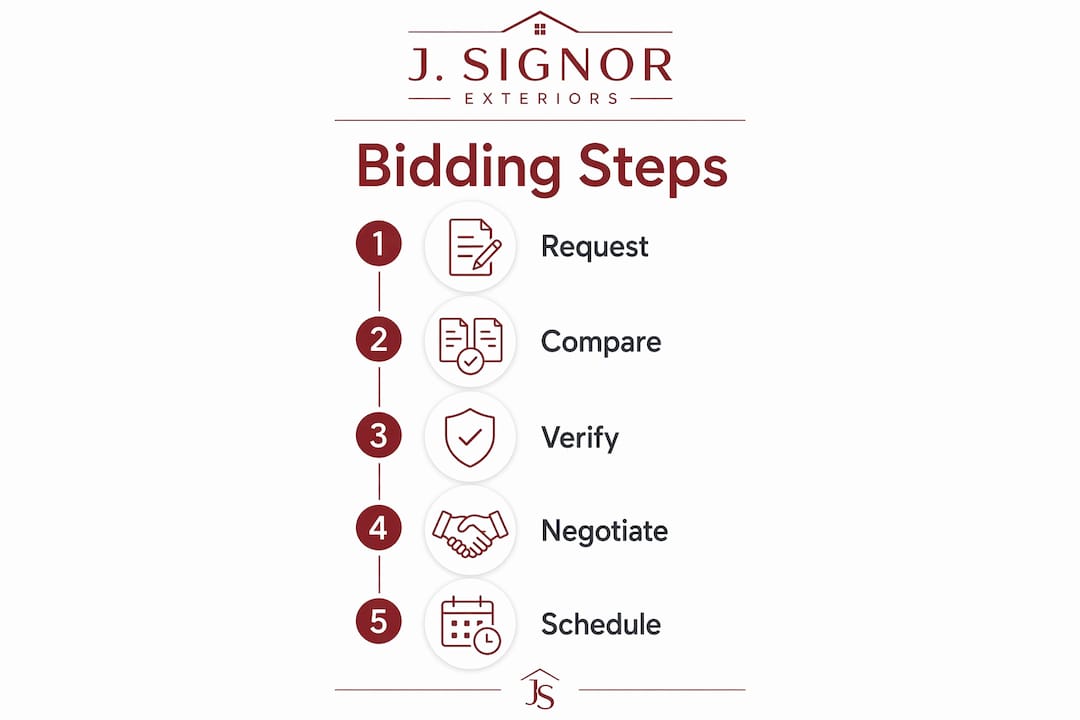
Obtain 3 to 5 written bids before committing to any exterior remodeling project. Fewer bids limit your ability to spot outliers. More bids give you a reliable picture of fair market pricing and contractor professionalism in your area.
Each bid should contain the following:
- A detailed scope of work describing every task, not just a summary
- A materials list with brand names, product grades, and color or style specifications
- A labor cost breakdown separate from materials
- A payment schedule tied to project milestones
- A project timeline with start and completion dates
- Warranty terms covering both materials and workmanship
A staged payment schedule of one third upfront, one third at the project midpoint, and one third on completion protects you from contractors who disappear after collecting a large deposit. Never pay the full amount before work begins. Any contractor who demands full payment upfront is not following standard industry practice.
Use this table to compare bids side by side:
| Bid factor | What to look for | Warning sign |
|---|---|---|
| Scope detail | Line-item tasks and materials | Vague descriptions like “roofing work” |
| Materials specified | Brand, grade, and product name listed | Generic terms like “standard shingles” |
| Payment schedule | Milestone-based payments | Full payment required upfront |
| Timeline | Specific start and end dates | “A few weeks” with no firm date |
| Warranty terms | Workmanship and manufacturer coverage | No warranty mentioned |
Pro Tip: A bid that comes in significantly lower than the others usually means the contractor is cutting corners on materials, skipping steps, or planning to add change orders later. Price alone is never the right filter.
What permits and planning do exterior projects require in Connecticut?
Building permits are required for most exterior remodeling projects in Connecticut, including full roof replacements, siding replacements, and window installations. Cities like Norwalk and Danbury both require permits with the contractor’s HIC registration number and proof of insurance submitted at the time of application. Skipping permits creates problems when you file an insurance claim or sell the property.
Your contractor is responsible for obtaining permits and scheduling inspections. If a contractor tells you permits are unnecessary or suggests you pull them yourself to save money, walk away. That arrangement shifts legal liability to you and removes the contractor’s accountability.
Unpermitted exterior work can void your homeowner’s insurance coverage for related claims and create disclosure obligations that complicate or delay a property sale.
Municipal roof permit guidance in cities like New Haven also references allowable re-roofing layers and full tear-off rules. Your bid should clarify whether the existing roof layers will be removed or covered. Skipping a full tear-off to save money can violate local code and lead to costly change orders mid-project.
Hiring a single contractor for multiple exterior elements, such as roofing, siding, windows, and gutters, reduces scheduling friction and improves coordination at material interfaces. Flashing and weather-resistive barriers must align precisely where roofing meets siding and where windows meet walls. When two separate contractors handle those adjacent scopes, accountability gaps appear and water infiltration risks increase.
- Confirm the contractor will pull all required permits before work starts
- Ask which municipal office issues permits for your specific city or town
- Request copies of all permits and inspection sign-offs for your records
- Verify that permit fees are included in the bid, not added later as extras
What questions help you identify the best exterior remodelers locally?
Portfolio review and warranty inquiry provide more reliable quality indicators than registration verification alone. Ask every candidate to show completed projects similar in scope to yours. A contractor who has replaced roofing, siding, and windows on Connecticut homes in the past two years has relevant, current experience.
Ask these questions during every contractor interview:
- How many projects similar to mine have you completed in the past 12 months?
- What manufacturer warranties apply to the materials you plan to use?
- What workmanship warranty do you offer, and what does it cover?
- Who will be on-site daily, you or a subcontractor?
- How do you handle flashing and weather-resistive barriers at roof-to-wall transitions?
The last question matters more than most homeowners realize. Exterior remodeling failures often occur at material interfaces like roof-to-wall transitions and window flashing. A contractor who gives a vague answer about flashing or housewrap is not detail-oriented enough for a durable exterior project.
Manufacturer preferred contractor locators, such as the AZEK Exteriors preferred contractor locator, identify installers with product-specific experience. They do not guarantee workmanship quality. Use them as a starting point, then vet each candidate independently with references and portfolio reviews.
Responsiveness during the bidding phase predicts behavior during the project. If a contractor takes five days to return a call before you hire them, expect the same during construction. Communication speed and clarity are non-negotiable standards.
Pro Tip: Never tell a contractor that your project has no rush. Contractors prioritize based on scheduling signals, and indicating urgency helps you stay on their active schedule rather than getting pushed back repeatedly.
Step-by-step guide to hiring an exterior remodeling contractor in Connecticut
Follow this sequence to move from research to a signed contract with confidence.
- Check HIC registration and insurance first. Use the Connecticut DCP eLicense portal to confirm registration status. Request a certificate of insurance directly from the insurer.
- Request 3 to 5 detailed written bids. Each bid must include scope, materials with brand names, labor breakdown, payment schedule, timeline, and warranty terms.
- Interview each candidate with targeted questions. Ask about flashing practices, subcontractor use, permit handling, and workmanship warranty coverage.
- Verify references and review completed project portfolios. Call at least two past clients and ask specifically about timeline adherence and how the contractor handled unexpected problems.
- Review the contract line by line before signing. The contract must include the HIC registration number, full scope of work, payment schedule, project timeline, and your right to cancel within three business days under Connecticut law.
- Confirm permits will be obtained before work starts. Ask for the permit number once it is issued and keep a copy.
- Monitor progress and document everything. Take photos at each project phase. Address concerns in writing, not just verbally.
Watch for these red flags at any stage:
- Pressure to sign immediately or lose the price
- Requests for cash payment only
- No physical business address or local references
- Reluctance to provide the HIC registration number
- Bids that exclude permit fees or debris removal
Key takeaways
Hiring a qualified exterior remodeling contractor in Connecticut requires verifying HIC registration, confirming insurance, collecting detailed bids, and confirming permit compliance before any work begins.
| Point | Details |
|---|---|
| Verify HIC registration first | Check the Connecticut DCP eLicense portal before contacting any contractor. |
| Confirm insurance independently | Request a certificate of insurance directly from the insurer, not the contractor. |
| Collect 3 to 5 detailed bids | Each bid must specify materials by brand, scope, payment schedule, and warranty terms. |
| Require permit compliance | Your contractor must pull all permits and provide copies of inspection sign-offs. |
| Evaluate beyond registration | Use portfolios, references, and warranty terms to assess real workmanship quality. |
What I have learned after watching too many exterior projects go sideways
HIC registration is the first filter, not the final one. I have seen homeowners hire registered contractors who delivered sloppy flashing work and disappeared before the final inspection. Registration tells you the contractor is legally allowed to work. It tells you nothing about whether they will do the job well.
The single biggest mistake I see is splitting exterior scopes between multiple contractors to save money. When one crew handles roofing and another handles siding, nobody owns the interface between them. That gap is exactly where water gets in. Hiring one contractor for the full exterior scope costs more upfront and saves significantly on callbacks, repairs, and disputes.
Skipping permits is the second most common mistake. Homeowners sometimes agree to skip them because the contractor suggests it will speed things up. It does not. It creates a liability problem that surfaces at the worst possible time, usually during a storm claim or a property sale.
Document everything in writing from the first conversation. Verbal promises from contractors do not hold up when a dispute arises. A well-documented project file, including bids, contracts, permits, and photos, is your best protection if something goes wrong.
— Adam
Jsignorexteriors: Connecticut exterior remodeling done right
Jsignorexteriors is a family-owned exterior remodeling contractor with more than 30 years of experience serving homeowners and businesses throughout Connecticut. The company is fully licensed and insured, handling roofing contractor services, siding replacement, window replacement, gutter installation, and decks under one roof.
Working with a single contractor for your full exterior scope means one point of contact, one warranty, and no gaps at material interfaces. Jsignorexteriors provides detailed written estimates, pulls all required permits, and completes projects on time and within budget. Contact Jsignorexteriors to schedule a consultation and get a written estimate for your next exterior project.
FAQ
What is a Home Improvement Contractor registration in Connecticut?
HIC registration is a state-required credential issued by the Connecticut Department of Consumer Protection that allows contractors to legally perform home improvement work. You can verify any contractor’s registration status through the DCP eLicense portal.
How many bids should I get for an exterior remodeling project?
Collect 3 to 5 written bids for any exterior project. This range gives you enough data to identify fair pricing and spot contractors whose bids are unusually low or vague.
Do I need a permit for roof or siding replacement in Connecticut?
Yes. Most exterior projects, including full roof replacements and siding installations, require building permits in Connecticut municipalities. Cities like Danbury and Norwalk require the contractor’s HIC number and proof of insurance with the permit application.
What should a contractor’s written bid include?
A complete bid includes a detailed scope of work, materials specified by brand and grade, a labor cost breakdown, a milestone-based payment schedule, a project timeline, and warranty terms for both materials and workmanship.
Why does hiring one contractor for multiple exterior scopes matter?
A single contractor manages coordination between roofing, siding, windows, and gutters, which reduces scheduling gaps and improves protection at material interfaces like flashing and weather-resistive barriers where most exterior failures occur.