
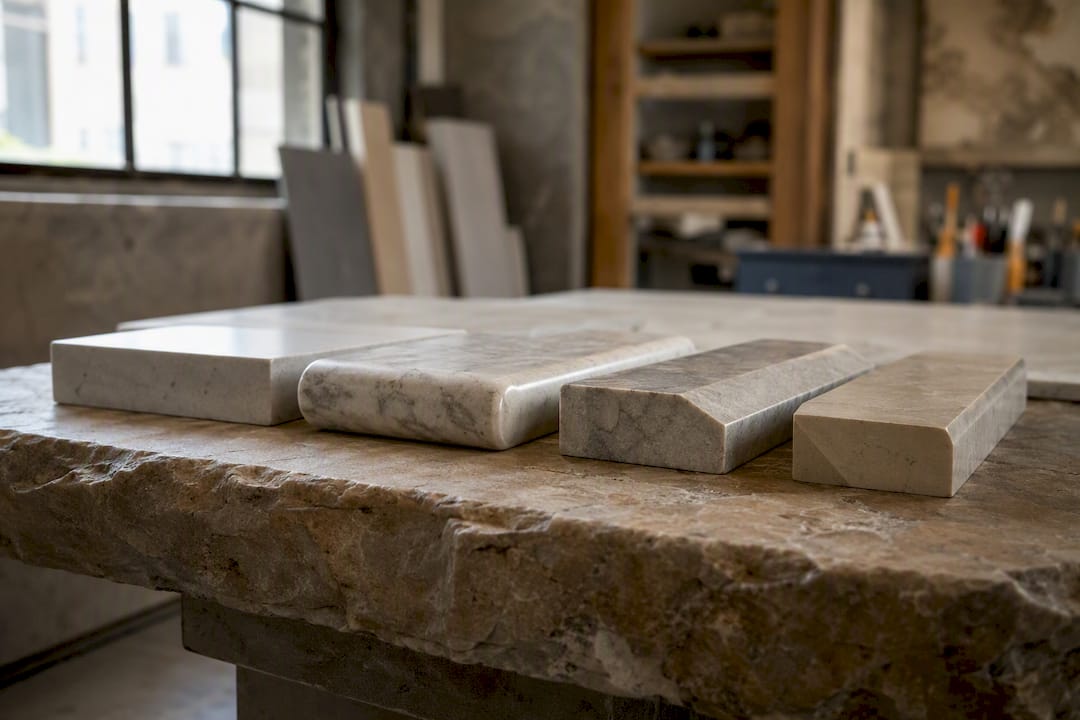
A countertop edge profile is the shape cut into the visible edge of your countertop slab, and it does more than decorate the counter. It shifts how safe the counter is around kids, how easy it is to wipe clean, and how much the finished kitchen costs. If you want the safest option, look at a bullnose. If low maintenance matters most, stick with eased or square. If you want a showpiece, ogee or waterfall edges make the biggest visual statement.
Here’s a fast breakdown before you dig into the details:
- Safety-friendly: Bullnose or half bullnose, both rounded with no sharp corners.
- Low-maintenance: Eased or square edges, since flat lines don’t trap crumbs or grease.
- High-style: Waterfall or ogee, for a kitchen that reads as custom and high-end.
Key Takeaways
Choosing the right countertop edge profile means balancing kitchen style, household safety, cleaning habits, and fabrication cost before you sign off on a slab.
| Point | Details |
|---|---|
| Definition matters first | A countertop edge profile is the shaped contour cut into the visible edge of the slab. |
| Eased edge is the default | Most fabricators include this square, softly rounded edge in base pricing. |
| Safety favors rounded edges | Bullnose and half bullnose reduce the risk of cuts and bruises due to their rounded geometry. |
| Ornate profiles cost more | Complex edges like ogee typically add $5 to $25 per linear foot over base pricing. |
| Work with a full-service contractor | Jsignorexteriors coordinates edge selection, fabrication, and installation within a complete kitchen remodel. |
Table of Contents
- What Are the Most Common Countertop Edge Profiles?
- How Do You Choose the Right Countertop Edge?
- What Do Countertop Edges Cost, and How Long Do They Take?
- Which Countertop Materials Work Best With Each Edge?
- What Does Your Fabricator Actually Think About Before Cutting an Edge?
- Let Jsignorexteriors Handle Your Countertop and Kitchen Remodel
- Frequently Asked Questions
- Sources
What Are the Most Common Countertop Edge Profiles?
Fabricators cut dozens of edge shapes, but most kitchens land on one of ten. Each balances look, safety, and price differently, and knowing the trade-offs up front saves you from falling for a profile that looks great in a showroom photo but drives you crazy in daily use.
Eased edge. A nearly flat, square edge with the corners softened just enough to prevent chipping, typically a 1/16 to 1/8 inch radius. It’s the default most fabricators quote first because it requires almost no extra tooling. Best for busy kitchens where function outranks flourish. (Visual sample: straight profile photo, side view.)
Square edge. Crisp 90 degree corners with zero softening. Reads modern and minimal, but the sharp corners bruise easily on cabinetry and can nick fingers. Best suited to contemporary kitchens with lower foot traffic. (Visual sample: close-up cross-section diagram.)
Bullnose. Fully rounded, top to bottom, with no flat edge left at all. The rounded geometry lowers the risk of cuts or bruises from bumps, which is why it shows up constantly in homes with young kids. Best for family kitchens and bathroom vanities. (Visual sample: rounded profile photo.)
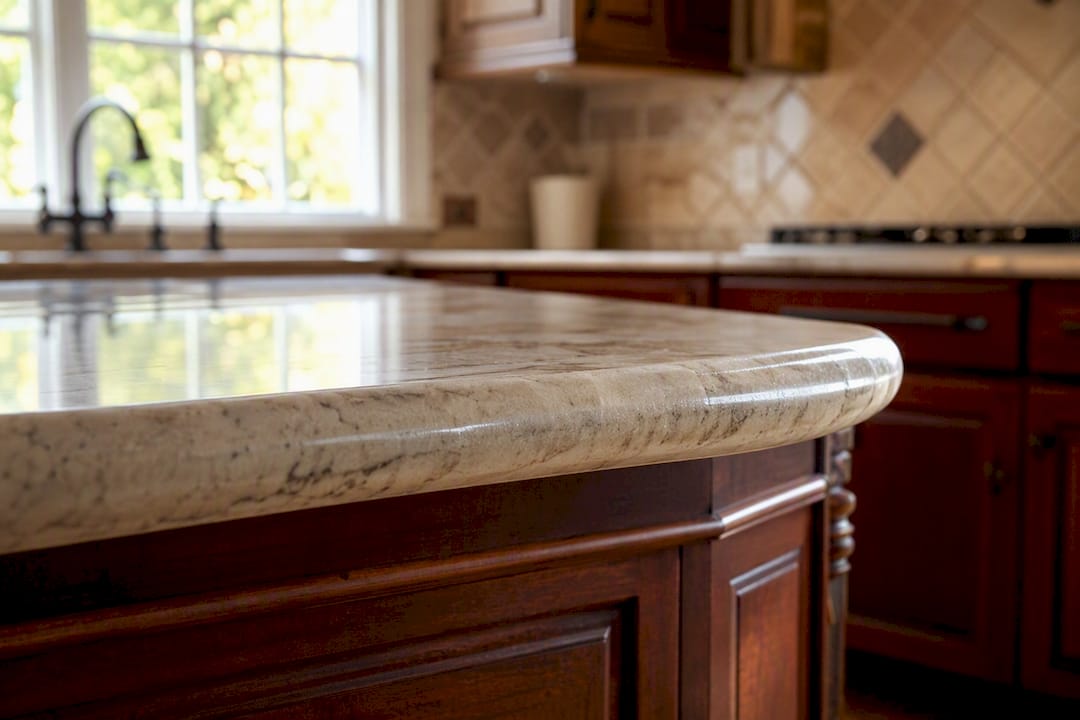
Half bullnose. Rounded on top, flat underneath, splitting the difference between bullnose softness and square practicality. Best for transitional kitchens that want a softened look without losing visual thickness. (Visual sample: side profile diagram showing the flat underside.)
Beveled edge. A flat, angled cut, usually 45 degrees, standing 1/8 to 1/2 inch tall. It catches light in a way flat edges don’t, giving the slab a faceted, jewelry-like look. Best for modern kitchens with waterfall islands or dark stone. (Visual sample: angled edge photo under raking light.)
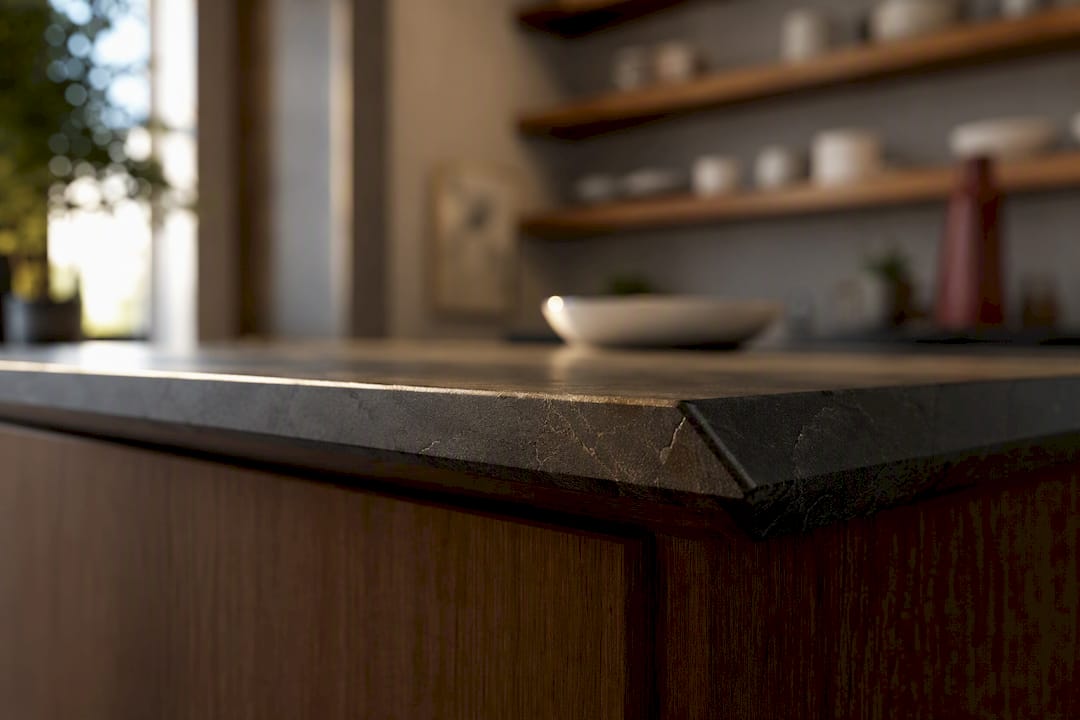
Pencil edge. A slim, uniform rounded edge, thinner than a bullnose. Best for minimalist kitchens where you want softness without bulk. (Visual sample: thin rounded profile close-up.)
Cove edge. A concave curve cut into the underside, creating a shadow line beneath the slab. Best for kitchens that want subtle depth without an ornate look. (Visual sample: underside shadow-line photo.)
Ogee. An S-curved profile combining a convex and concave line, the classic “formal” edge. It’s ornate, distinctive, and one of the pricier standard options. Best for traditional and European-style kitchens. (Visual sample: S-curve cross-section diagram.)
Dupont edge. A stepped profile combining a bullnose curve with a flat reveal below it. Best for transitional kitchens that want detail without going full ogee. (Visual sample: stepped profile photo.)
Mitered edge. Two slab pieces joined at a 45 degree seam to fake a thicker, more substantial edge. Best for kitchens where visual weight matters more than actual slab thickness. (Visual sample: mitered seam close-up.)
Waterfall edge. The slab wraps continuously down the side of an island to the floor, with no visible seam break in the design line. Best for open-concept kitchens built around a statement island. (Visual sample: full island photo, floor to countertop.)
Pro Tip: Match profile complexity to how the kitchen actually gets used, not just how it looks in photos. A heavily carved ogee on a small galley kitchen with constant food prep will collect flour and grease in every groove. Save the ornate profiles for perimeter counters that see less daily traffic, and keep prep zones simple.
How Do You Choose the Right Countertop Edge?
Run through this checklist before you commit to a profile:
- Does the profile match your kitchen’s overall style (modern, traditional, transitional)?
- Does it work for your household, especially if young kids or elderly family members use the kitchen?
- How much daily cleaning does the geometry demand?
- Does the cost fit your budget once fabrication complexity is factored in?
- Is the profile compatible with your chosen material’s thickness and strength?
Ask your fabricator these questions during the consultation:
- Does this profile weaken the slab edge or require extra support?
- Will it need seams or mitering, and where will those seams fall?
- What tooling does this edge require, and how does that affect lead time?
- How does this profile perform for food prep and cleanup?
- What’s included in the base price versus billed as an upgrade?
Watch for red flags: an elaborate profile quoted on a thin slab (it may chip), vague pricing that doesn’t break out edge upcharges, and ornate coves on counters used heavily for food prep, since complex profiles trap debris and make sanitizing harder.
Before you finalize anything, it helps to review common kitchen remodel planning mistakes so edge selection doesn’t become an afterthought squeezed in at the last minute.
What Do Countertop Edges Cost, and How Long Do They Take?
Edge complexity is one of the biggest hidden cost drivers in a countertop quote. Simple profiles like eased or pencil edges are usually folded into the base fabrication price because they need minimal router time. Ornate profiles, like ogee or dupont, typically add $5 to $25 per linear foot on top of that base, depending on the material and how many tooling passes it takes.
Timeline generally breaks down like this:
- Templating: Usually happens on-site after cabinets are installed, one to two hours.
- Fabrication: Simple edges finish in a day or two; ornate profiles or mitered waterfalls can take several extra days for lamination and multiple diamond-tool passes.
- Installation: Typically scheduled within one to two weeks of fabrication, depending on shop backlog.
Ornate edges take longer because each pass with diamond tooling removes only a small amount of material, and mitered edges need time for adhesive to cure before the seam gets polished flush.
Which Countertop Materials Work Best With Each Edge?
Not every material handles every profile well, and picking the wrong pairing can mean chipping, cracking, or edges that look muddy instead of crisp.
- Granite and quartz: Handle almost any profile, from simple eased edges to full ogee, since the stone is dense enough to hold detail.
- Laminate: Works best with simpler profiles like bullnose or beveled, since laminate can’t be carved as deeply as stone.
- Solid surface: Handles rounded profiles particularly well and can even be seamed invisibly, making it a strong choice for waterfall or mitered looks.
Ornate profiles collect more crumbs and grime in the grooves, so they need more frequent cleaning than flat eased or square edges, which wipe clean in one pass.
What Does Your Fabricator Actually Think About Before Cutting an Edge?
A shop’s pricing usually reflects how much CNC time and tooling wear a profile demands, which is why simple edges often ride along in the base quote while ornate ones add cost for extra passes. Before cutting anything, a fabricator checks slab thickness, overhang length, whether the profile requires a mitered return, and where seams will land.
- Verify slab thickness supports the chosen profile without weakening the edge.
- Confirm overhangs are supported adequately for the edge style.
- Check whether mitering is feasible given the slab’s veining or pattern.
Pro Tip: Accurate on-site templating saves the most time and money. A rushed template that misses cabinet-height variations often forces a costly second fabrication pass.
A Contractor’s Take on Edge Choice
Most homeowners fall in love with an ogee edge in a showroom, then realize eased or bullnose fits their actual kitchen better. Function should win more often than it does.
Let Jsignorexteriors Handle Your Countertop and Kitchen Remodel
Picking an edge profile is only one decision in a kitchen remodel that also involves cabinetry, layout, and coordinating a fabricator’s schedule with everything else happening in your kitchen. Jsignorexteriors manages that whole process for you, so you’re not chasing separate contractors or guessing which edge profile fits your slab thickness and budget.
Our team handles design input, fabrication coordination, and installation scheduling as part of a full kitchen remodeling project, so the countertop edge decision fits naturally into a plan instead of becoming a separate headache. If you’re ready to talk through options for your space, reach out to request a consultation and get a project estimate started.
Frequently Asked Questions
What is the most common countertop edge profile?
The eased edge is the most common choice. It’s a square edge with a small softened radius, typically 1/16 to 1/8 inch, and it’s usually included in base fabrication pricing.
Which countertop edge is safest for kids?
Bullnose and half bullnose edges are the safest choices because their rounded geometry removes sharp corners that cause cuts and bruises during bumps and falls.
Do fancier edge profiles cost more?
Yes. Ornate profiles like ogee or dupont typically add $5 to $25 per linear foot over simpler edges, since they require extra tooling passes and more fabrication time.
Which edge profile is easiest to clean?
Flat, simple profiles like eased or square edges are easiest to keep clean because they don’t have grooves or curves where crumbs and grease can collect.
Can any material use any edge profile?
Not always. Laminate works best with simpler profiles, while granite, quartz, and solid surface can support more detailed shapes like ogee or bullnose without chipping.
Sources
- Countertop Edge Profiles Guide (2026) | SlabWise
- Edge profiles glossary | Precision Edge Countertops
- Types of countertop edges | Angi
- Commercial kitchen stone countertops: a full guide | Dynamic Stone Tools