
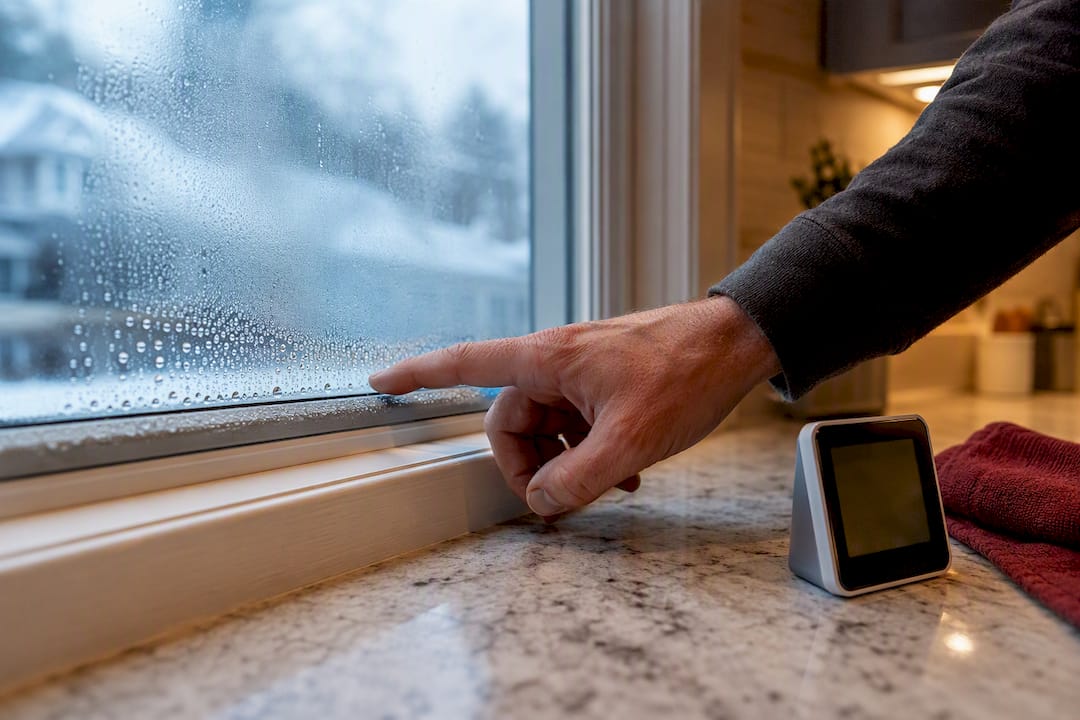
Water beading on the inside of your windows almost always means indoor humidity is meeting cold glass, not a broken window. The fastest way to confirm it is to place a hygrometer near the glass and check the reading against the outdoor temperature. If relative humidity is running high, start with ventilation and dehumidification before you assume the window itself needs work.
TL;DR:
- Using a hygrometer near the window and comparing indoor and outdoor readings helps determine if high humidity is causing interior condensation.
- Address indoor humidity by ventilating, using exhaust fans, and controlling moisture sources before considering window repairs.
- Fog between panes indicates failed seals in double- or triple-glazed windows, which often requires replacing the entire unit.
- Exterior condensation on glass in the morning is normal and not a sign of window failure, unlike persistent interior or between-pane fogging.
- Maintaining indoor humidity levels below 30 percent during cold weather can significantly reduce window condensation risk.
Table of Contents
- What Causes Interior Window Condensation?
- Interior vs. Exterior vs. Between-Pane: Which Surface Is Wet?
- Quick Daily Fixes for Interior Window Condensation
- How to Measure and Control Indoor Humidity
- When Fog Between the Panes Means the Seal Has Failed
- When Window Moisture Signals a Bigger Problem
- Upgrading Windows to Reduce Condensation Risk
- A Step-by-Step Diagnostic Checklist for Homeowners
- An Exterior Contractor’s Take on Condensation Calls
- Need a Second Opinion on Foggy or Failing Windows?
- Where to Learn More About Window Condensation
- Sources
What Causes Interior Window Condensation?
Every window has a dew point: the temperature at which water vapor in the air turns to liquid on a surface. Glass is usually the coldest surface in a room, so it’s where that transformation shows up first, long before you’d see moisture on drywall or trim. When warm, moist indoor air touches that cold glass, the air can’t hold onto its water vapor anymore, and it condenses right there on the pane.
The moisture itself comes from ordinary household life. Daily habits push more water vapor into the air than most homeowners realize:
- Cooking, especially boiling water or simmering sauces without a vented hood
- Showering and bathing without running the exhaust fan
- Drying laundry indoors or venting a dryer into the house instead of outside
- Running humidifiers, especially oversized units left on overnight
- Houseplants, aquariums, and even a full household of people breathing and sweating
Newer, tightly built homes make this worse in a specific way. Modern construction seals out the incidental air leakage that used to let moist air escape on its own, so humidity builds up unless you ventilate on purpose. An older, drafty house “breathes” condensation away without you noticing. A tight, efficient one won’t.
Interior vs. Exterior vs. Between-Pane: Which Surface Is Wet?
Not all window fog means the same thing, and figuring out which surface is wet takes about thirty seconds.
- Touch the glass. If moisture is on the room side and wipes away, it’s interior condensation, an indoor humidity problem.
- Check the time of day. Condensation that appears on the outside of the glass on cool mornings, then disappears as the sun warms the air, is exterior condensation. It’s typically harmless and actually a sign of well-insulated glass.
- Look between the panes. Fog, haze, or mineral streaks trapped inside a double- or triple-pane unit that never wipes clean signals a failed seal.
Exterior condensation confuses a lot of homeowners because it looks alarming on a dewy morning. It happens because high-performance glass keeps outdoor-facing glass cooler, the same way a cold glass of iced tea sweats on a humid porch. That’s a performance feature, not a flaw. Between-pane fog is the one that needs attention, and no amount of wiping will clear it.
Quick Daily Fixes for Interior Window Condensation
Before you spend money on anything, work through the free and cheap fixes. Most interior condensation responds quickly to basic habit changes.
- Wipe pooled water off sills every morning so it doesn’t sit against wood or painted surfaces.
- Set a small tray or towel on problem sills, or apply a water-resistant paint if staining has already started.
- Run bathroom and kitchen exhaust fans during and for 15 to 20 minutes after cooking or showering.
- Confirm your dryer vents outside, not into a crawlspace or attic.
- Open curtains and blinds partway during the day so warm room air can reach the glass instead of getting trapped behind fabric.
One of the most effective habits costs nothing: opening windows fully for five to ten minutes, twice a day, a technique sometimes called impact ventilation. A quick, full blast of fresh air swaps out moist indoor air fast without cooling down your walls and furniture the way leaving a window cracked all day does.
Pro Tip: Do your impact ventilation in the morning after showers and cooking, when indoor humidity peaks, rather than at night when outdoor air is often just as damp.
How to Measure and Control Indoor Humidity
Guessing at humidity doesn’t work. A basic hygrometer costing $10 to $20 tells you exactly what’s happening in the rooms where condensation shows up, and it’s the single best diagnostic tool in this entire process. Place one in the bedroom, one near the kitchen, and check both against outdoor temperature.
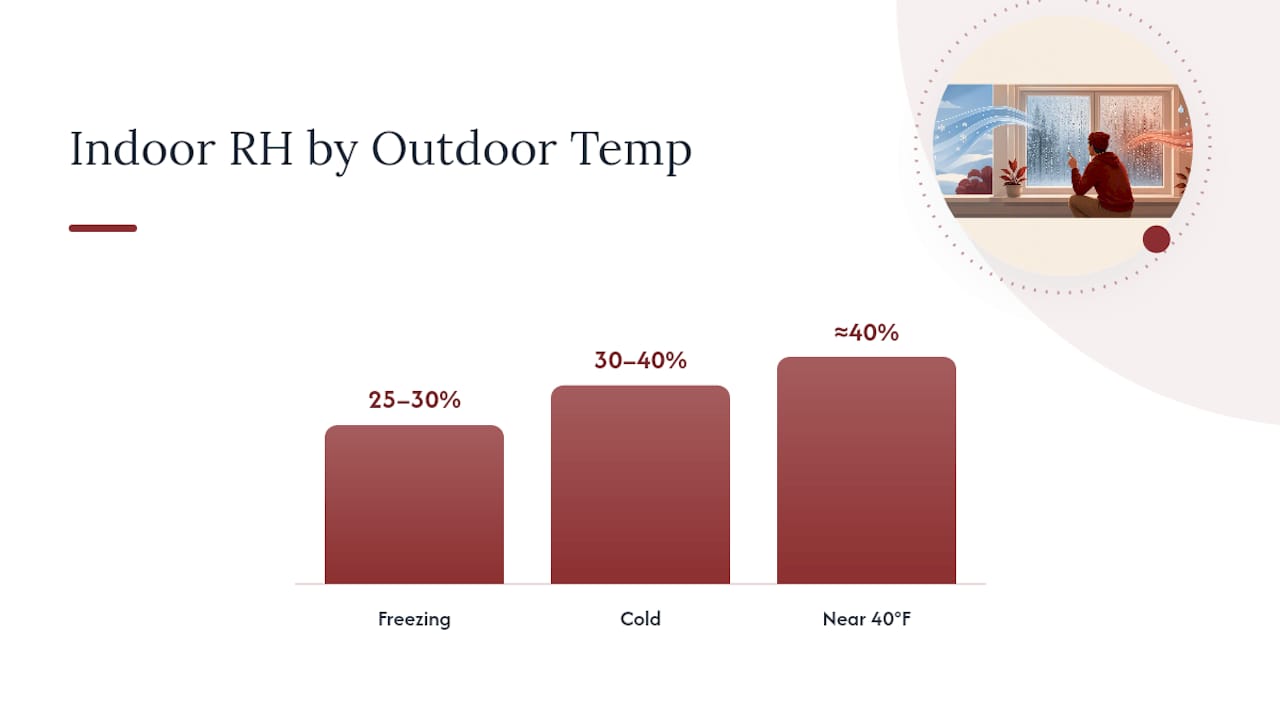
Target relative humidity shifts with the weather. When it’s freezing outside, even 40% indoor RH can be enough to condense on glass, so many building professionals recommend dropping winter targets closer to 25% to 30% on the coldest days and allowing more room, up to 40% or so, once outdoor temperatures climb back toward 40°F. Indoor humidity that’s fine in October can fog every window in January.
Statistic Callout: Consistently high indoor humidity is the leading driver of wintertime window condensation, ahead of any single factor tied to the window itself, according to cooperative extension guidance on the issue.
Match the tool to the problem:
- A portable dehumidifier handles one damp room, like a basement bedroom or a bathroom without good airflow.
- A whole-house dehumidifier tied into your HVAC system makes sense if every room reads high.
- Balanced ventilation with heat recovery (an HRV or ERV) suits tightly sealed homes that need fresh air exchanged without losing heating or cooling energy.
Run a quick weekly check: confirm exhaust fans are actually venting outside, not into an attic, keep humidifiers set conservatively, and cover pots while boiling water.
When Fog Between the Panes Means the Seal Has Failed
Condensation trapped between the panes of a double- or triple-glazed window is a different animal entirely. That haze or streaking signals the insulated glass unit’s seal has failed, letting outside moisture and air seep into the sealed gap. No amount of wiping fixes it because the moisture, and often mineral deposits, sits inside a space you can’t reach.
You have a few paths forward once that happens:
- Replace the IGU (the glass unit only): Often the most cost-effective fix if the frame is still in good shape.
- Replace the whole window: Worth considering if the frame is aging, drafty, or the style is being upgraded anyway.
- Temporary defogging service: Some companies drill and clear the moisture, but it’s a short-term cosmetic patch, not a lasting seal repair.
Check your window’s warranty before deciding anything. Many manufacturers cover seal failures for a set number of years, and knowing the unit’s age changes the math substantially. Take clear photos and measurements ahead of any contractor visit for foggy, between-pane windows so you get an accurate quote the first time.
When Window Moisture Signals a Bigger Problem
Occasional condensation that wipes away by mid-morning is cosmetic. Condensation that drips repeatedly, pools on sills for days, or shows up on multiple windows regardless of the weather is a different story.
Standing water breaks down painted finishes, softens wood sills, and eventually invites rot into the frame itself. It also creates exactly the environment mold needs. The EPA is direct about this: mold grows wherever moisture is present, and it doesn’t take long once conditions are right.
Statistic Callout: There’s no safe minimum time frame the EPA offers for mold growth, only the standing principle that moisture control is the key to mold control. Treat any window that stays wet for more than a few hours as a signal to act.
Watch for these related warning signs:
- A musty smell near window frames or in closets on exterior walls
- Dark spotting or staining on sills, trim, or nearby drywall
- Condensation appearing behind furniture or inside closets, where airflow is poorest
- Moisture that keeps returning to the same windows even after you’ve improved ventilation elsewhere
Upgrading Windows to Reduce Condensation Risk
If humidity control alone isn’t solving it, the glass itself may be too cold relative to your indoor air, and that’s a performance issue worth addressing. Low-E coatings paired with argon or krypton gas fill raise the interior glass surface temperature measurably, which narrows the gap between room air and glass. Warm-edge spacers, the material separating the panes at the frame, matter too; metal spacers conduct cold straight to the edge of the glass, while foam or composite spacers insulate that edge and cut down on perimeter fogging. Frame material plays a role as well, with vinyl and fiberglass outperforming plain aluminum on heat transfer.
When comparing replacement options, look at the NFRC Condensation Resistance (CR) rating printed on the window label. It’s scored on a scale where higher numbers mean better resistance to condensation, and it lets you compare products on this specific issue rather than relying on a salesperson’s description. Keep in mind that a strong CR rating reduces condensation risk; it doesn’t cancel out a home with genuinely excessive indoor humidity.
For single-pane or older double-pane windows that aren’t ready for full replacement, interior storm panels are a lower-cost way to add a thermal buffer and raise interior glass temperature without the expense of new units.
A Step-by-Step Diagnostic Checklist for Homeowners
Work through these steps in order before deciding whether this is a fix-it-yourself problem or a call-a-contractor problem.
- Place a hygrometer in the affected room and log the reading against outdoor temperature for a few days.
- Note exactly when and where condensation appears: morning only, after cooking, one window or several.
- Confirm bathroom and kitchen exhaust fans and the dryer vent actually exhaust outside.
- Inspect closely for fog or streaking trapped between the panes, not just on the surface.
- Pull back curtains and blinds for a day to see if improved air circulation changes the pattern.
- Try impact ventilation and exhaust fan use for a week, then remeasure.
If humidity stays above target and condensation persists despite these steps, or if you find fog between the panes, that’s your threshold for professional help. Bring your hygrometer readings, photos of the affected windows, and each window’s approximate age or model information to make a contractor visit faster and more accurate.
An Exterior Contractor’s Take on Condensation Calls
Most condensation calls we get turn out to be environmental, not structural. Start with a hygrometer and better ventilation before assuming the glass failed. If those steps don’t fix it, or if you find fog trapped between panes, that’s when upgrading the glazing or getting a proper inspection of the window and surrounding insulation makes sense. We’ve built homeowner guides on window condensation specifically because too many people replace windows that were never the problem in the first place.
— Adam
Need a Second Opinion on Foggy or Failing Windows?
If you’ve measured your humidity, run the fans, and the fog between your panes still won’t clear, that’s a window problem, not a humidity problem, and it’s worth a professional look. A professional contractor inspects the affected units in person, measures the actual condensation resistance you’d gain from new glazing, and gives you a written estimate comparing an IGU-only replacement against a full window swap, so you’re not guessing at the better value.

Experienced crews have handled replacement windows across many homes for an extended period, which means they understand differences in seal failures and price accordingly instead of pushing a blanket recommendation. A site visit typically includes checking existing frames for rot or insulation gaps around the window opening, since a new unit installed into a leaky frame will fog again regardless of its CR rating. If your sills show water damage or your windows are decades old, it’s also worth asking about broader replacement window options rather than a single-unit fix. Request an inspection and get a written estimate before you decide between repair and replacement.
Where to Learn More About Window Condensation
For homeowners who want to go deeper into the technical side of this issue, these sources cover the standards and safety guidance referenced throughout this article:
- Efficient Windows Collaborative on condensation and CR ratings
- EPA guidance on mold and moisture in homes
- Cornell Cooperative Extension fact sheet on window moisture condensation
- InspectApedia’s technical guide to window condensation problems
If your maintenance routine extends beyond the window itself, a partner resource on safe residential window cleaning practices is a useful companion for keeping sills and glass in good condition between seasons.
Sources
- Condensation — Efficient Windows Collaborative
- Why is mold growing in my home? — EPA
- Moisture condensation of windows — CCETompkins fact sheet
- Condensation: What It Is, Why It Happens, and Why It’s Rarely a Window Problem — Dynamic Fenestration