
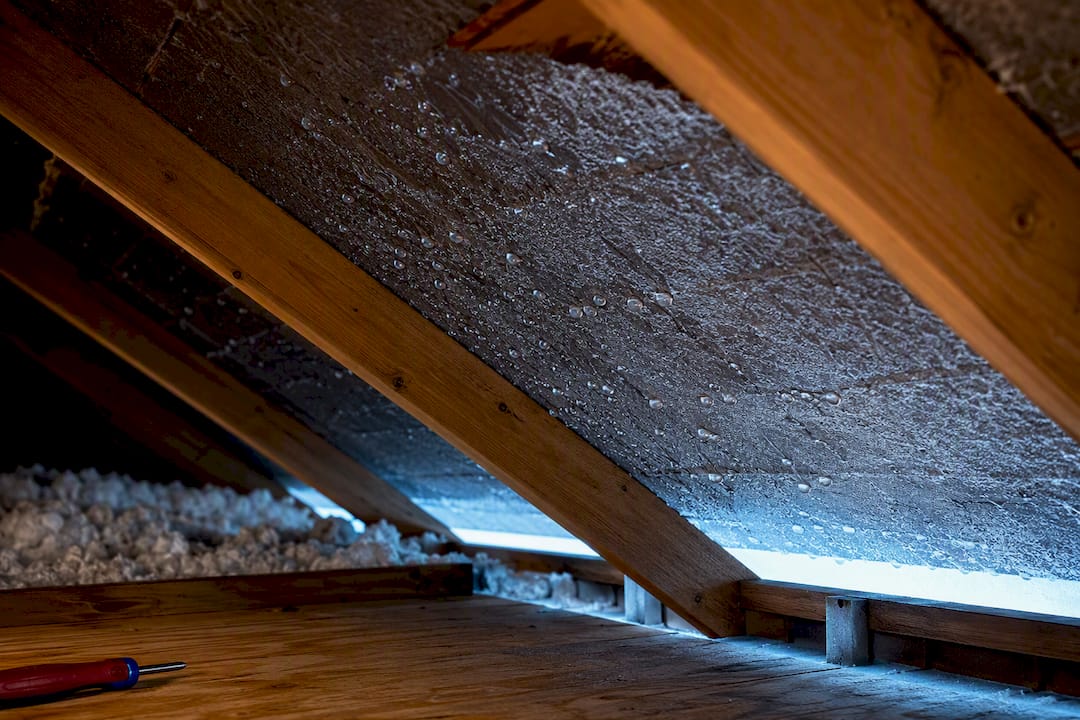
Attic condensation in winter happens when warm, moist air from inside your house leaks up into a cold attic and hits a surface cold enough to turn that moisture into frost or water. The single most effective fix is sealing air leaks at the ceiling plane, the boundary between your living space and the attic, before you touch the insulation or the vents.
TL;DR:
- Sealing air leaks at the ceiling level is the most effective way to prevent attic condensation, even before adding insulation or ventilation improvements.
- Signs of early attic condensation include frost on sheathing, damp insulation, water stains, and water drips near plumbing or vent openings.
- Proper attic moisture control requires sealing bypass points first, then balancing soffit-to-ridge ventilation, and maintaining insulation clearance from the roof deck.
- Ignoring attic condensation risks long-term damage like mold, rot, and compromised insulation, which can worsen winter after winter if left unaddressed.
- Hiring a professional makes the inspection more effective, especially if signs of extensive moisture damage or mold are present, and should include thorough sealing and ventilation assessment.
Table of Contents
- What Causes Attic Condensation in Winter?
- How Do You Spot Attic Condensation Early?
- How to Stop Attic Condensation: A Prioritized Fix List
- When Should You Call a Roofing Contractor?
- What Happens If You Ignore Attic Condensation?
- Contractor-Ready Checklist and Where to Learn More
- Why Air Sealing Gets Skipped, and Shouldn’t
- Ready to Stop Guessing About Your Attic?
- Sources
What Causes Attic Condensation in Winter?
Every gallon of warm, humid air inside your home wants to escape somewhere. When it finds a gap, a crack, or a poorly sealed fixture in your ceiling, it rises into the attic through what’s called the stack effect: warm air rises, cools, and loses its ability to hold moisture. That moisture has to go somewhere, and in a cold attic, it condenses the moment it touches roof sheathing that’s sitting below the dew point.
Your house generates more moisture than you’d think. Cooking, showering, breathing, and even houseplants all pump water vapor into indoor air. That air finds its way into the attic through recessed lighting fixtures, bathroom exhaust fans that dead end in the attic instead of venting outside, gaps around plumbing stacks, and an attic hatch that’s never been weatherstripped.
Here’s the part most homeowners get backwards: piling on more insulation before sealing those leaks can actually make frost worse. Extra insulation keeps the living space warmer, which sounds good, but it also makes the attic colder, since less heat escapes upward to keep the roof deck above the dew point. BuildingScience’s guidance on attic ventilation is blunt about this: insulation without air sealing can worsen condensation instead of solving it. Sequence matters as much as materials.
How Do You Spot Attic Condensation Early?
The best time to check your attic is during a hard cold snap, or right after a stretch of freezing weather starts to warm up. That’s when frost that’s been quietly forming on cold surfaces either shows itself clearly or starts to melt and drip, which is when homeowners usually notice the problem for the first time.
Bring a flashlight and look for these signs:
- Frost or ice crystals on nail heads, roof sheathing, or the underside of the roof deck.
- Insulation that feels damp or looks matted down instead of fluffy.
- Brown or gray water stains on sheathing, framing, or the attic floor.
- Active dripping, especially near plumbing stacks or bathroom exhaust ducts.
While you’re up there, trace the likely bypass points: recessed can lights, the attic hatch, plumbing stack penetrations, duct boots where HVAC ducts pass through the ceiling, and any knee walls bordering finished space. If you find soaked insulation, sagging sheathing, or a smell of mildew, stop and photograph what you see rather than digging further. That’s your cue to call a contractor instead of a DIY project.
How to Stop Attic Condensation: A Prioritized Fix List
Fixing attic condensation works best in order. Skip a step, or do them out of sequence, and you risk spending money without solving anything.
- Seal the ceiling plane first. Use expanding foam or caulk around recessed lights, plumbing stacks, wiring penetrations, and the attic hatch. This single step, according to inspection-based case studies from StructureTech, resolves the majority of frost problems traced back to air leakage.
- Balance your ventilation. Attics need intake low, at the soffits, and exhaust high, at the ridge or gables. The Building America measure guideline recommends a net free ventilating area of roughly 1 square foot of vents per 300 square feet of attic floor, or 1 per 150 when soffit intake isn’t available. Install baffles at the eaves so insulation never blocks that intake airflow.
- Check your insulation depth and clearance. Maintain at least 2 inches of clearance between insulation and the roof sheathing so air can still move, a detail the BASC condensation control guide treats as non-negotiable for drying capacity.
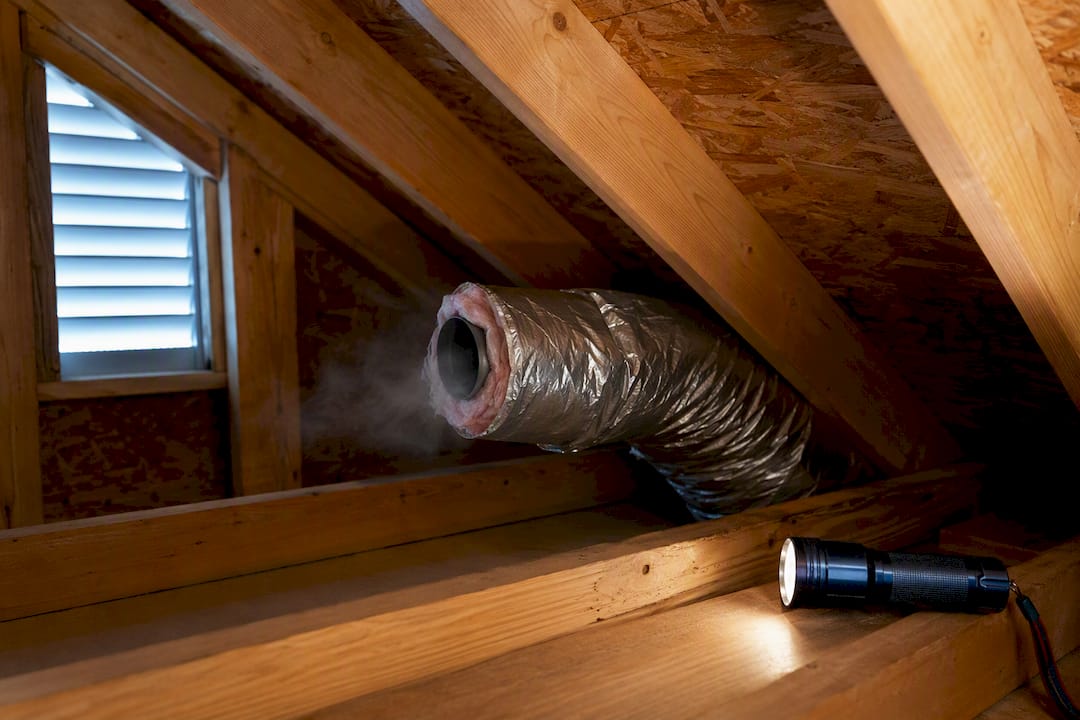
- Fix ducts and mechanical sources. Leaky supply ducts in the attic push conditioned, humid air straight into the space you’re trying to keep dry, and bathroom or dryer exhaust fans must vent outside, never into the attic itself.
- Consider encapsulation for complex rooflines. When a roof has too many valleys, dormers, or hips to support clean soffit-to-ridge airflow, converting the attic to conditioned space with spray foam or adding continuous rigid insulation above the roof deck keeps the sheathing above the dew point year-round.
Pro Tip: Never run an attic fan to “solve” condensation without checking pressure balance first. An unbalanced fan can pull even more warm, moist house air upward, turning a moderate problem into a worse one.
When Should You Call a Roofing Contractor?
Some attic condensation problems are a weekend project. Others aren’t. If you’re seeing extensive rot in the sheathing, visible mold colonies, water stains that keep reappearing after you’ve dried them, or ductwork that’s clearly disconnected or crushed, it’s time to bring in a professional rather than keep patching.
When you’re screening a contractor, ask specific questions:
- Do you perform a blower-door test or infrared inspection to find leaks before sealing?
- Will you air seal the ceiling plane as a distinct step, separate from insulation work?
- How do you calculate the ventilation ratio for my specific attic?
- What’s included in the final scope, and will I get before-and-after documentation?
A reasonable proposal names the square footage of net free ventilating area, lists every bypass point to be sealed, and includes photos or a written report confirming the work matches the plan.
What Happens If You Ignore Attic Condensation?
Short term, untreated condensation soaks insulation, stains ceilings, and drips onto stored belongings. That damage is usually reversible.
Left alone through multiple winters, it compounds. Wet insulation loses R-value and stays wet, wood sheathing delaminates, and persistent moisture invites mold growth that’s expensive to remediate. Chronic attic moisture also interacts with ice dam formation along the eaves, since an attic that’s too warm melts snow unevenly on the roof, creating the freeze-thaw cycle that damages shingles and gutters alike.
Contractor-Ready Checklist and Where to Learn More
Hand this list to any contractor you’re vetting, and use it to confirm the work actually got done:
- Ceiling plane fully air sealed (recessed lights, hatch, plumbing stacks, duct boots).
- Soffit-to-ridge ventilation confirmed with correct net free area for your attic’s square footage.
- Baffles installed to keep soffit intake clear of insulation.
- All ducts and exhaust fans verified to vent to the exterior, not into the attic.
- Before-and-after photos documenting the sealed bypass points.
If you’re also seeing soffit damage or blocked vents feeding into this problem, our guide on soffit and fascia repair walks through what secondary damage looks like. Homeowners dealing with fogged windows alongside attic issues might find our piece on diagnosing indoor humidity with a hygrometer useful for tracking down the moisture source at its origin. This contractor has extensive experience working on Connecticut roofs, including dealing with many frosted attics. That kind of repetition teaches you where the leaks actually hide.
Why Air Sealing Gets Skipped, and Shouldn’t
Most attic condensation advice online still leads with insulation and ventilation, treating air sealing as an afterthought buried three paragraphs down. That ordering is backwards, and the building science bears it out repeatedly: seal first, then balance ventilation, then think about insulation depth.
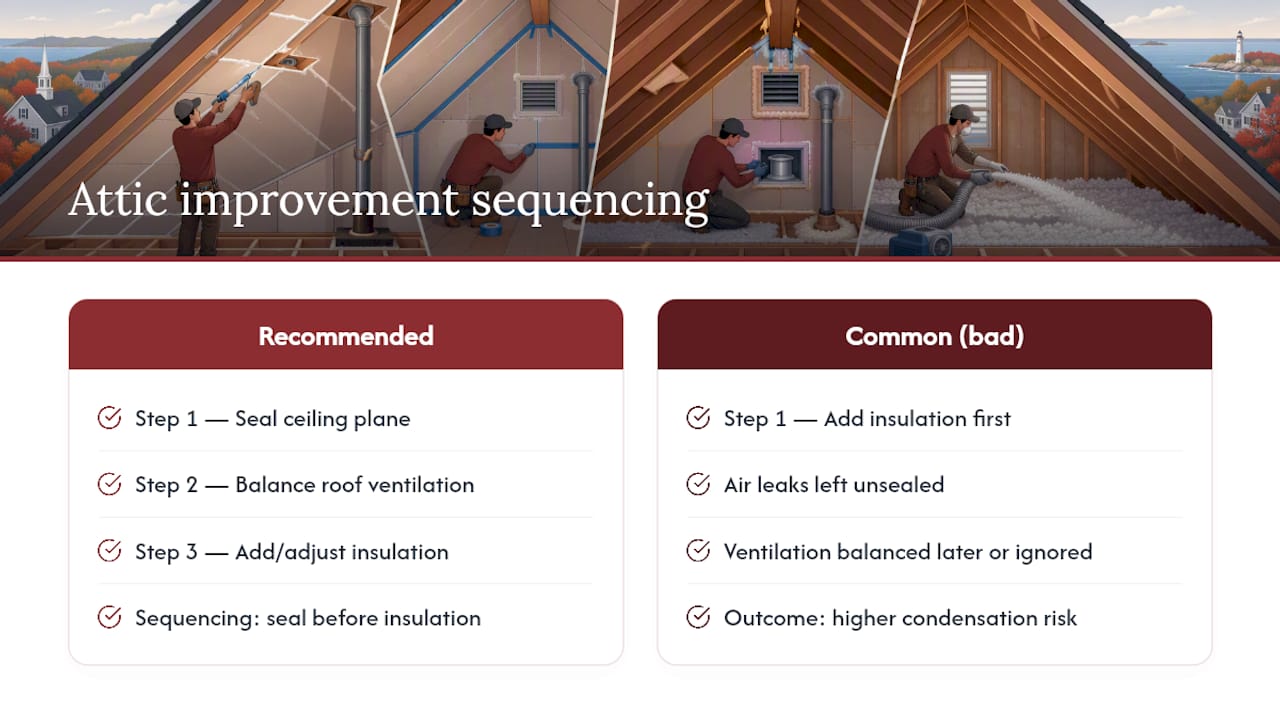
Part of the problem is that air sealing isn’t visually satisfying. You can’t see fresh insulation batts from the driveway, but you also can’t show off a tube of caulk in the attic hatch. Homeowners want a project that looks finished, and R-value numbers on an insulation bag feel like progress in a way that a sealed plumbing stack penetration doesn’t.
What the reader should take from this: don’t let a contractor sell you an insulation upgrade as the first move. Ask what they’re doing about air leakage before anything else goes in. If they can’t answer that question specifically, keep looking. The attics that stay dry through Connecticut winters are the ones where sealing happened before anyone touched a roll of batting, and that’s a sequencing decision, not a materials decision.
— Adam
Ready to Stop Guessing About Your Attic?
Diagnosing attic condensation on a ladder with a flashlight only gets you so far. Experienced Connecticut roofing professionals bring extensive knowledge to attic inspections, checking ventilation ratios, ceiling-plane air leaks, and roof deck condition in one visit instead of leaving you to piece it together yourself.

As a family-owned, licensed, and insured contractor, we look at the whole system: soffit and ridge ventilation, flashing details around plumbing stacks, and the roof decking underneath, since how flashing is installed often explains why moisture is finding its way in. If you’re weatherizing other parts of the house at the same time, tips on sealing doors against winter air loss pair well with attic sealing work. For Connecticut homeowners ready to get a real answer instead of another guess, reach out through our roofing contractor services page and schedule an inspection before the next cold snap sets in.
Sources
For homeowners who want to verify the building science behind this advice, these are the sources worth bookmarking: the Building America measure guideline on attic air sealing, BuildingScience’s BSD-102 digest on ventilation fundamentals, the PNNL condensation control guide for cold-weather assemblies, and StructureTech’s field notes on attic frost drawn from real inspections. GreenBuildingAdvisor and InspectApedia round out the practical, contractor-level detail.
- Guide to Attic Air Sealing (Building America / Measure Guideline)
- BSD-102: Understanding Attic Ventilation (BuildingScience)
- Condensation control: Attics and roofs in cold weather (BASC / PNNL)
- Frost in attics: why it’s there and how to fix it (StructureTech)