
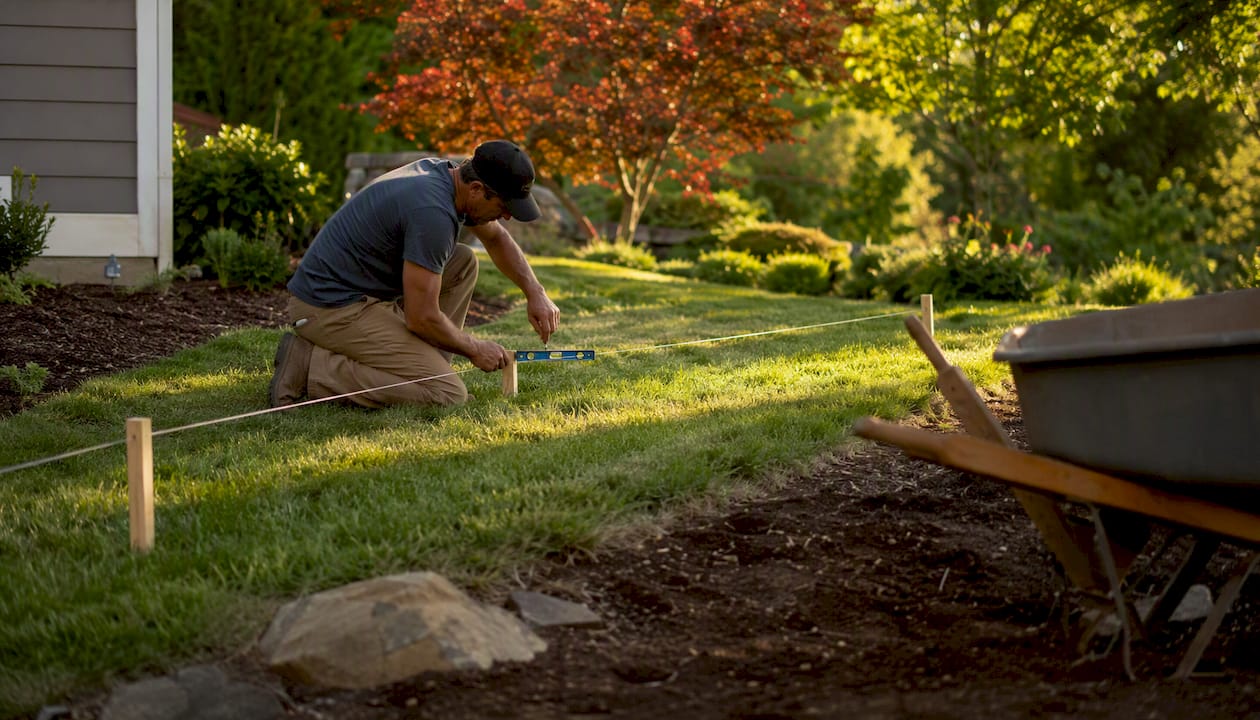
Grading is the single biggest factor in whether water pools against your foundation or drains safely away from it, and the industry benchmark is straightforward: soil and hard surfaces within 10 feet of your house should slope at least 0.5 inches per foot away from the home. Get that slope right and you’ve solved most of the drainage problems that plague Connecticut yards after a heavy rain. Get it wrong, and no amount of gutter maintenance or landscaping will keep your basement dry.
Pro Tip: If you can’t remember which way your yard slopes, set a garden hose running near your foundation for ten minutes and watch where the water goes. It tells you more than a tape measure ever will.
Most homeowners can check their own slope with a $10 line level and handle minor regrading themselves. But once you’re dealing with a slope that runs toward a neighbor’s property, a septic field nearby, buried utility lines, or a yard that requires a permit to disturb, that’s the point to call a licensed grading or exterior contractor instead of renting equipment for a weekend.
Key Takeaways
Proper grading directs water away from the foundation using a minimum slope of 0.5 inches per foot for the first 10 feet, and it only works when paired with a real discharge outlet.
| Point | Details |
|---|---|
| Minimum slope guideline | Keep at least 0.5 inches per foot of slope away from the house for the first 10 feet. |
| Protect foundation exposure | Never bury more than a few inches of foundation; keep at least 4 inches visible above grade. |
| Know when to call a pro | Bring in a licensed contractor for utility conflicts, steep slopes, or repeated basement flooding. |
| Maintain it annually | Clear gutters and catch basins, inspect after storms, and recompact settled fill each year. |
| Roof-to-grade connection | J. Signor Exteriors coordinates gutter pitch, downspout routing, and drainage tie-ins alongside grading fixes. |
Table of Contents
- Why the Role of Grading in Drainage Matters More Than Most Homeowners Realize
- How Grading Actually Moves Water Across a Yard
- How to Assess Your Yard Before You Touch Any Soil
- Grading a Yard Step by Step: A Homeowner’s Workflow
- What the Rules Say About Where Drainage Water Can Go
- When Grading Becomes a Job for a Professional
- Common Grading Mistakes and How to Keep the Fix Working
- How J. Signor Exteriors Fits Into Your Drainage Fix
- Sources
Why the Role of Grading in Drainage Matters More Than Most Homeowners Realize
Grading isn’t a cosmetic landscaping choice. It’s the mechanism that determines whether rainwater becomes a non-issue or a foundation crisis. A yard that slopes correctly away from the house moves water into the soil or a designated outlet before it ever has a chance to pool. A yard that slopes toward the house, or sits flat, gives water nowhere to go except down through your foundation walls or into your crawlspace.
The benefits of correct grading show up in ways homeowners don’t always connect back to the dirt itself:
- Drier basements and crawlspaces, since water never gets the chance to pond against the foundation wall long enough to seep through hairline cracks.
- Healthier turf, because grass roots suffocate in saturated soil, and proper grading keeps the root zone from staying waterlogged.
- Less erosion, since water moving in thin, even sheets carries far less soil away than water concentrated into a rushing channel.
- Fewer mosquito-breeding puddles, because standing water is exactly what mosquitoes need to complete their life cycle.
The signs that grading has failed are usually easy to spot once you know what to look for. Standing water 24 hours after a storm, soft or muddy patches that never fully dry out, small erosion channels (rills) cutting across a slope, and moisture stains or efflorescence at the base of your foundation all point to the same root cause. If you’re documenting your yard before making changes, photograph the puddling areas right after a rainstorm and any spot where you can see a natural swale or depression carrying water. Those photos become your before-and-after reference and your evidence if you ever need to explain a drainage complaint to a contractor or the town.
Poor grading rarely stays a small problem. Water that pools near a foundation today is water that finds a crack, a seam, or a weep hole tomorrow, and by then you’re looking at a repair bill instead of a garden project.
How Grading Actually Moves Water Across a Yard
Two types of water movement matter here, and understanding the difference changes how you plan a fix. Sheet flow is water moving across a broad, gently sloped surface in a thin, even layer, the kind of drainage a well-graded lawn produces. Concentrated flow happens when water gets funneled into a narrow path, whether that’s a swale, a driveway edge, or an eroded channel. Sheet flow is gentle and rarely causes damage. Concentrated flow moves faster, carries more force, and is what carves rills into a hillside or overwhelms a single point along your foundation.
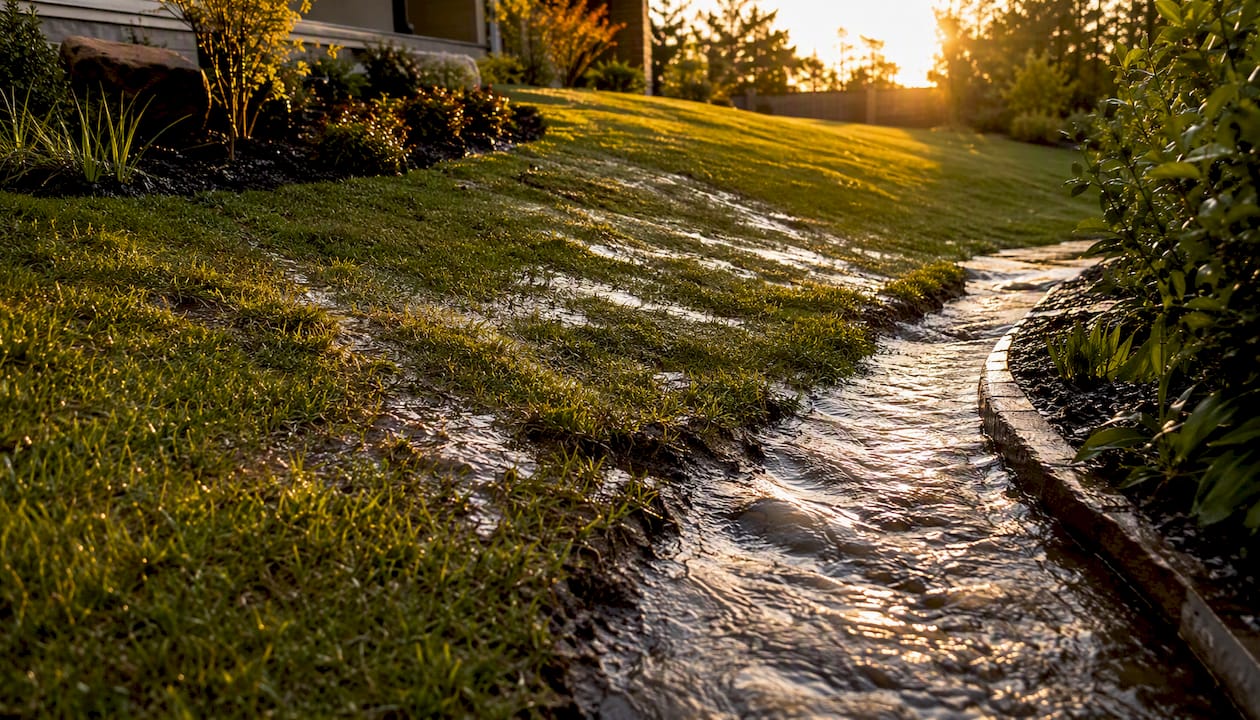
Every yard needs a discharge path for the water that grading moves. That might be a low point at the property line, a shallow swale that carries runoff to the street, a catch basin that collects it before piping it away, or an infiltration area where the soil is loose enough to absorb it. The point often gets missed: a discharge path only works if it actually leads somewhere. A swale that dead-ends at a neighbor’s fence line just relocates the puddle instead of solving it, which is exactly why a comprehensive drainage plan has to trace water from where it starts to where it truly exits.
Pro Tip: Watch for what contractors sometimes call a “grade bridge,” where soil gets piled up against siding to fix a low spot near the house. It looks like a fix, but it actually creates a direct path for moisture and pests to reach wood siding and framing that were never designed to sit below grade.
Grading works because it’s continuous, not because any single spot is perfectly sloped. One low point along an otherwise well-graded run can undo the whole system.
How to Assess Your Yard Before You Touch Any Soil
You don’t need surveying equipment to get a usable read on your yard’s slope. A few basic tools will tell you almost everything a contractor would check on a first visit:
- A line level and mason’s string. Tie the string between two stakes, level it with the line level, then measure the drop from the string to the ground at both ends.
- A tape measure. You’ll use this to measure both the horizontal distance (the run) and the vertical drop (the rise) between your two points.
- A smartphone slope app or basic laser level, which speed up the process if you’re checking multiple spots around the house.
- A water level (a simple length of clear tubing filled with water) works as a low-cost alternative when you don’t have a line level on hand, since water finds the same height at both ends of the tube.
Here’s a simple example of the math. Say you stretch a string 10 feet from your foundation and measure a 6 inch drop at the far end compared to the string’s height at the house. That’s 6 inches of drop over 10 feet, or roughly 0.6 inches per foot, which clears the recommended 0.5 inch per foot minimum with a little room to spare.
Once you have a feel for the math, walk the property and build a simple map:
- Mark every downspout location, since these are concentrated water sources that grading has to account for.
- Note any impervious surfaces (patios, driveways, walkways) that shed water toward the house instead of away from it.
- Flag the lowest point on the property, since that’s where water is heading whether you planned for it or not.
- Record any spot where you’ve noticed pooling, softness, or erosion in the past.
Keep this map. It becomes the reference point for any regrading work, and if you eventually bring in a contractor, it saves them time and saves you money on the initial assessment.
Grading a Yard Step by Step: A Homeowner’s Workflow
A regrading project has a logical order, and skipping steps is how DIY projects go sideways. Start with planning, not shoveling.
Planning and marking. Decide on your flowlines (the paths water will travel) and your final outlet before you move a single scoop of dirt. Call 811 or your local utility locate service before digging anything more than surface-deep, and check with your town on permit requirements, since some jurisdictions regulate significant regrading even on residential lots.
Earthwork. The physical process generally follows this sequence:
- Rough grade the area to establish the general slope direction.
- Add or remove soil as needed to hit your target slope, working from the high point down.
- Compact the soil in layers rather than all at once, since loose fill settles unevenly and can undo your slope within a season.
- Finish grade with topsoil to create a smooth, plantable surface.
- Seed, sod, or apply erosion control matting immediately, since bare soil is the most vulnerable to washing out in the first heavy rain after the work.
For equipment, small jobs are manageable with a shovel, a landscape rake, and a hand tamper. Larger regrading projects usually call for a rented skid steer to move soil efficiently and a plate compactor to properly densify it. Avoid renting heavy equipment if your yard has steep slopes, tight access, or nearby utilities. That’s a signal the job calls for a professional operator rather than a weekend rental.
Grading rarely works alone on a difficult site. It pairs naturally with:
- French drains, which capture and redirect subsurface water that grading alone can’t reach.
- Swales, shallow vegetated channels that guide surface water along a planned route.
- Catch basins, which collect water at a low point before piping it to an approved outlet.
- Downspout extensions and channel drains, which prevent roof runoff from overwhelming the graded slope right at the foundation.
Grading paired with these complementary systems tends to outperform any single fix on its own, especially on lots with heavy clay soil or minimal natural slope.
On cost and timeline: a simple regrade along one side of a house, done by hand or with a small rental, typically wraps up in a day or two. A full-property regrade involving heavy equipment, new swales, and sod replacement usually runs several days to over a week, and pricing depends heavily on how much soil needs to move, how far it has to travel, and whether erosion control or replanting is part of the scope. Steep sites and clay-heavy soil both push costs and timelines higher because they require more careful compaction and often additional drainage components.
What the Rules Say About Where Drainage Water Can Go
Grading doesn’t operate in a vacuum. Most municipalities have rules about where yard water is allowed to end up, and ignoring them can create real headaches with neighbors or code enforcement. A common thread across these local ordinances is that rain and snowmelt need to flow away from homes toward designated collection points like a municipal swale or catch basin, and property owners typically bear responsibility for maintaining that flow on their own lot. Connecting a private yard drain directly into a public sanitary sewer is prohibited in most jurisdictions, since sanitary systems aren’t designed to handle stormwater volume.
The 2021 International Residential Code sets baseline construction standards for lot grading and drainage that most local codes reference or build on, which is why checking with your building department before a major regrade is worth the phone call.
| Guideline | Recommended Minimum | Source |
|---|---|---|
| Slope away from foundation | 0.5 inches per foot for 10 feet | Building America Solution Center |
| Visible foundation above grade | 4 inches | Mississippi State Extension |
| Discharge destination | Approved swale, catch basin, or storm connection, never sanitary sewer | Township of Woolwich |
That 4 inch minimum matters more than most homeowners assume. Piling soil or mulch up against siding to fix a low spot buries the foundation and creates a direct bridge for moisture and termites to reach wood framing that was never meant to sit in contact with soil.
Before finalizing an outlet location, think about where that water ends up beyond your own property line. Directing a new swale toward a neighbor’s yard without their knowledge is a fast way to turn a drainage fix into a property dispute, so check that your discharge point either stays within your own lot or ties into an approved public system.
When Grading Becomes a Job for a Professional
Some yards are genuinely DIY-friendly. Others aren’t, and knowing the difference before you start digging saves you from an expensive redo. Bring in a landscape contractor or civil engineer if any of these apply:
- Utility lines, septic fields, or well systems run through the area you want to regrade.
- The slope you’re correcting exceeds what a shovel and rake can reasonably move, meaning significant excavation is required.
- Your basement or crawlspace has flooded more than once despite surface-level fixes.
- The site needs engineered drainage, such as a designed detention area or a piped system tied to municipal storm infrastructure.
A qualified pro brings more to the table than labor. Expect a site survey that identifies your actual high and low points, help navigating any permit requirements your town imposes, an engineered grading plan when the site calls for one, and a properly designed outlet that won’t just relocate the problem. Reputable contractors also carry the licensing and insurance that protect you if something goes wrong mid-project.
When you’re interviewing candidates, ask these questions before signing anything:
- Are you licensed and insured for grading and excavation work in this state?
- Can you provide references from similar drainage projects?
- What’s your realistic timeline given current weather and scheduling?
- What’s your plan for erosion control during and immediately after the work?
- How do you handle change orders if the site reveals unexpected conditions once digging starts?
Ballpark costs vary by soil type, slope severity, and whether the project includes supplemental drainage like French drains or catch basins, so get at least two written estimates before committing.
Common Grading Mistakes and How to Keep the Fix Working
Even a properly graded yard can fail within a year or two if it’s built on a shortcut. The most frequent mistakes worth avoiding:
- Overfilling against siding, which buries the foundation below the recommended 4 inch clearance and invites moisture and pest problems.
- Skipping compaction, which leaves fill soil to settle unevenly and quietly erase your slope over the following seasons.
- Creating a discharge path with no real outlet, which just moves the puddle a few feet instead of eliminating it.
- Ignoring downspout discharge, since a beautifully graded lawn can’t compensate for a downspout dumping directly against the foundation.
- Filling in a natural swale without providing a replacement path, which often redirects water somewhere worse.
Once a yard is properly graded, keeping it that way takes some ongoing attention rather than a one-time fix:
- Clear gutters and catch basins each fall and spring so they can actually handle peak flow.
- Walk the yard after any major storm to check for new pooling or soft spots.
- Look for settlement along fill areas each year and recompact or reshape as needed.
- Repair erosion rills promptly, before they widen and start redirecting water on their own.
A grade that worked perfectly the year it was installed can quietly fail three years later from nothing more dramatic than normal settlement. Annual inspection is what keeps that from turning into a surprise.
Watch especially for freeze/thaw cycles in colder climates, which can heave and resettle soil unevenly over a winter, and for particularly wet seasons that reveal weak points a dry summer never would. If a recently graded area starts showing the same pooling or soft spots you fixed the first time, that’s the signal to revisit the original plan rather than patch the symptom again.
A Contractor’s View on What Good Grading Actually Delivers
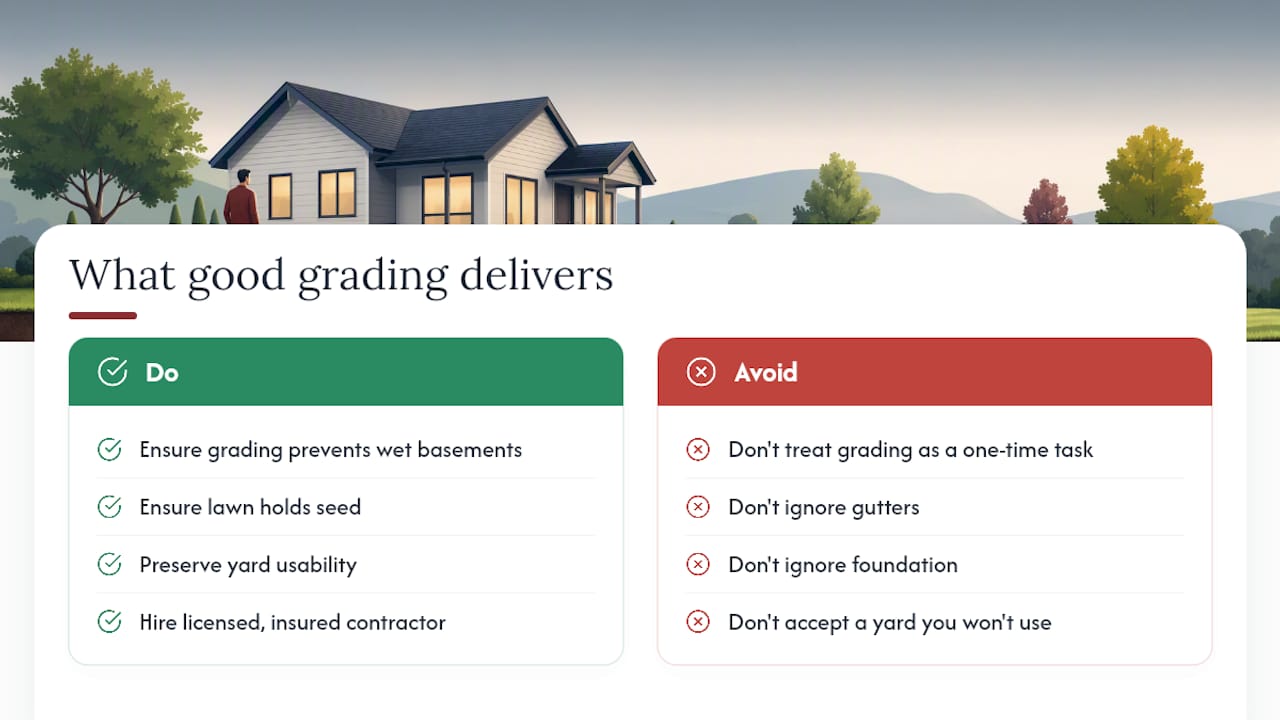
Homeowners tend to think of grading as a one-time landscaping task, but it’s closer to infrastructure. Get it right and the payoff is boring in the best way: no wet basement calls, no soggy lawn that won’t hold seed, no scrambling to redirect a downspout every time a storm rolls through. That’s the real measure of success, not how tidy the yard looks the week the work finishes.
Working with a licensed, insured contractor matters here specifically because grading interacts with so many other systems on your property, your gutters, your foundation, your neighbor’s runoff. A crew that understands how those pieces fit together will protect the usability of your landscape while they’re solving the water problem, instead of leaving you with a technically correct slope and a yard you no longer want to spend time in.
How J. Signor Exteriors Fits Into Your Drainage Fix
Grading solves half the equation, but water has to come from somewhere before it ever reaches your yard, and for most Connecticut homes, that starting point is the roof. If your gutters are pitched wrong or your downspouts dump water two feet from the foundation instead of routing it to a proper outlet, no amount of regrading below will keep up. J. Signor Exteriors has spent more than 30 years handling exactly this intersection, roofing, gutters, and site work that ties into a functioning drainage plan, rather than treating your yard and your roofline as unrelated projects.

When you bring in J. Signor Exteriors for grading-adjacent exterior work, here’s what the process typically looks like:
- A site inspection that traces water from your roofline down to your foundation and out to its final discharge point.
- A written plan that spells out gutter pitch corrections, downspout routing, or drainage tie-ins before any work begins.
- Help navigating local permit requirements when the scope calls for it.
- A licensed, insured crew handling the installation, not a rotating cast of subcontractors.
If you’ve noticed water pooling near your foundation, an overflowing gutter, or a downspout that seems to be making your yard’s drainage problem worse instead of better, start with a roofing consultation to see whether your roof drainage is part of the issue. Homeowners dealing with siding that’s showing moisture damage from a grading problem can also look into siding services as part of the same project scope. Reach out and get a written assessment before your next heavy storm turns a minor grading issue into a foundation repair.
Sources
- International Residential Code (IRC) 2021
- Mississippi State Extension: Signs of termite infestation
- The role of proper grading in solving yard drainage issues — Daybreaker Landscapes