
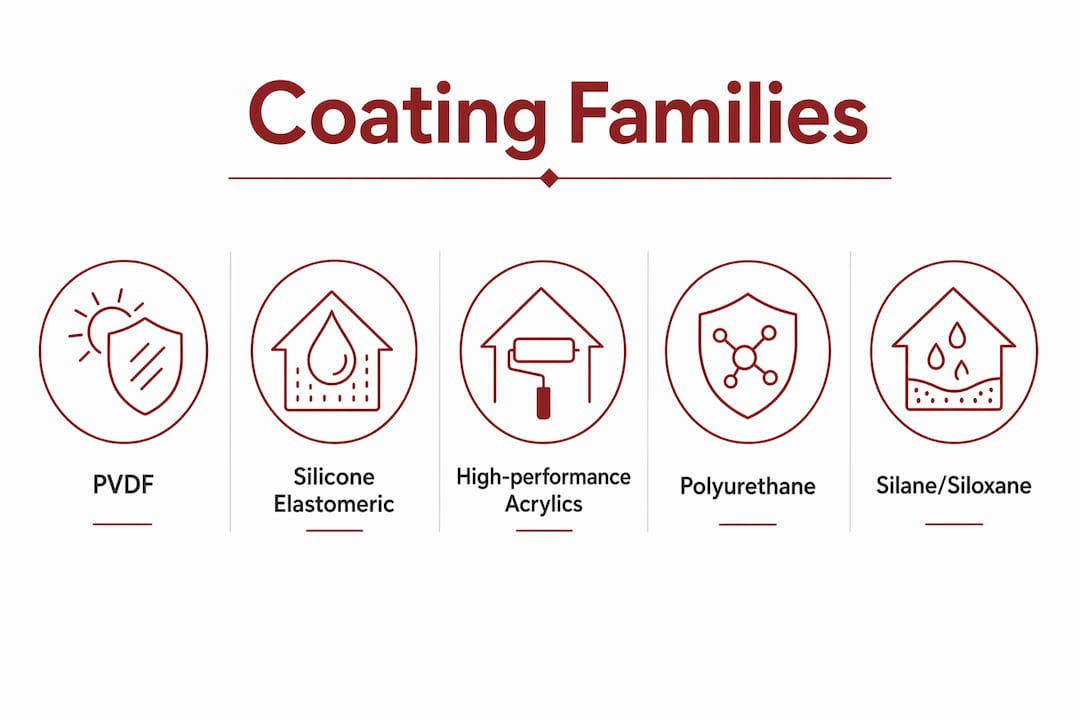
The top exterior coatings for commercial buildings are field-applied PVDF fluoropolymers, 100% silicone elastomeric systems, high-performance acrylics, polyurethane topcoats, and silane/siloxane penetrating repellents. The right choice depends on two things: your substrate (metal panels, masonry, concrete, wood, or storefront systems) and your local climate stressors (UV intensity, freeze-thaw cycles, coastal salt spray).
- Field-applied PVDF: metal panels, curtain walls, high-UV or coastal exposure
- 100% silicone elastomeric: masonry, stucco, concrete needing crack-bridging and breathability
- High-performance acrylics: versatile across substrates, cost-effective for moderate climates
- Polyurethane topcoats: abrasion-prone surfaces, trim, ferrous metal
- Silane/siloxane repellents: penetrating protection for masonry and concrete without film buildup
Pro Tip: Prioritize film flexibility and inorganic pigment chemistry above all else. Flexible films resist cracking; inorganic pigments resist UV-driven fading. Both reduce how often you repaint.
Table of Contents
- Why exterior coatings protect more than appearance
- Which coating family is right for your building?
- How do you specify and bid a coating project correctly?
- Surface preparation and application scheduling
- How coating choice affects long-term maintenance cost
- U.S. environmental and safety requirements
- What should you do before approving a coating contract?
- Key Takeaways
- What the spec sheets don’t tell you
- How Jsignorexteriors supports your coating project
- Useful sources and further reading
Why exterior coatings protect more than appearance
Protection and lifecycle value drive the real ROI on any coating investment, not the initial color choice. A coating that fails in year four because it cracked costs far more over 20 years than a premium system applied correctly once.
Cracking resistance is the single most critical attribute in exterior paint performance, according to Consumer Reports lab testing. Cracks let water into the substrate, and in Connecticut’s climate, that water freezes, expands, and accelerates structural damage through repeated freeze-thaw cycles.
Consumer Reports’ lab testing found that top-performing exterior paints resist cracking for the equivalent of 9 or more years of field exposure. For commercial assets where repainting means scaffolding, labor, and business disruption, that gap between a 9-year and a 15-year system is significant.
Which coating family is right for your building?
Each coating family has a specific job. Matching the chemistry to the substrate and exposure condition is what separates a 10-year system from a 20-year one.

| Coating Family | Best For | Typical Lifespan | UV/Color Retention | Flexibility/Crack Resistance | Maintenance Frequency | Warranty Available |
|---|---|---|---|---|---|---|
| Field-applied PVDF | Metal panels, curtain walls, coastal/high-UV | Long lifespan | Excellent (inorganic pigments) | Good | Low | Yes, with warranty available |
| 100% Silicone Elastomeric | Masonry, stucco, concrete | Long lifespan | Excellent | Excellent | Low | Yes, with warranty available |
| High-performance acrylic | Wood, fiber cement, masonry, general use | Moderate lifespan | Good to very good | Good | Moderate | Yes, varies |
| Polyurethane topcoat | Ferrous metal, trim, abrasion-prone surfaces | Moderate lifespan | Good | Moderate | Moderate | Yes, varies |
| Silane/siloxane repellent | Masonry, concrete (penetrating, no film) | Limited lifespan | N/A (no film) | N/A | Low | Limited |
Field-applied PVDF systems
Factory-baked PVDF coatings on new metal are not the same as field-applied restoration systems. Where replacing metal panels is cost-prohibitive, field-applied PVDF systems like APV’s NeverFade (Kynar Aquatec-based) bring fluoropolymer-level color stability to in-place restoration. APV claims a long lifecycle with inorganic pigments that resist chalking and fading. For coastal projects within roughly 1,500 feet of shoreline, Sherwin-Williams Flurothane Coastal specifies a 70% PVDF two-coat system with a thick-film primer and a 20/20/20 coastal warranty.
100% silicone elastomeric systems
Silicone elastomeric coatings form a permanently flexible, seamless membrane. SilShield 3100 from Momentive bonds primerless to many substrates, is rain-ready in 30 minutes, and offers vapor permeability that lets masonry walls breathe. That breathability matters: trapping moisture behind a waterproof film on masonry causes blistering, not protection. Warranty options reach 15 years.
High-performance acrylics
PPG’s SUN PROOF Exterior Latex and Behr’s product lines cover the acrylic category well. PPG SUN PROOF is a 100% acrylic latex formulated for commercial and residential use, with strong adhesion, dirt resistance, and application down to 35°F. Behr Dynasty adds early rain resistance at 60 minutes and low-temperature application, which matters for scheduling in New England. Acrylics are the most cost-effective option for moderate-exposure projects.
Polyurethane and silane/siloxane options
Polyurethane topcoats deliver high film hardness and abrasion resistance, making them the right call for ferrous metal, trim, and surfaces that take physical wear. Silane/siloxane repellents penetrate masonry and concrete rather than forming a surface film, reducing water absorption while preserving breathability. They work best as a maintenance treatment or as a complement to a full coating system.
How do you specify and bid a coating project correctly?
The specification is where most commercial coating projects succeed or fail. A vague bid invites substitutions that look equivalent on paper but perform very differently in the field.
Specs to require in every RFP:
- Resin chemistry (PVDF percentage for fluoropolymer systems)
- MPI designation and ASTM compliance (e.g., ASTM D4214 for chalk resistance, ASTM D2370 for tensile elongation)
- Pigment type: inorganic pigments required for UV-critical applications
- Dry film thickness (DFT) per coat and total system DFT
- Adhesion test method and minimum pull-off value (ASTM D4541)
- Water vapor permeability rating for masonry coatings
- Tensile elongation and crack-bridging rating
Questions to ask every contractor:
- What is the full surface prep scope (cleaning method, rust removal, efflorescence treatment, joint repairs)?
- Which primer system is specified, and is it manufacturer-approved for this topcoat?
- What are the ambient condition limits (minimum temperature, maximum humidity, dew point separation)?
- What is the rain window after application, and does the product carry an early rain resistance claim?
- What does the warranty cover, and what voids it (prep failures, non-approved primers, application outside temperature limits)?
Pro Tip: Pull the manufacturer’s Technical Data Sheet (TDS) and Safety Data Sheet (SDS) before accepting any contractor’s product substitution. Cross-check the warranty exclusions section — most warranty voids trace back to prep failures or application outside specified conditions.
A licensed contractor who verifies TDS and warranty terms before application protects your investment far better than one who bids the lowest price on an unspecified product.
Surface preparation and application scheduling
No coating system outperforms its prep. The substrate condition on application day determines whether you get the full rated lifespan or a premature failure.
- Clean the substrate thoroughly: pressure washing, solvent wiping for metal, or chemical cleaning for efflorescence on masonry.
- Remove rust and corrosion on metal surfaces down to bare metal or to the level the primer system requires.
- Repair cracks, joints, and penetrations before coating; elastomeric coatings bridge hairline cracks but are not a substitute for structural repairs.
- Apply the specified primer within the manufacturer’s recoat window; skipping or substituting primer is the most common cause of adhesion failure.
- Apply midcoat and topcoat within the specified temperature and humidity window; most systems require surface temperature at least 5°F above dew point.
- Verify cure before returning the surface to service or applying subsequent coats.
Behr Dynasty and PPG SUN PROOF both allow low-temperature application, which extends the workable season in Connecticut. Low-temperature application capability reduces scheduling risk on commercial projects where weather delays cost money. SilShield 3100 is rain-ready in 30 minutes, meaning a brief shower shortly after application will not ruin the job.
Pro Tip: Run a field mock-up on a representative section before full application. Pull an adhesion test (ASTM D4541) on the mock-up after cure. This catches primer incompatibility or surface contamination before it affects the entire facade.
How coating choice affects long-term maintenance cost
The upfront cost difference between a premium and a standard coating is almost always smaller than the lifecycle cost difference.
| Coating Family | Typical Repaint Interval | Inspection Cadence | Key Warning Signs |
|---|---|---|---|
| Field-applied PVDF | 15–20 years | Every 3–5 years | Chalking, color shift, adhesion loss at edges |
| 100% Silicone Elastomeric | 15+ years | Every 3–5 years | Cracking at joints, dirt pickup, color change |
| High-performance acrylic | 7–12 years | Every 2–3 years | Chalking, cracking, peeling at laps |
| Polyurethane topcoat | 15 years | Every 2–3 years | Film erosion, rust bleed on metal |
| Silane/siloxane repellent | 5–10 years | Every 2–3 years | Water absorption test (no visual film to inspect) |
Consider a typical masonry facade. A standard acrylic may require more frequent recoating compared to a silicone elastomeric system, which generally needs fewer recoats over a similar period. The higher upfront cost often produces a lower total spend, plus less scaffolding disruption.
Inorganic pigments and PVDF resin chemistry materially reduce chalking and fading, which directly extends recoat intervals. The commercial exterior remodeling ROI case is strongest when you account for avoided repaints over a 15–20 year horizon.
U.S. environmental and safety requirements
VOC limits vary by state and air quality district. California’s South Coast AQMD sets some of the strictest limits in the country, but many northeastern states, including Connecticut, follow rules tied to the Ozone Transport Commission. Water-based PVDF systems and many modern acrylics are formulated as low-VOC to comply with these regulations.
- Solvent-based systems (some polyurethanes, epoxies) require containment, respiratory protection, and may trigger air permit requirements on large commercial jobs.
- Spray application requires overspray containment and may require notification of adjacent tenants or businesses.
- SDS review is required before any product is brought to the jobsite; confirm the contractor has reviewed and distributed SDS documents to the crew.
- Warranty compliance: applying a product outside its specified temperature range, humidity window, or without the approved primer typically voids the manufacturer warranty. Verify these conditions are documented in the contractor’s scope of work.
Always confirm that the products specified comply with local VOC regulations before finalizing the bid. Your contractor should provide the VOC content from the TDS for each product in the system.
What should you do before approving a coating contract?
A clear action sequence prevents the most common commercial coating failures.
- Shortlist by substrate and climate: metal gets PVDF or polyurethane; masonry gets silicone elastomeric or acrylic; coastal projects get 70% PVDF with coastal warranty.
- Confirm resin and pigment specs in writing: require the product name, MPI designation, ASTM references, and inorganic pigment confirmation in the bid.
- Require a field mock-up and adhesion test before full application begins.
- Verify warranty terms: what is covered, what voids it, and who activates it with the manufacturer.
- Establish a maintenance plan: schedule the first inspection and define the trigger conditions for early intervention.
- Know when to replace vs. recoat: if the substrate shows active corrosion, structural cracking, or widespread delamination, replacing the substrate before recoating is the right call. Coating over a failing substrate extends nothing.
Choosing the right coating family and specifying it correctly is the single highest-leverage decision in a commercial exterior project.
Key Takeaways
Substrate type and local climate are the two variables that determine which exterior coating system delivers the best long-term value for a commercial building.
| Point | Details |
|---|---|
| Substrate drives selection | Match PVDF to metal, silicone elastomeric to masonry, and polyurethane to abrasion-prone surfaces. |
| Three specs to require in every bid | Resin chemistry/pigment type, dry film thickness with adhesion test values, and full warranty terms. |
| Higher upfront cost can lower lifecycle cost | Premium systems with 15–20 year intervals often cost less over 20 years than repainting a standard acrylic twice. |
| Prep determines performance | Skipping primer or applying outside temperature limits voids most warranties and causes premature failure. |
| Jsignorexteriors for Connecticut projects | Jsignorexteriors verifies TDS/SDS documents, runs field mock-ups, and manages warranty activation on commercial coating projects in Connecticut. |
What the spec sheets don’t tell you
Most coating guides focus on product chemistry. What they understate is how much the outcome depends on decisions made before the first coat goes on.
The coating families covered here are genuinely excellent when specified and applied correctly. But the gap between a 15-year system and a 7-year system on the same building usually comes down to three things: prep quality, primer selection, and whether the contractor actually read the TDS. Inorganic pigments and PVDF resin chemistry are real advantages, but they cannot compensate for a primer that was not approved for the substrate or a topcoat applied at 32°F.
The other thing worth saying plainly: the warranty is only as good as the documentation behind it. A manufacturer warranty that was never activated, or that was voided by an undocumented prep shortcut, is worth nothing when you need it at year 12. Require written confirmation of warranty activation as a project closeout deliverable, not an afterthought.
For Connecticut buildings specifically, the freeze-thaw cycle is the stress that separates adequate coatings from durable ones. A system that performs well in a mild climate may crack and admit water after two New England winters. Prioritize crack-bridging and flexibility ratings for any masonry or stucco facade in this region.
How Jsignorexteriors supports your coating project
Jsignorexteriors brings over 30 years of Connecticut exterior experience to commercial coating projects, from substrate assessment through warranty closeout. The team reviews manufacturer TDS and SDS documents before any product is approved, runs field mock-ups with adhesion testing, and confirms that application conditions meet manufacturer requirements on every job day.
Services relevant to commercial coating projects include substrate assessment and repair, field-applied coating installation, primer system selection, mock-up and adhesion testing, and manufacturer warranty activation. When the substrate condition warrants replacement rather than recoating, Jsignorexteriors handles commercial siding and roofing work as well, so you are not managing two separate contractors on the same facade.
If you manage a commercial property in Connecticut and want a coating specification you can trust, contact Jsignorexteriors for a project assessment and bid review.
Useful sources and further reading
Use these sources to pull exact spec numbers when writing RFPs or evaluating contractor proposals.
- APV NeverFade (Kynar Aquatec PVDF): field-applied PVDF lifecycle claims, inorganic pigment data, and restoration system specs. Consult for metal restoration projects where panel replacement is not feasible.
- Sherwin-Williams Flurothane Coastal TDS: 70% PVDF coastal system specs, primer requirements, and 20/20/20 warranty terms. Required reading for any project within 1,500 feet of shoreline.
- Momentive SilShield 3100: silicone elastomeric TDS covering vapor permeability, crack-bridging, cure times, and warranty options up to 15 years. Use for masonry breathability data.
- Behr Dynasty Exterior: acrylic system with early rain resistance (60 minutes) and low-temperature application (35°F). Useful for scheduling specs in cold-weather climates.
- Consumer Reports Exterior Paint Testing: independent lab results on cracking resistance and color retention. Use to cross-check manufacturer claims with third-party test data.
Always verify MPI designations and ASTM references directly in the manufacturer’s TDS before including product names in a contract. Published spec sheets are updated periodically, and the version on the manufacturer’s website at bid time is the controlling document.