
A construction contract is a legally binding agreement that sets the terms, conditions, and responsibilities for building projects between owners, contractors, and other parties. Understanding what is construction contract terms means knowing exactly what you are agreeing to before work begins. For Connecticut homeowners and business owners, that knowledge protects your money, your property, and your timeline. A contract without clear terms is not a safety net. It is a liability.
What are the essential construction contract terms every owner must know?
A well-structured construction contract provides the financial and operational framework that keeps projects on track. Most disputes trace back to one missing or vague clause. Knowing the six core components puts you in control before the first nail is driven.
The six foundational components every contract must include are:
- Scope of Work. This defines exactly what the contractor will build, install, or repair. Vague scope language is the single most common source of disputes. If it is not written down, you cannot enforce it.
- Payment Terms. This covers the deposit amount, payment schedule, and retainage. Retainage is a percentage of each payment held back until the project reaches final completion. It protects you if work is left unfinished.
- Project Timeline. Start date, milestone dates, and the final completion date must all appear in writing. Without a timeline, you have no basis to claim delay damages.
- Change Order Procedures. Any modification to the original scope must go through a formal change order. This document records what changed, why it changed, and what it costs. Verbal agreements on changes are nearly impossible to enforce.
- Insurance Requirements. The contract must specify the minimum coverage levels the contractor carries. Connecticut law requires contractors to carry general liability and workers’ compensation insurance. You can verify contractor insurance requirements before signing.
- Dispute Resolution. This clause defines whether disagreements go to mediation, arbitration, or court. Mediation is faster and cheaper. Arbitration is binding. Litigation is the most expensive path.
These six critical components form the baseline for any enforceable construction agreement. Missing even one creates a gap that can cost you thousands.
Pro Tip: Read the General Conditions section of your contract carefully. Ignoring it is a leading cause of disputes because it contains the rules, rights, and limitations that govern the entire agreement, not just the price and timeline.

How are construction contract terms interpreted legally in Connecticut?
Courts interpret construction contracts using the “plain and ordinary meaning” rule. That means a judge reads your contract the way a reasonable person would read it, not the way your contractor explained it verbally. Legal interpretation relies on everyday definitions unless technical terms are specifically defined within the document itself.
This rule has a direct consequence for you. If your contract uses a term like “substantial completion” without defining it, a court will apply its general legal meaning. That meaning may not match what you expected. The concept of “substantial performance” allows a contractor to claim payment even before all work is fully finished. This makes the definition of final completion and retainage critical to protecting your interests.
Three other legal concepts shape how your contract works in practice:
- Defined terms. Any word or phrase that carries special meaning in your project should appear in a definitions section. This removes ambiguity and prevents courts from applying a generic interpretation.
- Special Conditions and Schedule of Amendments. These sections can override the standard terms printed in the main contract body. Homeowners often overlook these additions, which can shift significant risks onto them without any obvious warning.
- Flow-down clauses. These bind subcontractors to the same terms as the prime contract. Flow-down clauses extend liability and duties down the entire chain, meaning your roofing subcontractor is bound by the same rules as the general contractor.
Pro Tip: Never assume a standard contract form protects you automatically. Terms like “liquidated damages” and “retainage” require negotiation to fit your specific project size and risk level.
Courts also apply the principle that every word in a contract carries meaning. Ignoring a minor clause or an amendment schedule can inadvertently shift risk onto you as the owner. Read every page, including the attachments.
What are the main types of construction contracts?
Contract type determines who carries the financial risk and how key terms like payment and changes are structured. Choosing the wrong contract type for your project can expose you to costs you never anticipated.
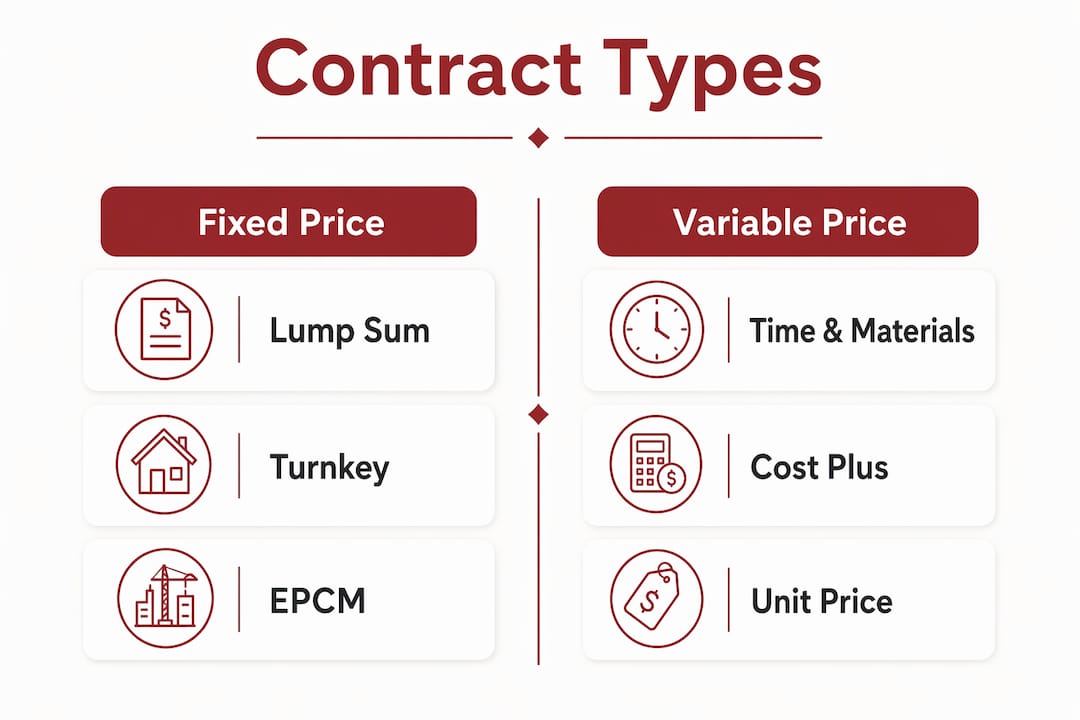
| Contract Type | Pricing Structure | Risk Holder | Best For |
|---|---|---|---|
| Lump Sum (Fixed Price) | Single fixed price for all work | Contractor | Well-defined scope projects |
| Cost Reimbursement | Owner pays actual costs plus fee | Owner | Projects with uncertain scope |
| Time and Materials | Hourly rate plus material costs | Owner | Small repairs or undefined work |
| Lump Sum Turnkey (LSTK) | Fixed price, contractor handles design and build | Contractor | Full project delivery |
| EPC Management (EPCM) | Contractor manages, owner retains risk | Owner | Large commercial projects |
Industry standards distinguish Lump Sum Turnkey and EPCM contracts by where risk sits. In an LSTK contract, the contractor handles design and construction for a fixed price, so cost overruns are the contractor’s problem. In an EPCM arrangement, the contractor manages the process but the owner retains financial risk.
For most Connecticut homeowners, a Lump Sum or Fixed Price contract is the clearest choice. The scope must be well defined before signing, but you know your total cost upfront. Time and Materials contracts work for small repairs where the full scope cannot be determined in advance, but they require close oversight to avoid runaway costs.
The contract type also shapes how change orders work. A Fixed Price contract treats any scope addition as a formal change requiring written approval and a price adjustment. A Time and Materials contract absorbs small changes more fluidly, but that flexibility can mask cost growth. Understanding contractor pricing terms before you choose a contract type helps you ask the right questions.
What steps should Connecticut owners take when reviewing contract terms?
Reviewing a construction contract is not a passive exercise. You need to work through it systematically before you sign anything. Here is a practical sequence that protects you at every stage.
- Verify the Scope of Work matches your expectations. Read every line of the scope description. Compare it against the proposal or estimate you received. Any gap between the two is a negotiation point before signing.
- Analyze the payment schedule. Confirm that payment milestones align with actual project progress. Front-loaded payment schedules favor the contractor. A balanced schedule ties payments to completed work.
- Understand retainage terms. Know what percentage is held back and what triggers its release. Contracts must clearly define final completion to prevent disputes over retainage at project close.
- Request a clear change order process. The contract should require written approval for every change before work begins. Verbal change approvals create disputes that are difficult to resolve.
- Confirm insurance coverage. Ask for a certificate of insurance before work starts. For commercial projects in Connecticut, review licensing and insurance requirements to confirm the contractor meets state standards.
- Read the dispute resolution clause. Know whether you are committing to mediation, arbitration, or litigation. Arbitration clauses are often buried in the General Conditions and are binding once you sign.
- Consult a professional if needed. If the contract uses legal or technical language you do not understand, a construction attorney or experienced contractor can clarify it before you commit.
Pro Tip: Standard industry contract forms are not universal. Terms like “liquidated damages” and “retainage” should be tailored to each project to match your project size and financial exposure.
The General Conditions section defines responsibilities and rights that govern the entire project. Focusing only on price and timeline while skipping General Conditions is a leading cause of disputes. Give that section the same attention you give the numbers.
Key Takeaways
A construction contract’s terms define every financial and legal obligation in your project, and missing or vague clauses are the primary cause of costly disputes.
| Point | Details |
|---|---|
| Six core components | Every contract needs scope, payment, timeline, change orders, insurance, and dispute resolution. |
| Plain meaning rule | Courts read contracts as written, so vague language works against you, not the contractor. |
| Substantial performance risk | Define final completion clearly to prevent contractors from claiming payment before work is done. |
| Contract type shapes risk | Fixed Price protects owners on defined projects; Time and Materials requires close cost monitoring. |
| General Conditions matter | Skipping this section is a leading cause of disputes; read every clause before signing. |
What 30 years of contracts taught me about reading the fine print
Most homeowners I talk to focus on two things when they get a contract: the total price and the start date. Those two numbers feel like the whole deal. They are not. The real exposure sits in the clauses nobody reads, and I have seen that play out in ways that cost people real money.
The clause that surprises owners most is substantial performance. A contractor can legally claim they have “substantially completed” a project even when punch list items remain open. If your contract does not define final completion precisely, you may find yourself releasing retainage before the last details are finished. That leverage disappears the moment you pay.
Special conditions and amendment schedules are the other blind spot. These sections sit at the back of the contract and often override the standard terms at the front. I have reviewed contracts where a single paragraph in the Schedule of Amendments shifted full responsibility for unforeseen site conditions onto the owner. That is a significant financial risk buried in fine print.
My honest advice: treat the contract review as part of the project, not a formality before it starts. If you are working with a contractor who resists written change orders or cannot explain a clause clearly, that tells you something important about how the project will run. A contractor worth hiring welcomes your questions. Transparency at the contract stage is the best predictor of a smooth project.
— Adam
Working with Jsignorexteriors on your Connecticut project
Jsignorexteriors has served Connecticut homeowners and businesses for more than 30 years with a commitment to clear contracts and honest communication from the first conversation. Every project starts with a written scope, a defined payment schedule, and a timeline you can hold us to.
Whether you need roofing services in Connecticut or guidance on what your exterior remodel contract should include, Jsignorexteriors walks you through every term before work begins. You will know exactly what you are getting, what it costs, and when it will be done. Reach out to Jsignorexteriors to schedule a consultation and get a contract you can actually understand.
FAQ
What is a construction contract in simple terms?
A construction contract is a legally binding document that defines the scope of work, payment terms, timeline, and responsibilities between an owner and a contractor. It provides the framework that keeps both parties accountable throughout the project.
What are the most important clauses in a construction contract?
The six most critical clauses are scope of work, payment terms, project timeline, change order procedures, insurance requirements, and dispute resolution. Missing any one of these creates gaps that commonly lead to disputes.
What does “substantial performance” mean in a construction contract?
Substantial performance allows a contractor to claim payment when most of the work is complete, even if minor items remain unfinished. Owners should define final completion and retainage release terms clearly to protect against premature payment.
How do flow-down clauses affect Connecticut homeowners?
Flow-down clauses bind subcontractors to the same terms as the prime contract, extending liability down the entire project chain. As an owner, you benefit when subcontractors are held to the same standards as your general contractor.
What is the difference between a fixed price and a time and materials contract?
A fixed price contract sets one total cost for a defined scope, placing cost overrun risk on the contractor. A time and materials contract charges actual hours and costs, which gives flexibility but requires the owner to monitor spending closely.