

A contractor license is an official government authorization certifying that a contractor meets state-required standards for competency, safety, and financial responsibility. In Connecticut, this credential separates qualified professionals from unqualified operators who put your property and finances at risk. The Connecticut Department of Consumer Protection (DCP) oversees contractor licensing and registration, giving homeowners and business owners a clear legal framework for accountability. Understanding what a contractor license covers, the types available, and how to verify one protects you before you sign a single contract.
What is a contractor license and why does it matter in Connecticut?
A contractor license is government authorization ensuring competency, safety, and financial responsibility on every job site. It is not simply a business registration or a tax ID. The license certifies that a contractor has met specific state standards, passed required reviews, and carries the financial backing to stand behind their work.
Connecticut enforces this through the DCP, which has authority to impose penalties, suspend licenses, or revoke credentials for violations. That enforcement power is what gives the license real teeth. Without it, a contractor faces no formal accountability to the state, and you face no formal recourse beyond a civil lawsuit.
For homeowners and business owners, the license is the first filter. It does not guarantee perfect work, but it does confirm that the contractor cleared a legal and professional baseline before stepping onto your property.

What are the types of contractor licenses in Connecticut?
Connecticut distinguishes between two primary categories: the Home Improvement Contractor (HIC) registration and specialized trade licenses. Understanding the difference prevents costly hiring mistakes.
The HIC registration applies to contractors performing residential work such as roofing, siding, decks, and remodeling. It requires annual renewal with a $220 fee and mandatory continuing education hours. This is the credential most homeowners encounter when hiring for exterior or interior residential projects.
Specialized trade licenses cover specific disciplines including electrical, plumbing, and HVAC work. These require separate examinations and documentation beyond the general HIC registration. A contractor holding an HIC registration cannot legally perform specialized trade work without the corresponding trade license.
| License Type | Key Requirements | Allowed Scope |
|---|---|---|
| Home Improvement Contractor (HIC) | Annual renewal, $220 fee, continuing education | Residential remodeling, roofing, siding, decks |
| Electrical License | State exam, documented experience, insurance | Electrical installations and repairs |
| Plumbing License | State exam, apprenticeship hours, bond | Plumbing systems, fixtures, piping |
| HVAC License | Trade exam, financial responsibility proof | Heating, ventilation, air conditioning |
| Commercial Contractor | Experience documentation, financial statements | Commercial construction and renovation |
Pro Tip: Always ask your contractor which specific license covers the work they plan to perform. An HIC registration alone does not authorize electrical or plumbing work, even on a residential project.
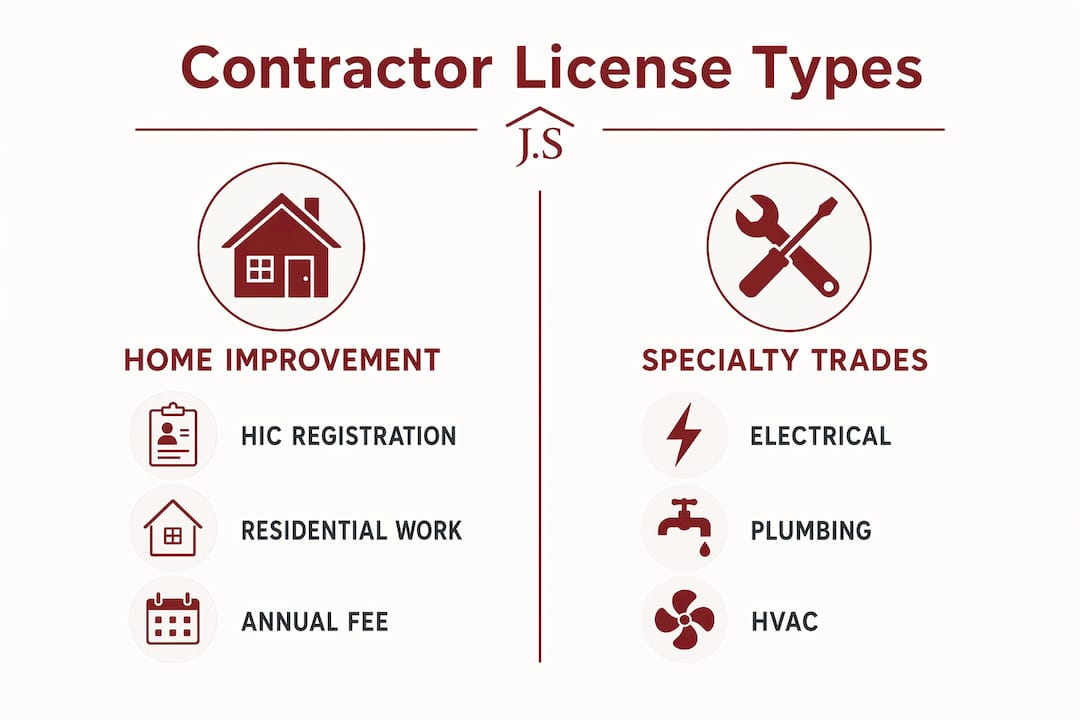
General contractor licenses allow managing entire projects and hiring subcontractors, while specialty licenses cover specific trades. For a project involving both exterior remodeling and electrical upgrades, you need to verify both credentials separately.
Why is hiring a licensed contractor critical for Connecticut homeowners?
Hiring a licensed contractor is the single most effective way to protect your property investment and your legal standing. The risks of skipping this step are concrete and costly.
Unlicensed contractors often lack insurance, which exposes you to direct financial liability if a worker is injured on your property. Without workers’ compensation coverage, a medical claim can fall on your homeowner’s insurance or, worse, on you personally. Licensed contractors carry both liability insurance and workers’ compensation as part of their licensing requirements.
Permit compliance is the second major risk. Permit fees range from $150 for minor renovations to over $15,000 for larger projects. Work performed without permits can be red-tagged by municipal inspectors, forcing you to halt the project or tear out completed work. That cost lands on you as the property owner, not the contractor.
Here are the core benefits of hiring a licensed contractor in Connecticut:
- Legal compliance. Licensed contractors pull permits and follow Connecticut building codes, keeping your project legal and your property insurable.
- Insurance protection. Licensing requirements include liability and workers’ compensation coverage, shielding you from accident claims.
- Background accountability. The DCP reviews contractor backgrounds and can act on complaints, giving you a formal dispute channel.
- Contract enforceability. CT law requires written contracts with specific disclosures. Licensed contractors must comply, making agreements legally binding.
- Financial recourse. Licensing boards can impose fines and revoke credentials, creating real consequences for poor performance.
Pro Tip: Before signing any contract, confirm the contractor’s license is active. An expired license voids many of the legal protections you think you have.
For a deeper look at how insurance ties into contractor credentials, the guide on contractor insurance in Connecticut breaks down exactly what coverage you should expect.
How to verify a contractor’s license in Connecticut
Verifying a contractor’s license takes less than five minutes and can save you thousands of dollars. The Connecticut DCP operates the eLicense portal, where you can search by contractor name, business name, or registration number to confirm current status.
A common and expensive mistake is confusing a business registration with a contractor license. A business license proves the company is registered to operate. A contractor license certifies technical trade competency. These are separate documents, and only the contractor license matters for construction work.
Before hiring any contractor, gather this information:
- Registration number. Every licensed Connecticut contractor has a DCP-issued number. Ask for it upfront.
- License type. Confirm the license covers the specific work being performed, not just general contracting.
- Expiration date. Check the eLicense portal to confirm the license is current, not lapsed or suspended.
- Insurance certificates. Request copies of liability and workers’ compensation certificates directly from the insurer.
- Written contract. Connecticut law mandates that home improvement contracts include the registration number, project scope, and a 3-day cancellation notice. Failure to include these disclosures can make the contract unenforceable.
Pro Tip: Do not accept a contractor’s verbal assurance that they are licensed. Pull the DCP eLicense record yourself. Suspended and expired licenses appear in the system, and a quick search protects you from fraud.
The exterior remodeling project checklist from Jsignorexteriors includes a full verification section that walks you through each step before work begins.
How to get a contractor license in Connecticut
Getting a contractor license in Connecticut follows a defined process with specific requirements at each stage. The path differs slightly between HIC registration and specialized trade licenses, but the core structure is consistent.
For the Home Improvement Contractor registration, the process includes:
- Application submission to the Connecticut DCP with all required documentation.
- Fee payment of $220 for initial registration and the same amount annually for renewal.
- Continuing education hours completed before each renewal cycle.
- Proof of insurance including general liability coverage at required minimums.
For specialized trade licenses, the requirements are more demanding:
- Documented experience in the specific trade, verified through employer records or apprenticeship logs.
- Written examination covering trade-specific codes, safety standards, and Connecticut regulations.
- Financial responsibility documentation including bonds and insurance certificates.
- Background review conducted by the relevant licensing board.
Most states require contractors to pass written exams, document experience, provide financial statements, and maintain bonds and insurance. Connecticut follows this model closely. Continuing education is mandatory for license renewal across most categories, keeping licensed contractors current with code changes and safety standards.
| Requirement | HIC Registration | Specialty Trade License |
|---|---|---|
| Application fee | $220 annually | Varies by trade |
| Examination | Not required | Required |
| Experience documentation | Not required | Required |
| Insurance proof | Required | Required |
| Continuing education | Required for renewal | Required for renewal |
| Bond | Not always required | Often required |
For commercial projects, the licensing requirements carry additional layers. The guide on commercial contractor licensing in CT details the financial and legal requirements specific to non-residential work.
Key Takeaways
A contractor license is the legal baseline every Connecticut homeowner and business owner should verify before hiring anyone to work on their property.
| Point | Details |
|---|---|
| License definition | A contractor license is government authorization certifying competency, safety, and financial responsibility. |
| Connecticut HIC registration | Residential contractors need annual HIC renewal at $220 with mandatory continuing education. |
| License types differ | HIC registration does not cover specialized trades; verify the correct license for each scope of work. |
| Verification is your responsibility | Use the Connecticut DCP eLicense portal to confirm active status before signing any contract. |
| Written contracts are required | CT law mandates contracts include the registration number and a 3-day cancellation right or they may be unenforceable. |
Why licensing is a floor, not a ceiling
Licensing tells you a contractor cleared the legal minimum. It does not tell you whether they show up on time, communicate clearly, or take pride in their work. I have seen licensed contractors deliver mediocre results and unlicensed ones do clean work. The license matters, but it is the starting point of your vetting process, not the finish line.
The mistake I see Connecticut homeowners make most often is treating the license check as the only check. They confirm the HIC number, skip the reference calls, and sign a contract without reading the cancellation clause. Then a dispute arises and they realize the contract is missing required disclosures, which makes it harder to enforce.
Licensing establishes a legal baseline for competence and safety, but it does not replace reviewing references and portfolio work. Ask for three completed projects similar to yours. Call those homeowners. Look at photos. A licensed contractor with a strong track record is the combination you want, not just the credential alone.
The other thing worth knowing: confusing a business license with a contractor license is one of the most common and costly mistakes homeowners make. A business registration means the company exists legally. A contractor license means the company is authorized to perform construction work. They are not the same document, and only one of them protects you.
— Adam
Jsignorexteriors: Connecticut’s licensed exterior contractor
Jsignorexteriors has served Connecticut homeowners and businesses for more than 30 years as a fully licensed and insured exterior remodeling contractor. Every project, from roofing and siding to decks, gutters, and replacement windows, is completed under the proper credentials and in full compliance with Connecticut licensing requirements.
When you hire Jsignorexteriors, you get a contractor whose license is current, whose insurance is verified, and whose work is backed by three decades of Connecticut projects. Whether you need a licensed roofing contractor or a full exterior remodel, the team brings the credentials and the craftsmanship to match. Contact Jsignorexteriors to confirm your project scope and get a written estimate that meets every requirement under Connecticut law.
FAQ
What does a contractor license cover in Connecticut?
A Connecticut contractor license authorizes the holder to legally perform construction or home improvement work within the scope of their specific credential. An HIC registration covers residential remodeling, while trade licenses cover specialized work like electrical or plumbing.
Can you work without a contractor license in Connecticut?
Working without the required license in Connecticut is illegal for covered trades and home improvement work. Homeowners who hire unlicensed contractors risk voided insurance claims, permit violations, and personal liability for on-site accidents.
How do I verify a contractor’s license in Connecticut?
Use the Connecticut Department of Consumer Protection eLicense portal to search by contractor name or registration number. The portal shows current license status, expiration date, and any suspensions or revocations.
How much does a contractor license cost in Connecticut?
The Home Improvement Contractor registration costs $220 annually. Specialty trade licenses carry separate fees that vary by trade and licensing board.
What should a Connecticut home improvement contract include?
Connecticut law requires written contracts to include the contractor’s HIC registration number, a clear project scope, and a 3-day cancellation notice. Contracts missing these disclosures may be unenforceable under state law.