

Contractor project management is the structured process of overseeing contractors across every phase of a construction project to deliver work on time, within budget, and to the required quality and safety standards. Most project managers understand scheduling and cost tracking. Far fewer recognize that contractor management also covers contract governance, change control, payment certification, and legal compliance. These duties are not optional extras. They are the core of what separates a project that finishes well from one that spirals into claims and delays. Whether you manage roofing, siding, or large commercial builds, the principles of contractor oversight apply at every scale.
What is the role of contractor project management?
Construction management applies project management techniques across planning, design, and construction with the goal of controlling scope, time, and cost while maintaining quality. That definition covers the full range of contractor management duties: planning, cost and time management, quality assurance, contract administration, safety, and professional practice. Each duty connects to the others. A lapse in contract administration, for example, creates cost exposure. A gap in safety oversight creates legal liability.
The role of contractor project management is not just coordination. It is a governance function that protects the project owner’s investment at every stage. Construction project managers coordinate cost, quality, schedule, scope, function, safety, and stakeholder communications to keep projects on track. That integrated oversight is what makes contractor management a discipline in its own right, not a subset of general administration.

What are the primary duties and lifecycle stages?
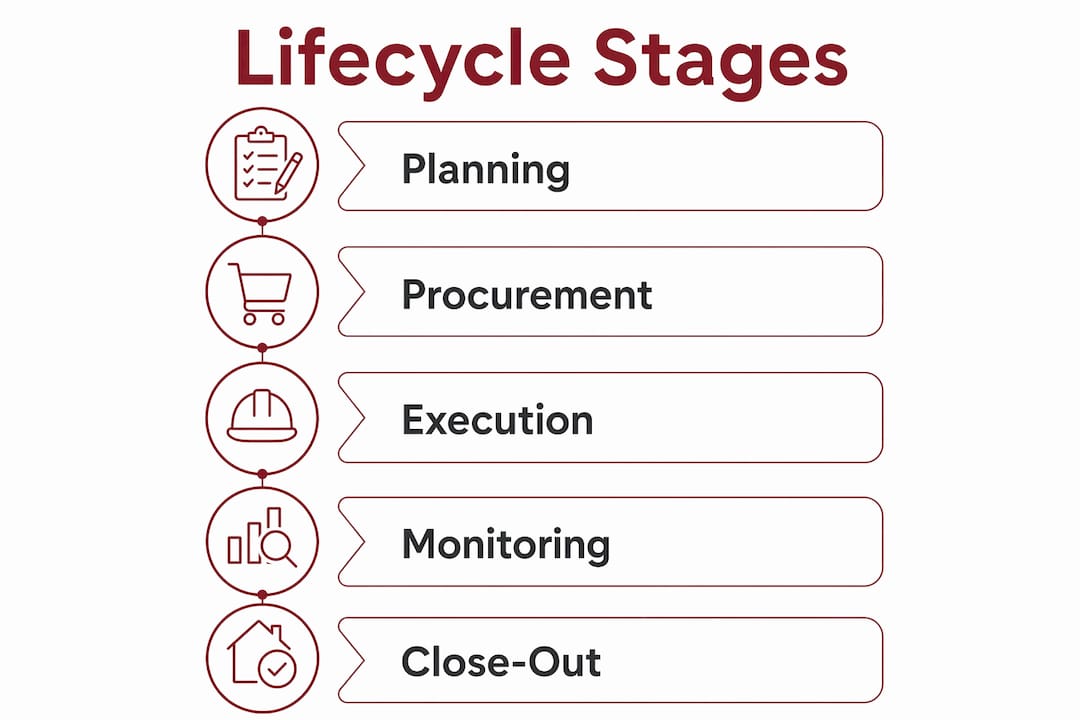
Contractor management is a structured lifecycle process that runs from procurement through contract formation, mobilization, active monitoring, change management, payment certification, and close-out. Each phase has distinct deliverables and risks. Skipping or rushing any phase creates problems that compound later.
The lifecycle breaks down into four main stages:
- Pre-contract. This phase covers contractor selection, pre-qualification, scope definition, and contract negotiation. Getting the contractor estimate and contract terms right at this stage prevents disputes downstream.
- Mobilization. The contractor is onboarded, inducted into site safety requirements, and given access to drawings, specifications, and the project program. This is where expectations are set clearly.
- Active delivery. The project manager monitors schedule progress, tracks costs against budget, manages change orders, certifies payments, and enforces quality and safety standards. This is the longest and most demanding phase.
- Close-out. Final account settlement, defect resolution, documentation handover, and lessons-learned capture all happen here. A clean close-out protects the owner from lingering claims.
The skills required across these stages span three domains: commercial (contract law, cost management, payment certification), technical (reading drawings, understanding specifications, quality inspection), and interpersonal (negotiation, conflict resolution, stakeholder communication). No single skill set is enough on its own.
Pro Tip: Document every instruction to a contractor in writing, even verbal ones confirmed by email. This single habit prevents the majority of end-of-project disputes over scope and payment.
How does contractor management differ from general contractor execution?
Contractor project managers focus on governance: tracking progress against program, monitoring budget, managing owner communications, and controlling change orders. General contractors focus on execution and protecting their own margin. These are fundamentally different incentives, and understanding that difference is the most important insight in contractor management.
| Dimension | Project Manager | General Contractor |
|---|---|---|
| Primary focus | Owner’s interests and governance | Execution and margin protection |
| Budget role | Monitors cost vs. owner budget | Manages cost vs. contract price |
| Change orders | Reviews and approves on owner’s behalf | Submits and negotiates for profit |
| Schedule | Tracks progress vs. program | Manages crew and subcontractor output |
| Risk | Identifies and reports early | Manages internally to protect margin |
This distinction matters because general contractors are not obligated to flag problems that hurt their position. A project manager working for the owner has a duty to surface those problems early. That is why proactive contract administration and early risk detection are the defining features of effective contractor oversight.
The governance role also includes managing the interfaces between subcontractors. When a roofing subcontractor finishes and a siding subcontractor starts, the handoff must be documented and inspected. Gaps at these interfaces are where schedule and budget blowups most often originate.
Pro Tip: Review the contractor’s program at the start of each month, not just at milestone dates. Monthly reviews catch drift before it becomes a delay.
Why is safety and quality oversight critical?
Contractors working under host control require safety management per ISO 45001, including pre-qualification, induction, active monitoring, and incident reporting. Contractor safety oversight is legally the host organization’s responsibility. It must be integrated into the host’s occupational health and safety system, not left to the contractor’s internal management alone.
Lifecycle safety oversight covers four steps:
- Pre-qualification. Verify the contractor’s safety record, licenses, insurance, and method statements before any work begins.
- Induction. Brief every worker on site-specific hazards, emergency procedures, and reporting requirements before they start.
- Active monitoring. Conduct regular site inspections, review toolbox talk records, and track near-miss reports throughout delivery.
- Incident reporting. Require immediate notification of any incident and conduct root-cause analysis to prevent recurrence.
Quality management follows a parallel structure. Quality control must be planned before work starts with quality plans, inspection and test plans, and non-conformance report processes. Planning these tools in advance means that when a defect appears, the correction process is already agreed upon. That prevents the adversarial disputes that arise when a contractor and owner disagree on what “acceptable” looks like.
Structured quality and safety oversight does more than prevent accidents and defects. It protects the project schedule. A safety incident stops work. A quality failure triggers rework. Both cost time and money that no contingency budget fully absorbs.
What are best practices and tools for effective contractor oversight?
Contractor project management failures at interfaces between subcontractors cause schedule and budget overruns. A RACI matrix (Responsible, Accountable, Consulted, Informed) clarifies who owns each task across all trades and subcontractors. Without it, accountability gaps appear exactly where they hurt most: at handoffs.
Practical best practices for managing contractors effectively include:
- Use a RACI matrix from day one. Assign responsibility for every key deliverable before mobilization. Update it when scope changes.
- Require a contractor quality plan. The plan should name the quality manager, list hold points for inspection, and define the non-conformance process.
- Set a structured reporting cycle. Monthly contractor performance reports should cover schedule status, cost performance, risk highlights, quality metrics, and decisions needed. This gives owners the information they need to act early.
- Use construction management software. Tools like Procore, Autodesk Construction Cloud, and Buildertrend support scheduling, cost tracking, and document control in one place.
- Maintain a change order log. Every change, no matter how small, should be logged with its cost and schedule impact before approval.
Transparent reporting is not just a management nicety. It is the mechanism that allows early corrective action before a small problem becomes a project-ending crisis. When you select the right contractor at the start, structured reporting throughout delivery is what keeps that relationship productive.
Pro Tip: Never approve a change order without a written schedule impact assessment alongside the cost. Cost-only approvals are how projects stay on budget but finish late.
Key Takeaways
Effective contractor project management protects the owner’s investment by combining governance, lifecycle oversight, and structured communication from procurement through close-out.
| Point | Details |
|---|---|
| Governance over coordination | Contractor management covers contract administration, change control, and legal compliance, not just scheduling. |
| Lifecycle phases matter | Each phase from pre-contract to close-out has distinct duties; skipping any phase creates compounding risks. |
| Safety is the owner’s legal duty | Under ISO 45001, the host organization is responsible for contractor safety, not just the contractor. |
| RACI prevents interface failures | Assigning responsibility across subcontractors before mobilization stops accountability gaps at handoffs. |
| Structured reporting enables early action | Monthly performance reports covering cost, schedule, quality, and risk allow owners to correct problems before they escalate. |
What 30 years of contractor work taught me about governance
Most project managers I have worked alongside treat contractor management as a coordination task. They track the schedule, check the invoices, and call it done. That approach works fine until the first major change order or subcontractor dispute. Then the absence of proper contract administration becomes very expensive, very fast.
The most common failure I see is at the interface between trades. A roofing crew finishes, a siding crew starts, and nobody formally inspects the transition. Three months later, a water intrusion problem appears and both contractors point at each other. A documented inspection at the handoff, with photos and a sign-off, eliminates that argument entirely.
The second failure is treating change orders as administrative paperwork rather than commercial events. Every change order is a renegotiation. Approving one without a schedule impact assessment is how projects stay on budget but finish two months late. The owner pays twice: once for the change and once for the delay.
Contractor project management done well is not about being adversarial with your contractors. It is about being clear, consistent, and documented. Contractors respect that. The ones who push back on documentation are usually the ones with something to hide.
— Adam
Jsignorexteriors: contractor project management you can count on
Jsignorexteriors brings more than 30 years of exterior contracting experience to every project in Connecticut. The company manages roofing, siding, gutters, windows, and decks with the same structured approach described in this article: clear scope, documented change orders, quality inspections at every stage, and a commitment to finishing on time and within budget.

Homeowners and commercial property managers across Connecticut trust Jsignorexteriors because the company treats every project as a governance responsibility, not just a construction task. If you need a licensed, insured roofing contractor in Connecticut who manages the full project lifecycle with transparency and accountability, Jsignorexteriors is ready to help. Contact the team today to discuss your project.
FAQ
What is contractor project management?
Contractor project management is the structured process of overseeing contractors from procurement through close-out to deliver projects on time, within budget, and to required quality and safety standards. It covers contract administration, change control, payment certification, and compliance, not just scheduling.
How does a project manager differ from a general contractor?
A project manager works on behalf of the owner to govern cost, schedule, and quality, while a general contractor focuses on executing the work and protecting their own margin. These different incentives mean the project manager must independently verify progress and flag risks the contractor may not volunteer.
Why is safety oversight the owner’s responsibility?
Under ISO 45001, the host organization is legally responsible for contractor safety within its operational control. That means the owner or project manager must integrate contractor safety into the site’s occupational health and safety system, including pre-qualification, induction, and active monitoring.
What is a RACI matrix and why does it matter?
A RACI matrix assigns Responsible, Accountable, Consulted, and Informed roles to every task across all subcontractors and trades. It prevents accountability gaps at handoffs between trades, which are the most common source of schedule and budget overruns on construction projects.
What should a contractor performance report include?
A contractor performance report should cover schedule status, cost performance, risk highlights, quality metrics, and decisions needed from the owner. Monthly reporting at this level gives project stakeholders the information they need to take corrective action before problems escalate.