
Negotiating a commercial contractor contract is the process of reaching a legally sound agreement that defines scope, payment, liability, and responsibilities before a single nail is driven. Business owners in Connecticut face a specific challenge: state statutes on prompt payment, indemnification, and lien rights can override terms you thought you had locked down. Getting this right protects your budget, your property, and your working relationship with the contractor. The guidance below covers the essential contract terms, preparation steps, negotiation tactics, and common pitfalls that Connecticut business owners encounter most often.
What are the essential contract terms to negotiate with commercial contractors?
Limitation of liability is the most frequently negotiated commercial contract term, a pattern that has held since 2007. That tells you where the real financial risk sits. Mutual caps near one times the annual contract fee are standard practice, with specific carve-outs for high-risk categories like fraud or gross negligence.
Payment terms deserve equal attention. Net 30 on undisputed invoices is the commercial standard, and any contract that shortens that window without a dispute carve-out puts you at a disadvantage. If you receive a faulty invoice, you need language that lets you withhold payment on the contested portion while the rest processes normally.
Scope of work is where most budget overruns begin. Vague scope language invites change orders, and undefined change procedures turn routine site adjustments into costly disputes. Define exactly what triggers a change order, who approves it, and at what markup rate.

Lien rights in Connecticut require specific attention. Conditional lien waivers should be required with every payment application. You exchange unconditional waivers only after payment clears and you have verified the work. Accepting an unconditional waiver before payment confirmation strips you of dispute rights you may need later.
Key clauses to review in every commercial contractor agreement:
- Indemnification: Push for fault-based indemnification so you are not covering the contractor’s negligence.
- Renewal and termination: Confirm automatic renewal windows and termination-for-convenience rights with reasonable notice periods.
- Warranties: Specify the duration, what is covered, and the process for making a warranty claim.
- Dispute resolution: Agree on mediation before arbitration or litigation to keep costs manageable.
- Insurance requirements: Confirm minimum coverage levels and require you to be named as an additional insured.
Pro Tip: Request a certificate of insurance directly from the contractor’s insurer, not just a copy from the contractor. This confirms the policy is active and lists you correctly as an additional insured.
How should Connecticut business owners prepare before negotiating?
Preparation is the foundation of every successful contract negotiation. Disputes often arise from unclear priorities and ambiguous phrasing, which means the work you do before the first meeting directly reduces your legal exposure later.
Follow these steps before you sit down at the table:
-
Review Connecticut statutes. State law on prompt payment, indemnification fault lines, and lien rights can override negotiated terms. Connecticut’s statutory requirements frequently surprise owners who assume their negotiated language controls. Know what the law mandates before you agree to anything.
-
Assess your project risk. Walk through the project scope and identify where cost overruns, delays, or workmanship failures would hurt you most. A roof replacement on an occupied commercial building carries different risk than a siding job on a vacant property.
-
Define your BATNA. Your Best Alternative to a Negotiated Agreement is the option you fall back on if talks fail. Identifying your BATNA before negotiating tells you exactly how far you can push and when to walk away.
-
Rank your priorities. Separate the terms you must win from the terms you can trade. Liability caps and lien waiver language are non-negotiable for most owners. Payment timing may have more flexibility.
-
Prepare alternative language. Draft clean replacement clauses for the terms you want to change. Presenting specific language moves the conversation forward faster than vague objections.
-
Decide when to involve an attorney. For projects above a certain dollar threshold or involving complex phasing, a construction attorney familiar with Connecticut law is worth the cost. For smaller scopes, a thorough self-review using a checklist may suffice.
Vetting the contractor before you negotiate is just as important as the negotiation itself. Reviewing commercial contractor licensing in CT confirms you are dealing with a qualified party before you invest time in contract talks.
What strategies lead to successful contract negotiations?
Collaborative negotiation produces agreements both parties feel comfortable honoring, and it reduces future disputes compared to adversarial tactics. That is not a soft preference. It is a practical outcome. Contractors who feel pressured into unfavorable terms find ways to recover margin elsewhere, usually through change orders.
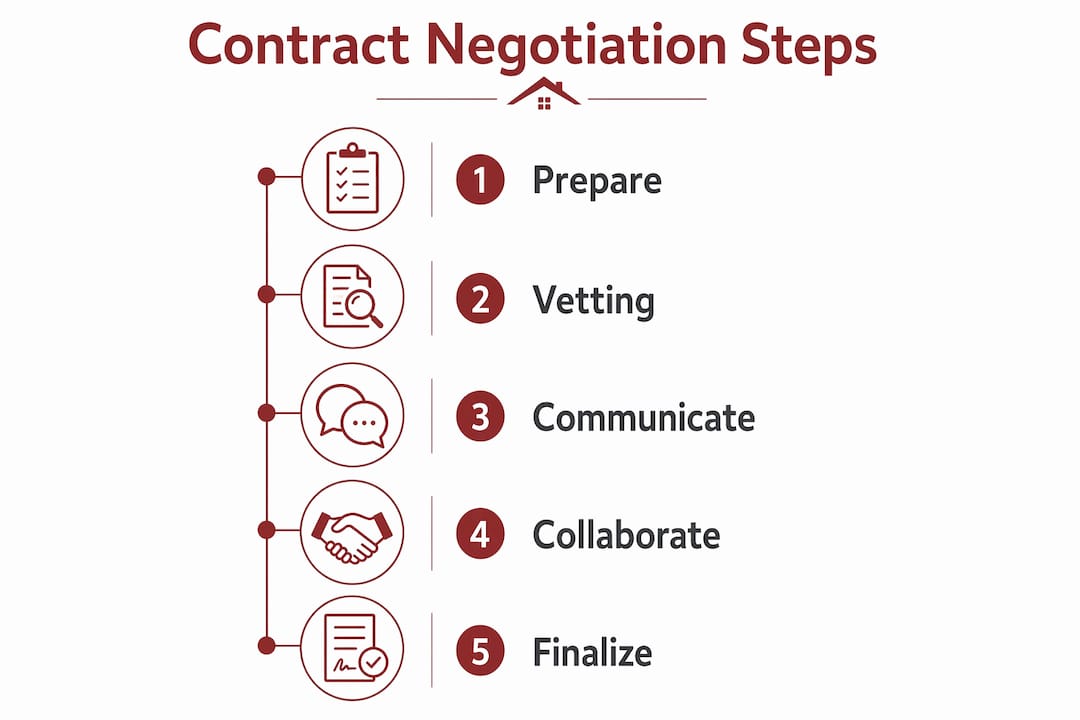
The most effective approach treats negotiation like a strategic sequence rather than a single conversation. Reciprocal concessions work by offering small wins on low-priority points in exchange for major gains on your priorities. You give ground on payment timing; you hold firm on liability caps. The contractor feels heard, and you protect what matters most.
Practical tactics that work in commercial contractor negotiations:
- Address contractor interests directly. Ask what the contractor needs from the contract to feel protected. Intellectual property on custom designs, tool and equipment provisions, and subcontractor payment timing are common contractor concerns. Solving these costs you little and creates goodwill.
- Use specific language, not vague objections. “This clause exposes me to unlimited liability” is weaker than presenting a revised clause with a mutual cap. Clean alternative language closes deals faster.
- Anticipate multiple moves. Think two or three concessions ahead. If you give on payment terms now, know what you will ask for in return before the contractor responds.
- Document every agreed change in writing. Verbal agreements during negotiation disappear. Confirm each change in a written summary before the final contract is drafted.
Pro Tip: Before the negotiation meeting, send the contractor a written summary of the three terms most important to you. This signals good faith, reduces surprises, and often prompts the contractor to share their own priorities in advance.
Understanding contractor project management responsibilities helps you negotiate scope and supervision terms with more confidence.
What common contract pitfalls should Connecticut business owners avoid?
The most expensive mistakes in commercial contractor agreements happen before construction starts, not during it.
-
Using template contracts without modification. AIA contract forms and other standard templates require project-specific modifications. A template that worked on a previous project may leave critical gaps for your current scope, site conditions, or Connecticut-specific requirements.
-
Leaving change order processes undefined. Experienced owners negotiate change order pricing and field ticket approvals before signing. Skipping this step means any site condition change becomes a negotiation under pressure, when your leverage is lowest.
-
Ignoring document alignment. Ambiguities among governing documents, including plans, specifications, and the contract scope, are a leading cause of disputes and delays after signing. Every document in the contract package must tell the same story.
-
Accepting unconditional lien waivers too early. Signing an unconditional waiver before payment clears removes your ability to dispute workmanship or incomplete work. Always use conditional waivers tied to confirmed payment.
-
Overlooking Connecticut statutory overrides. State law on prompt payment and indemnification does not care what your contract says. If your negotiated terms conflict with Connecticut statutes, the statute wins.
“The biggest risk in a commercial contractor agreement is not the clause you negotiated poorly. It is the clause you never thought to negotiate at all. Connecticut business owners consistently underestimate how state law reshapes the terms they assumed were settled.”
Reviewing a detailed exterior remodel contract guide for Connecticut projects gives you a practical checklist to cross-reference against any commercial agreement.
Key Takeaways
Successful commercial contract negotiation in Connecticut requires preparation, knowledge of state statutes, and a collaborative approach that protects your priorities without damaging the working relationship.
| Point | Details |
|---|---|
| Prioritize liability and payment terms | Limitation of liability and Net 30 payment standards are the most critical terms to negotiate in any commercial agreement. |
| Know Connecticut law before you negotiate | State statutes on prompt payment, indemnification, and lien rights override negotiated terms and regularly surprise owners. |
| Define change order processes upfront | Negotiate change order pricing and approval procedures before signing to prevent budget overruns during construction. |
| Use conditional lien waivers | Require conditional waivers with each payment application and exchange unconditional waivers only after payment clears. |
| Prepare your BATNA and alternative language | Knowing your fallback position and drafting clean replacement clauses gives you real leverage at the table. |
What I have learned negotiating contractor contracts in Connecticut
After more than three decades working on exterior projects across Connecticut, the pattern I see most often is this: business owners spend weeks choosing a contractor and then rush through the contract. That imbalance is where problems start.
The owners who get the best outcomes treat the contract as a project document, not a formality. They come to the table with specific language, ranked priorities, and a clear understanding of what Connecticut law already mandates. They do not try to win every point. They trade low-stakes terms for protection on the ones that matter.
One thing that consistently surprises Connecticut business owners is how state prompt payment statutes affect cost-plus contracts. Owners assume their negotiated markup caps control the final number. They often do not, and discovering that mid-project is painful.
My honest advice: build the relationship before you build the contract. A contractor who trusts you will flag problems early. A contractor who feels squeezed will protect their margin in ways you will not see coming until the invoice arrives.
— Adam
Jsignorexteriors: transparent contracts for Connecticut commercial projects
Jsignorexteriors has been completing commercial exterior projects across Connecticut for more than 30 years, and every project starts with a contract that is clear, complete, and built around your scope. As a fully licensed and insured contractor, Jsignorexteriors walks you through key clauses before you sign, including scope definitions, change order procedures, and payment terms, so there are no surprises once work begins.
Whether you need commercial roofing in Connecticut or a full exterior remodel, Jsignorexteriors delivers written agreements that reflect Connecticut statutory requirements and industry best practices. Contact Jsignorexteriors to review your project scope and get a contract you can negotiate with confidence.
FAQ
What is the most negotiated term in commercial contractor contracts?
Limitation of liability is the most frequently negotiated commercial contract term, followed by indemnification and payment terms. Mutual caps near one times the annual contract fee are the accepted standard.
How do lien waivers work in Connecticut commercial projects?
Conditional lien waivers should be exchanged with each payment application, and unconditional waivers should only be signed after payment has cleared. Signing an unconditional waiver early removes your right to dispute incomplete or defective work.
What is a BATNA and why does it matter in contractor negotiations?
A BATNA is your Best Alternative to a Negotiated Agreement, meaning the option you have if talks fail. Knowing your BATNA before negotiating tells you how firm to hold on key terms and when walking away is the right call.
Do Connecticut statutes override negotiated contract terms?
Yes. Connecticut’s statutory requirements on prompt payment, indemnification, and lien rights take precedence over negotiated language when there is a conflict. Review state law before finalizing any commercial contractor agreement.
When should I involve an attorney in contract negotiation?
Involve a construction attorney for large or complex projects, multi-phase scopes, or any contract where liability exposure is significant. For smaller commercial projects, a thorough self-review using a structured checklist may be sufficient.