
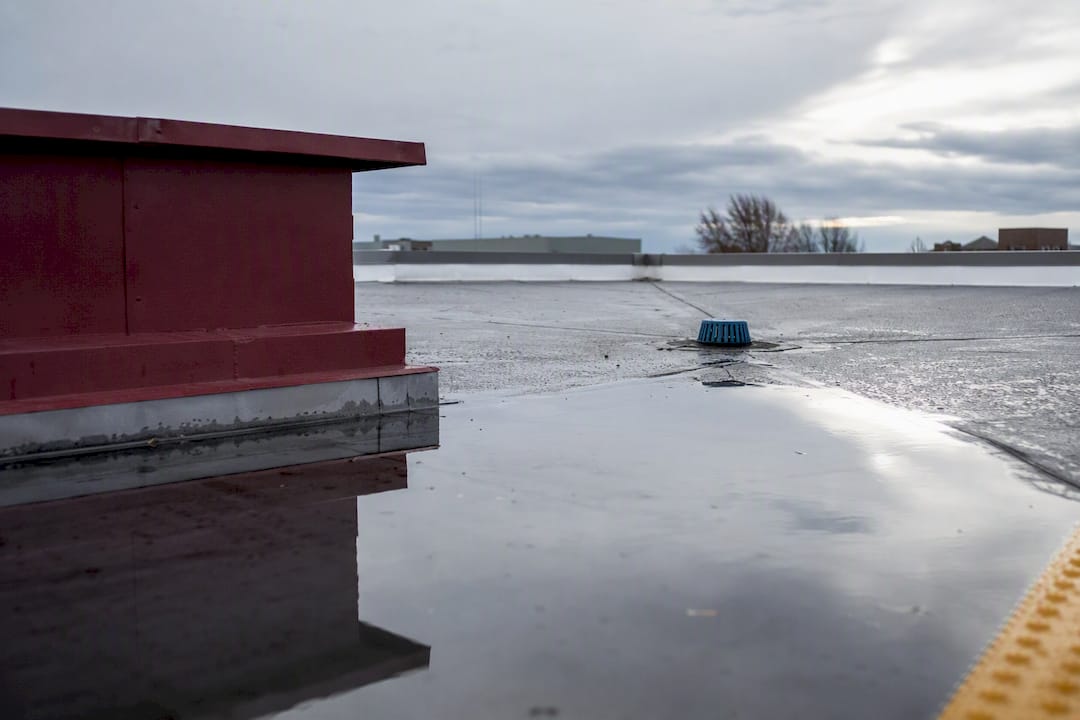
Water still sitting on your flat roof 48 hours after the rain stopped is officially ponding, not just puddling, and it needs attention now. Photograph it, clear the drains and strainers, and note whether it’s happened before. If it’s deeper than an inch, covers more than 100 square feet, or keeps coming back after every storm, stop troubleshooting yourself and call a roofing contractor.
TL;DR:
- Drains should be checked and cleared within 48 hours after rain, as standing water beyond this period qualifies as ponding, which requires action.
- Every inch of ponding water adds roughly 5.2 pounds per square foot of dead load, risking membrane wear, insulation saturation, and structural sagging.
- Most ponding issues are caused by insufficient slope, clogged drains, or structural sag, rather than membrane defects, and fixing the root cause can range from simple drain cleaning to re-sloping the roof.
- Routine maintenance, including quarterly drain clearing and post-storm inspections, can prevent most ponding from escalating to costly repairs.
- Manufacturers and insurers generally exclude ponding water from warranties and coverage, making early detection and repair critical to avoid significant expenses.
Table of Contents
- How to Assess and Document Ponding Water on a Flat Roof
- Why Ponding Water Puts Your Roof and Your Warranty at Risk
- What Actually Causes Water to Pool on a Flat Roof
- Fixing Flat Roof Ponding: From Quick Repairs to a Full Re-Roof
- Maintenance Checklist to Keep Ponding From Coming Back
- How J. Signor Exteriors Diagnoses Ponding in the Field
- Where Most Ponding Advice Gets It Backward
- Get a Flat Roof Inspection From J. Signor Exteriors
- Sources
How to Assess and Document Ponding Water on a Flat Roof
Check the roof within 48 hours of the rain ending, not immediately after. That timing matters because the NRCA defines ponding as water that remains on a roof surface 48 hours past the end of rainfall, under normal drying conditions. Water that drains within a day isn’t a problem. Water still there two days later is.
Once you’ve confirmed it’s ponding, document it properly:
- Note the date, the weather leading up to it, and how many days it’s been sitting.
- Measure the depth with a tape measure or ruler at the deepest point, and estimate the surface area in square feet.
- Run a bucket test: pour a few gallons near the drain and time how fast it clears. Slow or no movement points to a clog or a low spot with no path to the outlet.
- Photograph the same spot from the same angle each visit to build a timeline.
Pro Tip: Every inch of standing water adds roughly 5.2 pounds per square foot of dead load. A 10-by-10-foot area with two inches of ponding is carrying over 1,000 pounds your roof deck wasn’t necessarily designed to hold indefinitely.
Why Ponding Water Puts Your Roof and Your Warranty at Risk
Standing water doesn’t just sit there harmlessly waiting to evaporate. It actively works against every layer of your roof system, and the damage compounds the longer it stays.
- Membrane wear: UV breakdown slows in shaded, wet areas, but constant moisture stresses seams and accelerates aging around laps and penetrations.
- Insulation saturation: Water that finds its way through pinholes or seams soaks the insulation below, killing its R-value and often requiring full replacement rather than a patch.
- Structural load: That 5.2 pounds per square foot per inch adds up fast on a large ponded area, and sagging decks create lower spots that collect even more water, a cycle known as progressive deflection.
- Warranty exposure: Most manufacturers, including major players like GAF, Carlisle, Firestone, Sika, and Versico, exclude ponding water from coverage altogether, treating it as a maintenance failure rather than a material defect.
That last point catches a lot of owners off guard. You can have a fully warrantied membrane and still pay out of pocket for ponding-related repairs, because the manufacturer will point to standing water as the root cause, not the product. Insurers scrutinize the same evidence when reviewing water-damage claims.
What Actually Causes Water to Pool on a Flat Roof
Ponding almost always traces back to one of five root causes, and figuring out which one you’re dealing with determines whether the fix costs a few hundred dollars or tens of thousands.
- Insufficient slope: Industry guidance from the Asphalt Roofing Manufacturers Association calls for a minimum 1/4 inch per foot of slope for positive drainage. Roofs built flatter than that, or ones where the slope was never installed correctly, will pond by design.
- Clogged or undersized drains: Leaves, granules, and debris choke strainers, and older buildings sometimes have too few drains or scuppers for the roof’s total area.
- Structural deflection: Aging decks sag between supports, especially on older commercial buildings, creating low points no amount of drain cleaning will fix.
- Compressed insulation: Rooftop units, foot traffic paths, and equipment pads compress insulation over the years, forming depressions right where you least expect them.
- Localized drainage conflicts: HVAC condensate lines dumping onto the roof, or a poorly flashed penetration, can create a wet spot that looks like a slope problem but isn’t.
A gutter pitch that’s out of spec can produce a similar pooling pattern on lower roof edges, which is worth ruling out before assuming the whole field is affected.
Fixing Flat Roof Ponding: From Quick Repairs to a Full Re-Roof
The right fix depends entirely on scale. A single slow drain and a systemic slope failure are two different problems with two very different price tags, and matching the fix to the actual cause is where most owners either save money or waste it.
Immediate fixes cost the least and solve the most common cause. Clearing debris from drains and strainers, installing a leaf guard, and running a temporary pump for an active ponding event will resolve ponding tied to simple clogs. Industry data suggests routine drain cleaning resolves close to a third of reported ponding cases without any structural work at all.
Localized repairs target isolated low spots. A cricket (a small tapered structure that redirects water around an obstruction), a compact tapered insulation panel, or an added scupper or interior drain can eliminate a specific problem area without touching the rest of the roof. These work well when the ponding is confined to one section, like around a rooftop unit or in a corner with a known low spot.
Permanent solutions address systemic slope failure. Full tapered polyiso insulation systems, or a complete re-slope during a re-roofing project, restore proper drainage across the entire field. If a sagging deck is the underlying cause, expect a structural engineer to get involved before any roofing work starts.
Coatings occupy a middle ground. Silicone roof coatings tolerate some standing water better than other coating chemistries and can buy time on an aging membrane, but they don’t fix slope or drainage. Think of them as a bridge to a real repair, not the repair itself.
Here’s how the costs typically break down:
| Fix Type | Typical Cost Range | Best For |
|---|---|---|
| Drain cleaning / strainer install | $150 | Recurring minor ponding, clogged outlets |
| Adding a drain or scupper | $1,500–$4,000 | Undersized drainage, isolated low spots |
| Cricket or small tapered panel | $800 | Localized dips near equipment or penetrations |
| Tapered insulation retrofit / full re-roof | Varies widely by square footage and scope | Systemic slope failure, aging membrane |
Property managers overseeing larger commercial roofs should also know that very large footprints or heavy rainfall regions sometimes call for siphonic drainage systems rather than standard gravity drains, since gravity systems lose efficiency once the roof area gets big enough. For most residential and smaller commercial flat roofs, though, a well-placed drain or two solves the problem.
Maintenance Checklist to Keep Ponding From Coming Back
Prevention is cheaper than any repair on this list, and it only takes a few recurring tasks to stay ahead of it.
- Clear drains and scupper openings quarterly, and again after any major storm.
- Walk the roof after heavy rain and check for water sitting more than a day or two.
- Run a bucket test on any drain that looks slow, and log the result with a date.
- Photograph problem areas every visit to build a record for warranty or insurance conversations.
- Install inexpensive strainers or leaf guards at drain openings to cut down on debris buildup between visits.
Pro Tip: Keep a simple folder, digital or physical, with dated photos and inspection notes. If you ever need to file an insurance claim or push back on a warranty denial, that timeline is your strongest evidence.
Owners who follow a preventive maintenance schedule rarely see ponding escalate past the “clean the drain” stage, because small clogs get caught before they become standing water for days at a time.
How J. Signor Exteriors Diagnoses Ponding in the Field
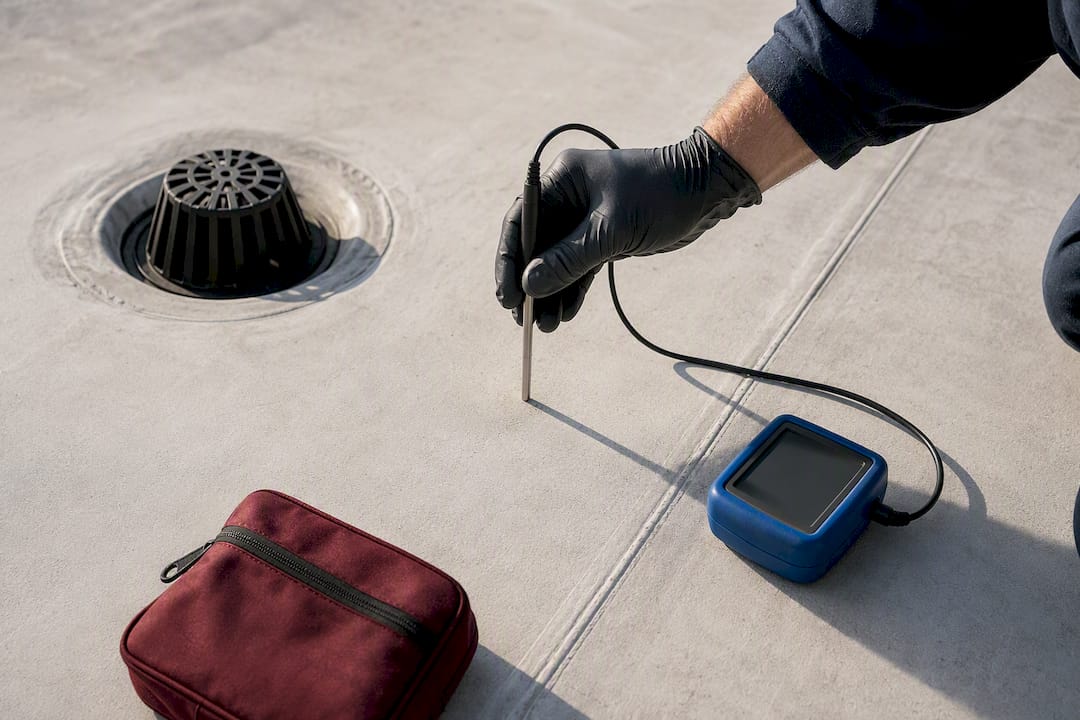
Every inspection starts the same way: a drain flow test, a depth and area measurement at the low point, and a probe check on the insulation underneath to see how much moisture has already soaked in. We check seams near the ponded area too, since that’s usually where early membrane stress shows up first.
Most repair packages fall into one of two categories: a cricket paired with a small tapered panel for isolated problem spots, or a full tapered re-roof when the slope issue runs across the entire field. With more than 30 years serving Connecticut properties as a licensed and insured contractor, we’ve seen both scenarios often enough to size up which one a roof needs within a single visit.
When probing reveals deck softness or visible sagging, we bring in a structural engineer before recommending any fix. Slope problems are a roofing issue. Deflection problems are a structural one, and treating the second as the first just wastes money.
Where Most Ponding Advice Gets It Backward
Most guides treat ponding water like a cosmetic nuisance, something to shrug off until it causes a visible leak. That’s backward. By the time you see a stain on a ceiling, the insulation underneath has likely been saturated for months, and the warranty conversation with the manufacturer is already lost, since ponding exclusions are standard across the industry.
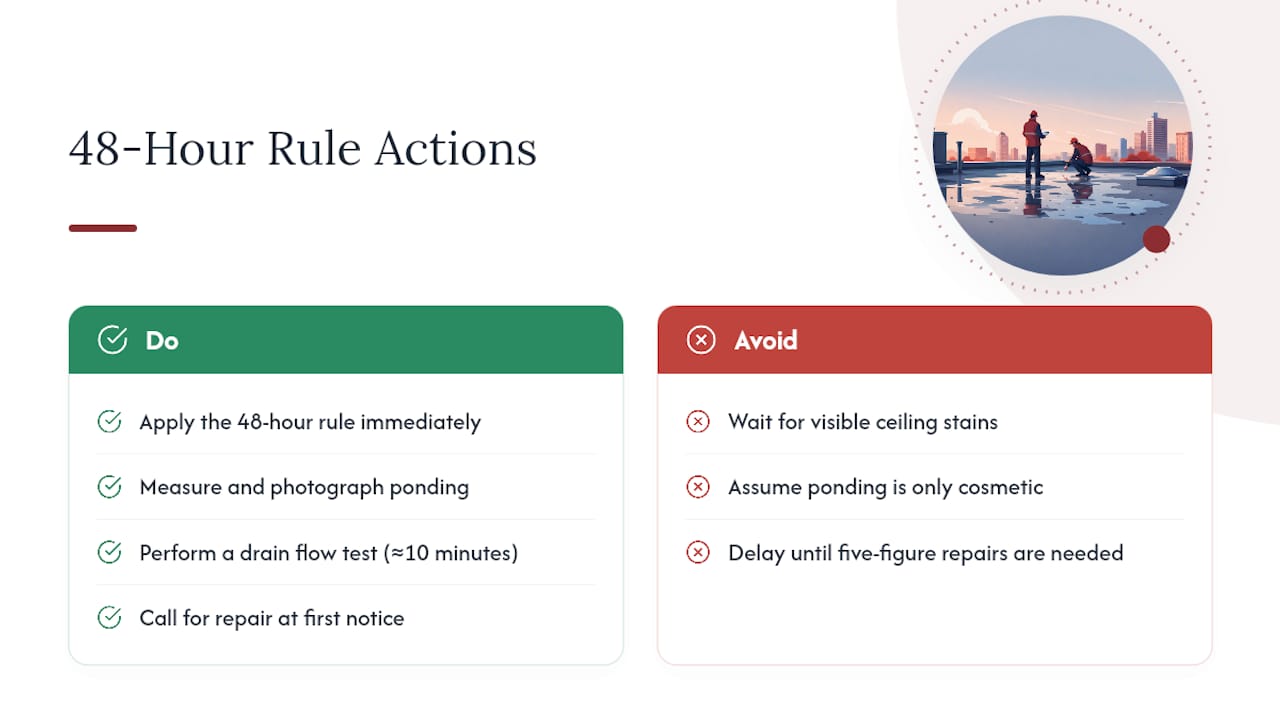
The advice that actually holds up is less exciting: measure, photograph, and act on the 48-hour rule every time, not just when it looks bad. Most owners wait for a leak before calling anyone, and by then the fix has moved from a $1,500 drain addition to a five-figure insulation replacement. The cheapest moment to fix ponding is always the first time you notice it hasn’t drained.
If there’s one thing worth prioritizing above all else, it’s the drain flow test. It costs nothing, takes ten minutes, and catches the single most common cause of ponding before it ever becomes a structural conversation. Slope problems and deck deflection are real, but they’re rarer than a clogged strainer, and no amount of tapered insulation fixes a roof if nobody ever checks the drains.
— Adam
Get a Flat Roof Inspection From J. Signor Exteriors
If you’ve measured standing water past the 48-hour mark, the next move isn’t more guesswork, it’s a professional look at what’s actually driving it. J. Signor Exteriors inspects drains, scuppers, and slope conditions on flat and low-slope roofs throughout Connecticut, then recommends the fix that matches the actual cause, whether that’s a new drain, a cricket and tapered panel, or a full re-roof with corrected slope.

During an inspection, we run the same drain flow test and depth measurement outlined above, check flashing and seams for early stress, and give you a written estimate before any work starts. For roofs where ponding has already reached the membrane or deck, our roofing services cover everything from targeted repairs to full roof replacement with properly tapered insulation. Request an inspection through our roofing contractor page and get a clear answer on what your roof actually needs before another storm rolls through.
Sources
- NRCA guidelines (ponding water reference)
- Ponding water basics — Asphalt Roofing Manufacturers Association (ARMA)
- Flat Roof Report — Ponding water overview
- Ponding Water Flat Roof: 2026 Fix Guide | The Roofing Brief