

Contractor insurance is defined as a stack of multiple insurance policies working together to protect contractors and their clients from financial losses caused by job-site accidents, property damage, and legal liability. No single policy covers every risk a contractor faces. Most contractor insurance packages include 4–7 separate coverages, and small contractor packages typically run $1,800–$8,500 annually. For homeowners and contractors in Connecticut, understanding what is contractor insurance means knowing which policies are required by law, which are required by contract, and what gaps look like when coverage is missing.
What is contractor insurance and what does it actually cover?
Contractor insurance is not one product. It is a coordinated set of policies, each designed to address a specific category of risk that arises during construction and remodeling work. The industry term for the full package is a “contractor insurance program,” and it typically includes General Liability, Workers’ Compensation, Commercial Auto, Inland Marine, and Surety Bonds. Each policy fills a gap the others do not.
Here is what each core coverage does:
- General Liability Insurance: Covers third-party bodily injury and property damage that occurs on or near the job site. If a visitor trips over materials at your home and breaks an arm, General Liability pays the medical and legal costs. Industry standard minimum limits are $1 million per occurrence and $2 million aggregate.
- Workers’ Compensation Insurance: Covers medical bills and lost wages for employees injured on the job. Workers’ Compensation is legally required in 49 states once a contractor hires employees, and Connecticut is no exception.
- Commercial Auto Insurance: Covers vehicles used for business purposes, including trucks hauling materials to your property. Personal auto policies do not cover business use, so this gap is real and common.
- Inland Marine Insurance: Protects tools and equipment in transit and on job sites. Standard property insurance does not cover equipment away from a fixed location, which is exactly where contractor tools spend most of their time.
- Surety Bonds: License bonds and performance bonds guarantee a contractor meets their legal and contractual obligations. Surety license bonds typically cost $100–$500 per year and are often required by state law.
Pro Tip: Ask your contractor to name each policy separately when they share their coverage. A contractor who cannot list their individual policies likely does not have a complete insurance program.
How does contractor insurance work in Connecticut?
Connecticut has specific legal requirements that shape what coverage a contractor must carry before they can legally work on your property. Understanding these rules protects you as a homeowner and keeps contractors compliant.

Workers’ Compensation is mandatory for any contractor with employees in Connecticut. There is no minimum payroll threshold. The moment a contractor hires one employee, the law requires coverage. Contractors who work solo as sole proprietors may be exempt, but they carry personal financial risk if they are injured on your job.
General Liability minimum limits of $1 million per occurrence and $2 million aggregate are the baseline for most commercial projects and many high-value residential jobs. These limits are not set by Connecticut statute for all work, but they are required by most general contractors, property managers, and municipalities before a subcontractor can set foot on a project. Residential homeowners should apply the same standard.
Connecticut contractor licensing also ties directly to insurance. License bonds are commonly required as part of the state licensing process. A bond is not insurance. It is a financial guarantee that the contractor will follow the law and honor their contract. If they do not, the bond pays the affected party, and the contractor must repay the bonding company.
Here is what you should verify before any contractor starts work on your Connecticut property:
- A current Certificate of Insurance (COI) listing all active policies and their coverage limits
- Policy effective and expiration dates that cover the full project timeline
- Your name listed as a certificate holder so you receive notice of any cancellation
- Minimum General Liability limits of $1M/$2M
- Workers’ Compensation coverage if the contractor has employees
Pro Tip: Request the COI directly from the contractor’s insurance agent, not just from the contractor. Agents issue the document, and receiving it from the source confirms it is current and unaltered.
A Certificate of Insurance is the official document proving a contractor’s coverage during the project timeframe. Homeowners who skip this step have no formal proof that coverage existed if a claim arises later.
What factors influence the cost of contractor coverage?
Contractor insurance pricing depends on several measurable factors. Knowing them helps both homeowners evaluate bids and contractors plan their budgets accurately.
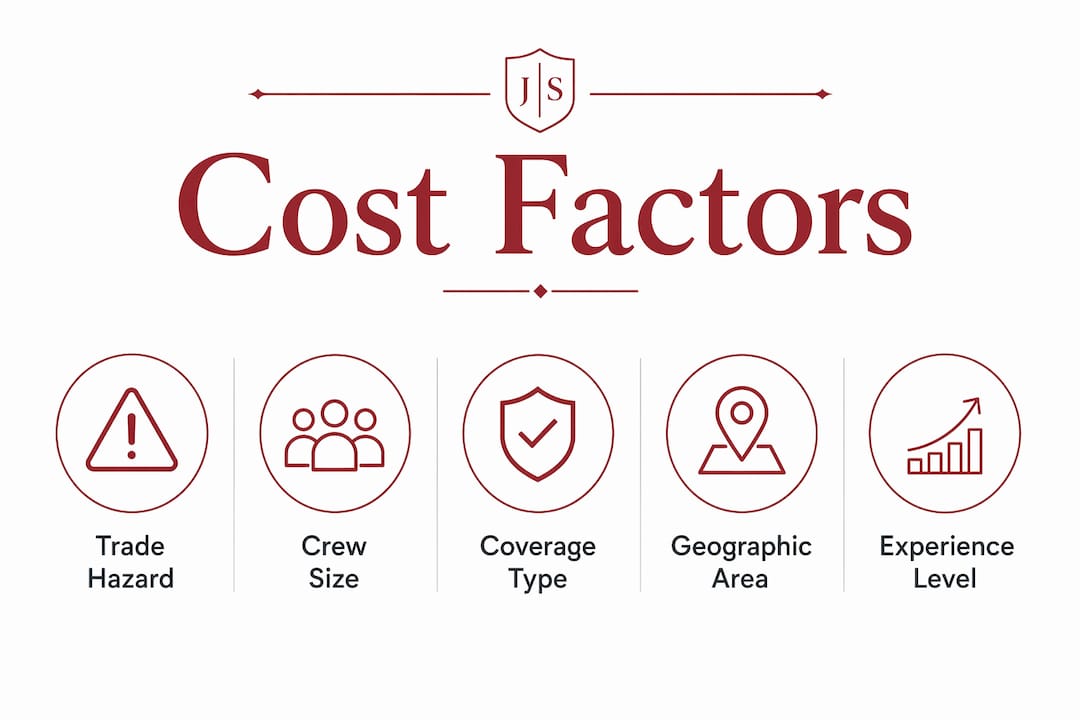
| Factor | How it affects cost |
|---|---|
| Trade hazard level | Roofing and masonry cost more to insure than painting or carpentry |
| Number of employees | Higher payroll increases Workers’ Compensation premiums directly |
| Business vehicles | Each commercial vehicle adds to the Commercial Auto premium |
| Project type | Commercial projects require higher limits and endorsements, raising costs |
| Annual revenue | General Liability premiums often scale with gross revenue |
Insurance carriers price the full contractor program based on the most hazardous work performed, even if that work is a small portion of total revenue. A contractor who does 90% siding and 10% roofing pays roofing rates on their General Liability policy. That is a pricing reality most contractors learn the hard way.
General Liability alone costs small crews approximately $600–$1,800 per year. The full insurance stack for a small Connecticut contractor typically falls in the $1,800–$8,500 range annually, depending on trade, crew size, and vehicle count.
Pro Tip: Contractors who pursue both residential and commercial work need to tell their insurer about both. Hiding commercial work to keep premiums low can void coverage entirely when a claim is filed.
What are the benefits of contractor insurance for homeowners and contractors?
Carrying the right contractor insurance delivers concrete benefits to both sides of a construction project. The protection is not theoretical. It is financial and legal.
For homeowners, the most direct benefit is liability protection. If an uninsured contractor is injured on your property, you could be held responsible for their medical costs under Connecticut premises liability law. Contractors lacking adequate insurance risk bankruptcy from a single major claim. That same financial collapse can leave your project unfinished and your property damaged, with no recourse.
For contractors, insurance is a business qualification tool. Commercial projects, municipal contracts, and many high-value residential jobs require proof of coverage before a contractor can bid. Failing to include project-specific endorsements like “Waiver of Subrogation” or “Primary and Non-Contributory” clauses can disqualify a contractor from a commercial build entirely. Insurance is not just protection. It is a credential.
The practical benefits break down clearly:
- Financial protection: Covers legal defense costs, settlements, and medical bills that would otherwise come out of pocket
- Project eligibility: Meets the insurance requirements that unlock access to larger and commercial contracts
- Homeowner protection: Shields you from liability if a contractor’s employee is hurt on your property
- Business continuity: Keeps a contractor operating after a claim instead of shutting down
- Contractual compliance: Satisfies the insurance clauses in exterior remodel contracts that protect both parties
Insurance is also a signal of professionalism. Contractors who carry complete coverage and can produce a COI on request have invested in their business and their clients. Those who cannot are a financial risk to everyone on the project.
Key takeaways
Contractor insurance is a stack of multiple policies that together protect both contractors and homeowners from financial losses caused by job-site accidents, property damage, and legal liability.
| Point | Details |
|---|---|
| Not a single policy | Contractor insurance programs typically include 4–7 separate coverages working together. |
| Connecticut legal requirements | Workers’ Compensation is mandatory for any contractor with employees in Connecticut. |
| COI verification | Always request a current Certificate of Insurance and ask to be listed as a certificate holder. |
| Cost drivers | Trade hazard level, payroll, vehicles, and project type all directly affect premium costs. |
| Insurance as a credential | Proper coverage qualifies contractors for commercial jobs and protects homeowners from liability. |
What I have learned from 30 years of insured contracting in Connecticut
The most common mistake I see is homeowners assuming that because a contractor shows up with a crew and equipment, they must be insured. That assumption has cost Connecticut homeowners real money. A contractor can be licensed and still carry inadequate coverage, or let a policy lapse mid-project without telling anyone.
The second mistake is contractors treating insurance as a checkbox rather than a business tool. The biggest coverage gap is not a missing policy. It is a policy that does not match the actual work being done. A contractor who adds roofing to their service list without updating their General Liability policy is effectively uninsured for that work.
Here is what I tell every homeowner before a project starts: request the COI before you sign anything. Do not accept a photo of an insurance card or a verbal confirmation. The COI lists the policy numbers, limits, effective dates, and the insurer’s contact information. If a contractor hesitates to provide one, that hesitation is your answer.
For contractors, the advice is equally direct. Your insurance stack should reflect your actual project mix, not your ideal one. If you want to pursue commercial work, get the endorsements commercial clients require before you bid. “Waiver of Subrogation” and “Additional Insured” status are not optional extras on commercial jobs. They are entry requirements.
Insurance is not a cost of doing business. It is the foundation that makes doing business possible.
— Adam
Jsignorexteriors: fully insured Connecticut contracting you can verify
Jsignorexteriors has operated as a fully licensed and insured exterior remodeling contractor in Connecticut for more than 30 years. Every project, from roofing and siding to decks and masonry, is backed by a complete contractor insurance program that meets Connecticut’s legal requirements and the standards of both residential and commercial clients.
When you hire Jsignorexteriors, you can request a current Certificate of Insurance before work begins. The company carries General Liability, Workers’ Compensation, and all required coverages so you are never exposed to liability from an uninsured crew on your property. If you are planning a roofing project, the Connecticut roofing services page outlines what insured, licensed work looks like from start to finish.
FAQ
What is contractor insurance in simple terms?
Contractor insurance is a group of policies that protect contractors and homeowners from financial losses caused by accidents, injuries, and property damage during construction work. No single policy covers all risks, so contractors carry several coverages together.
Is contractor insurance required by law in Connecticut?
Workers’ Compensation is legally required for any Connecticut contractor with employees. General Liability is not always mandated by state law but is required by most commercial contracts and many residential project agreements.
What is a Certificate of Insurance and why does it matter?
A Certificate of Insurance is the official document that proves a contractor’s active coverage, policy limits, and coverage dates. Homeowners should verify the COI before work starts and ask to be listed as a certificate holder to receive cancellation notices.
How much does contractor insurance cost in Connecticut?
Small contractor insurance packages typically range from $1,800–$8,500 per year. General Liability alone costs approximately $600–$1,800 annually for small crews, with total costs varying by trade, crew size, and vehicle count.
What is the difference between a surety bond and contractor insurance?
A surety bond guarantees a contractor will meet their legal and contractual obligations. Insurance pays for covered losses. License bonds protect third parties by guaranteeing compliance, while insurance policies pay claims directly when accidents or damages occur.