
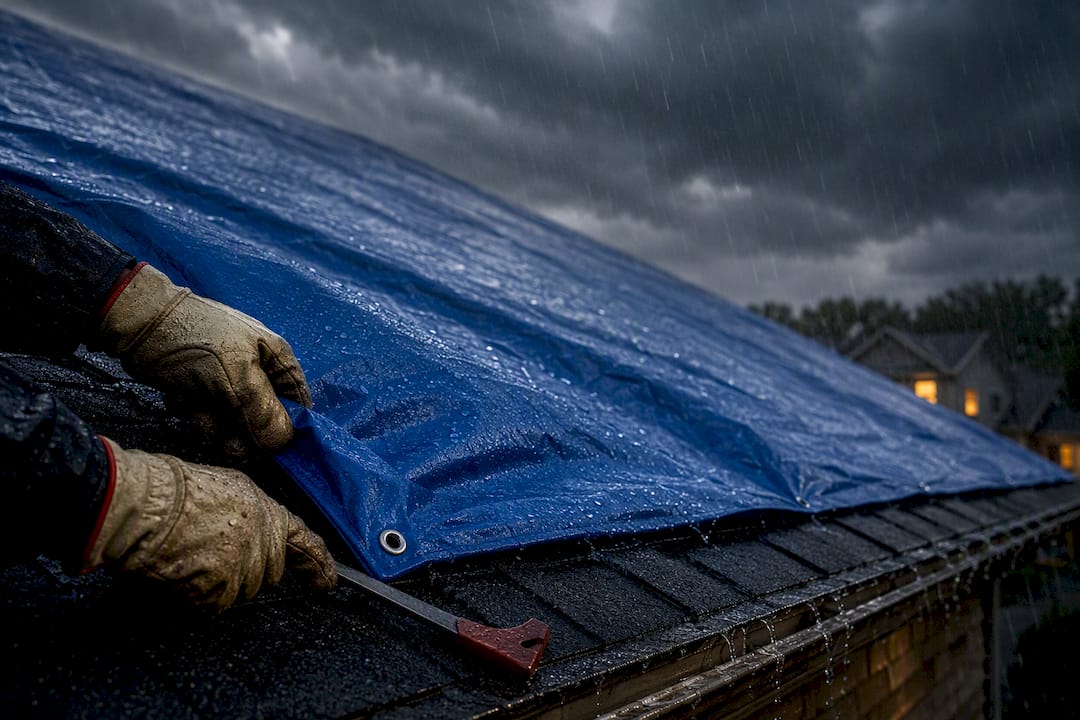
If your roof leak in rain is happening right now, the order of operations is simple: keep everyone away from wet electrical fixtures, then contain the water with buckets and towels to protect your floors and furniture. Only attempt a temporary tarp or wet-patch fix if it’s safe to be on the roof, and treat any exterior work as a stopgap. Permanent repairs have to wait for dry conditions.
TL;DR:
- Most roof leaks during heavy rain are caused by weaknesses in flashing, vents, valleys, or clogged gutters, often hidden from view.
- Immediate safety measures include turning off electrical circuits near leaks and releasing trapped water in the ceiling with a small hole to prevent collapse.
- Temporary tarping can be effective if installed correctly after the roof dries, but it is not a substitute for permanent repairs and must be secured properly to shed water.
- Accurate leak detection involves inspecting the attic for water trails and confirming with a hose test from the roof, working uphill from the stain’s location.
- Calling a professional is essential if structural damage, electrical hazards, or extensive storm damage is present, especially for complex or high-risk roof sections.
Table of Contents
- Why Roofs Leak in Heavy Rain: A Quick Diagnostic Checklist
- What Should You Do First When a Ceiling Leaks During a Storm?
- Can You Tarp a Roof in the Rain?
- How Do You Find Where a Roof Is Actually Leaking?
- When Should You Call a Professional Instead of Fixing It Yourself?
- How Can You Prevent Roof Leaks Before the Next Storm?
- What a Contractor Actually Checks After a Storm
- A Contractor’s Honest Take on Storm Leaks
- Get Emergency Roof Help From a Professional Exterior Contractor
- Sources
- FAQ
Why Roofs Leak in Heavy Rain: A Quick Diagnostic Checklist
Your roof might handle drizzle fine and still fail during a downpour. That’s not bad luck. It’s physics. Light rain runs off the surface quickly, but a heavy volume of water combined with wind pressure pushes against seams, laps, and fasteners that were never meant to hold back standing or driven water. A roof that’s marginal in a dozen small spots can look perfectly fine for years, then suddenly leak during the first real storm of the season.
Wind-driven rain is especially good at finding weaknesses because it forces water sideways and upward, under shingle edges and into gaps that gravity alone would never reach. Roofing systems shed rain in layers, and when one layer is compromised, water can travel along the decking for several feet before it ever shows up as a stain on your ceiling, according to The Roofing Brief’s guide to fixing roof leaks.
The usual suspects during a storm include:
- Flashing around chimneys, walls, and roof transitions, where metal seals can crack or pull loose
- Vent pipe boots, the rubber collars around plumbing stacks, which dry out and split with age
- Skylight perimeters, where the seal between glass and roof deck is a common failure point
- Valleys, the V-shaped channels where two roof slopes meet and water volume concentrates
- Clogged gutters that back up and force water under the shingle edge instead of away from the house
- Nail pops and exposed fasteners that create tiny entry points invisible from the ground
Hail bruising and lifted or torn shingles point to storm damage specifically. Granule loss, curling, and gradual sealant failure point to age and neglected maintenance instead. Knowing the difference matters for your insurance claim, since one is often covered and the other usually isn’t.
What Should You Do First When a Ceiling Leaks During a Storm?
Your first move has nothing to do with the roof. It’s about keeping people safe inside the house. Water and electricity are a dangerous combination, and a leak near a light fixture, ceiling fan, or outlet is not a “wait and see” situation.
Here’s the priority order:
- Cut power to affected circuits at the breaker panel if water is near any electrical fixture, and stay off wet floors near outlets until you do.
- Contain the water with buckets, towels, and a tarp over furniture or flooring you can’t move.
- Relieve pressure on a bulging ceiling by carefully poking a small hole at the center of the bulge with a screwdriver, directing the trapped water into a bucket below. A controlled release like this reduces the chance of a full ceiling collapse, according to Severe Storm Restorations’ homeowner checklist.
- Move valuables and electronics away from the drip zone, even if that means relocating them to another room temporarily.
- Photograph and log everything as it happens: the ceiling stain, the bucket catching water, a timestamp, and a note about the weather conditions outside.
Pro Tip: Text yourself a quick note with the date, time, and rainfall intensity the moment you notice the leak. That small habit gives your insurance adjuster a timeline that’s far more convincing than a memory reconstructed a week later.
Standing water left in insulation or drywall doesn’t stay harmless for long. The EPA’s mold guidance notes that mold can begin colonizing wet building materials within a day or two, which is exactly why drying out the affected area fast matters as much as stopping the drip itself. If you’re dealing with missing or torn shingles as part of the leak, our guide on handling missing shingle repair walks through what’s safe to address yourself.
Can You Tarp a Roof in the Rain?
You can, but only if it’s safe to be up there, and “safe” rules out most active storms. Wet shingles are slippery, wind gusts make ladder work dangerous, and lightning turns a roof into the worst possible place to stand. If the storm has genuinely passed and the roof has dried enough for solid footing, a properly installed tarp is one of the most effective temporary fixes available.
The technique matters more than the material. A tarp laid flat over a leak without securing the upslope edge usually routes water underneath it instead of over it, according to The Home Depot’s roof tarping guide. Do it right instead:
- Use a heavy 8 mil poly tarp, large enough to extend at least 4 feet past the damaged area on every side
- Roll the upslope edge around a 2×4 board so it won’t fold or fill with wind
- Slip that rolled edge under the shingle course above the leak, creating a seal that sheds water rather than trapping it
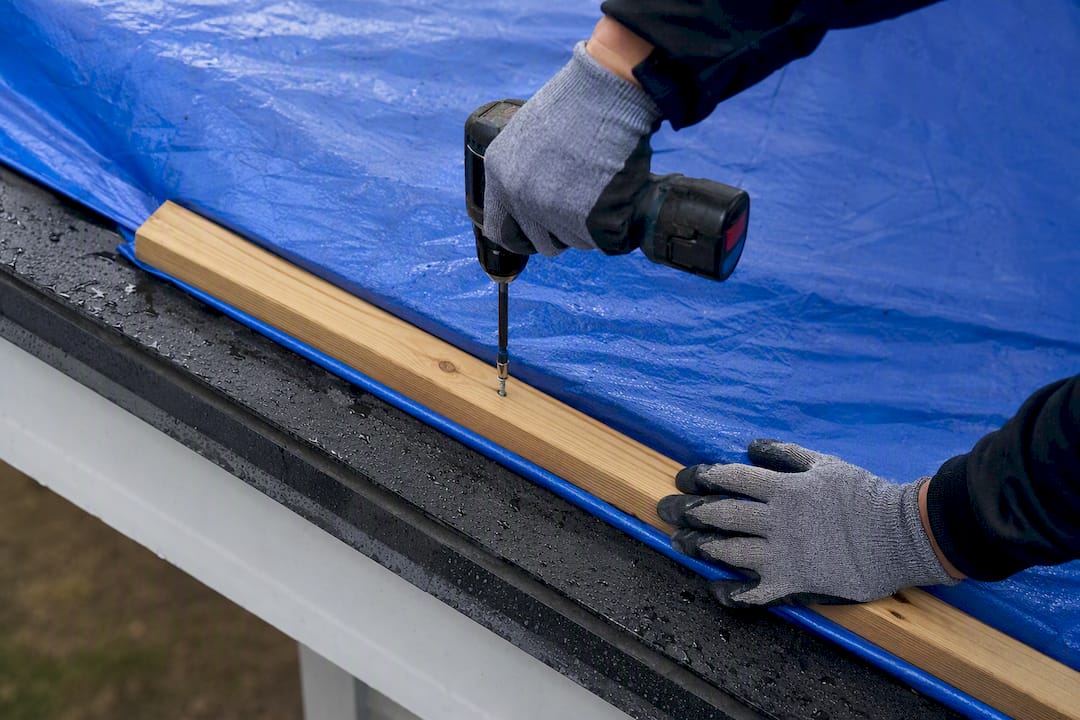
- Secure the tarp’s edges with furring strips screwed into the roof deck, never with nails punched straight through the tarp itself
For interior drips that need an immediate stop while you wait for the roof to dry, an emergency wet-patch compound like Henry 208R can seal an active leak from below or around a penetration. It’s a genuine short-term fix, not a repair. Permanent roofing work, including new sealant or shingle replacement, needs dry conditions and typically won’t hold properly until 24 to 48 hours after the rain stops, per Henry’s product guidance.
Pro Tip: A quality tarp, installed correctly, can protect a roof for weeks. But UV exposure breaks poly tarps down fast, so treat any temporary cover as a countdown clock, not a fix. Schedule the permanent repair while the tarp is still holding, not after it fails.
If the damage is extensive, on a steep pitch, or above the second story, hire an emergency tarping service rather than climbing up yourself. The cost of a professional tarp job is small compared to a fall.
How Do You Find Where a Roof Is Actually Leaking?
Chasing the ceiling stain almost never leads you to the actual hole. Water travels downhill along rafters and decking before it drips, so the wet spot on your ceiling is often several feet away from where the water actually got in.
Here’s the tracing process pros rely on:
- Check the attic during or right after the rain, following any wet streak or dark trail on the underside of the decking uphill, toward the roof ridge rather than toward the eave.
- Mark the suspected entry point with chalk or drive a small screw through the deck at that spot so you can find it again from the roof side.
- Measure from a fixed rooftop reference point, like a chimney or vent stack, so you can pinpoint the mark’s exact location once you’re outside.
- Inspect everything uphill of the wet mark, especially flashing, valleys, and any roof penetration, since the actual breach is rarely directly above the stain.
- Run the hose test on a dry day. Have a helper stay in the attic while you run water over one section at a time, starting at the lowest suspect area and working upward, letting each zone soak for several minutes before moving on. This reproduces storm conditions and lets you watch the leak happen in real time, a method detailed by The Roofing Brief.
If your roof has a flat or low-slope section, ponding water adds another variable worth understanding separately. Our breakdown of flat roof ponding water and drying timelines covers that scenario in more detail.
When Should You Call a Professional Instead of Fixing It Yourself?
Some situations don’t leave room for a DIY attempt. Call a licensed roofer immediately if the leak is near any electrical panel or fixture, if you can see exposed or sagging roof decking, if a ceiling section is bulging significantly, or if you’re simply unsure whether the roof structure is sound enough to walk on.
A professional inspection covers ground a homeowner usually can’t from the ground or a quick attic peek:
- Attic moisture levels and insulation saturation
- Flashing condition at every chimney, wall, and roof transition
- Underlayment and decking integrity beneath the shingles
- Gutter and drainage function across the whole roofline
That level of detail matters for your insurance claim. Adjusters weigh documented specifics like granule loss in the gutters, dented metal flashing, or attic moisture readings far more heavily than a homeowner’s general description of “the roof is leaking,” according to GAF’s guide to storm damage inspection. Photograph everything before cleanup, save every receipt for emergency tarps or wet-patch materials, and call your insurance agent before you sign any repair contract. If you’re trying to gauge whether a quoted repair price is reasonable, our guide on what counts as a fair roof repair price is a useful reference point before you commit.
How Can You Prevent Roof Leaks Before the Next Storm?
Most emergency leaks trace back to something that was fixable months earlier for a fraction of the cost. Prevention isn’t glamorous, but it’s cheap compared to a ceiling repair and mold remediation after a missed storm season.
A few habits pay for themselves:
- Clean gutters and valleys at least twice a year, and more often if you have overhanging trees
- Trim back branches that scrape the roof surface or dump extra debris into valleys and gutters
- Inspect flashing after any high-wind event or hailstorm, even if you don’t see an active leak yet
- Watch for granule loss, curling, or creasing across the shingle field, which signals a section nearing the end of its service life
- Replace vent pipe boots on a proactive schedule rather than waiting for the rubber to crack
Poor yard drainage can also push water back toward your foundation and soffits during heavy rain, which is worth addressing alongside your roof. Trewlandscape’s stormwater drainage guidance covers grading and drainage fixes that reduce that kind of water pressure around your home.
Pro Tip: Schedule a roof inspection every spring and fall, before the heavy rain and winter storm seasons hit. A $150 to $300 inspection that catches a failing flashing seal is a lot cheaper than the ceiling repair, insulation replacement, and mold remediation that follow a missed one. For a full seasonal breakdown, see our preventive roof maintenance guide.
What a Contractor Actually Checks After a Storm
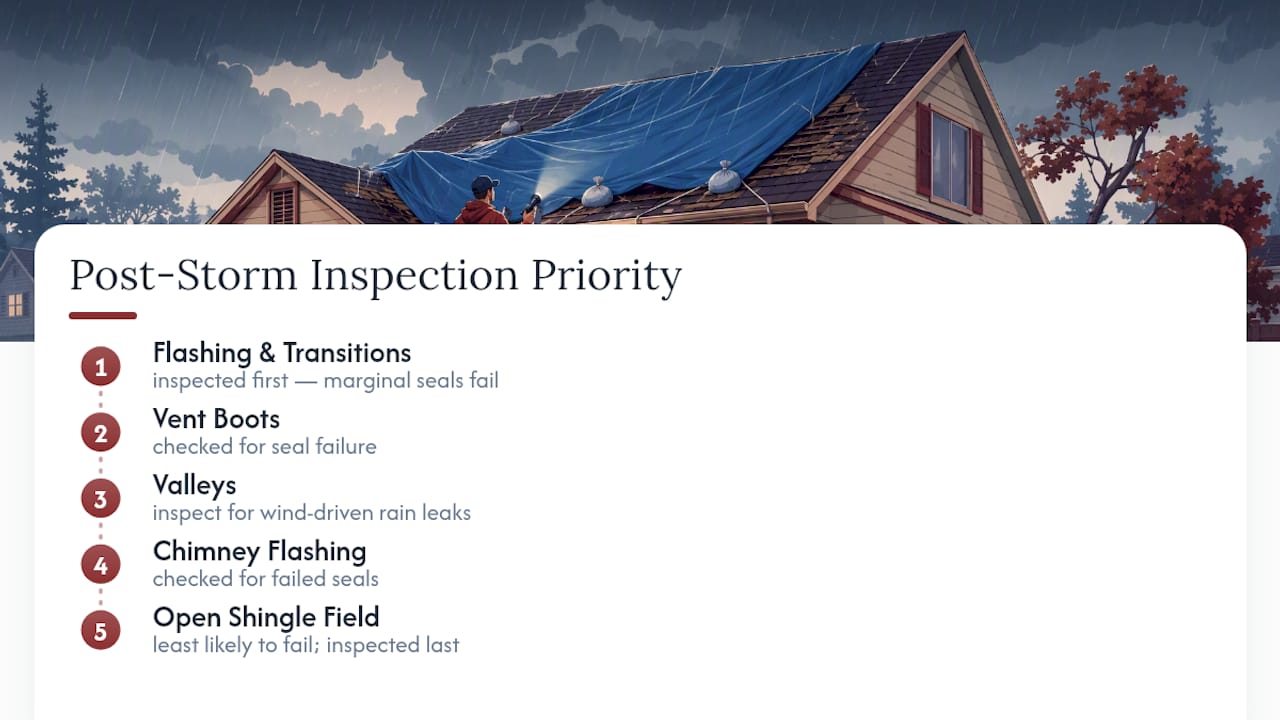
When our crews respond to a storm-damage call, flashing and roof transitions get inspected first, since they fail more often than the open shingle field ever does. We look at vent boots, valleys, and chimney flashing before anything else, because that’s where marginal seals give out under wind-driven rain.
Our emergency tarps use furring strips screwed into the decking, never nails through the tarp itself, and a properly installed tarp holds through the following weeks of weather while the permanent repair gets scheduled. Every inspection comes with photo documentation and a written report your insurance adjuster can use directly.
A Contractor’s Honest Take on Storm Leaks
Most homeowners lose time deciding whether a leak is “bad enough” to call someone. That hesitation is the real damage multiplier, not the storm itself. Mold sets in fast, wood rots quietly, and a same-day fix turns into a multi-room repair. Move fast on safety and documentation, use temporary measures only when it’s genuinely safe, and don’t be afraid to call a professional the moment the situation feels beyond a bucket and a tarp.
— Adam
Get Emergency Roof Help From a Professional Exterior Contractor
An experienced exterior contractor can help you with storm-damaged roofs by providing emergency tarping done with proper technique, supported by written inspection reports that your insurance company can use.

When our crews tarp a roof, we document the damage with photos before we touch anything, then follow up with a detailed inspection covering the flashing, decking, and gutters, so you walk into your insurance conversation with real evidence instead of a verbal description. As a family-owned, fully licensed and insured contractor, we aim to get your home protected fast and your permanent repair scheduled without the runaround. If you’re dealing with an active leak or storm damage right now, request an inspection through our roofing services page and we’ll get a crew out to assess the damage and give you a written estimate.
Sources
- Henry Wet Patch product page (Henry 208R) — Walmart listing
- EPA – Mold course, Chapter 2
- How to tarp a roof — The Home Depot guide
- GAF — Understanding roof storm damage: causes, signs, how to inspect and next steps
FAQ
Can you fix a leaking roof while it’s raining?
You can apply temporary measures like a wet-patch compound from inside, but permanent repairs need dry conditions, generally 24 to 48 hours after the rain ends, for proper bonding.
Is it normal for a roof to leak in heavy rain but not light rain?
Yes. Heavy rain and wind-driven rain expose marginal flashing, seals, and drainage issues that light rain simply doesn’t test, which is why a roof can seem fine for years and suddenly leak during a major storm.
Does homeowners insurance cover roof leaks from rain?
Coverage usually depends on the cause. Sudden storm or wind damage is typically covered, while leaks traced to long-term neglect or lack of maintenance are usually not, so documentation and a contractor’s inspection report matter for your claim.
How expensive is it to fix a leaky roof?
Costs vary widely depending on the cause and extent of damage, from a simple flashing reseal to full section replacement. Jsignorexteriors provides written estimates after an on-site inspection, and current pricing details are available through our roofing services page.
What’s the fastest way to find where a roof is actually leaking?
Check the attic during or right after rain and trace wet streaks uphill toward the ridge, then confirm the spot with a hose test on a dry day, working from the lowest suspect area upward while someone watches from inside.