
Adopt a documented Planned Preventative Maintenance (PPM) program, run it through a Computerized Maintenance Management System (CMMS), and anchor it to a seasonal calendar with a funded maintenance reserve. That single decision separates properties that hold value from those that drain budgets on emergency repairs. Preventive maintenance returns roughly 4–7x compared with reactive repair costs when scheduled and executed consistently, and deferred maintenance incidents can cost thousands of dollars per event before turnover costs are added.
Start here, today:
- Schedule spring and fall system service for HVAC, roof, and gutters before the seasons change.
- Build an asset inventory with a criticality ranking so you know which systems get monthly attention versus quarterly checks.
- Create one recurring CMMS task this week, even if it is just an HVAC filter change or smoke detector battery check, to establish the habit of scheduled work orders.
A documented PPM program does three things at once: it cuts emergency spend, protects long-term asset value, and creates the paper trail you need for insurance claims, capital planning, and tenant disputes.
Key Takeaways
A documented PPM program tied to a CMMS, a seasonal calendar, and a funded maintenance reserve is the single most effective way to reduce total cost of ownership and protect commercial property value over time.
| Point | Details |
|---|---|
| Start with PPM, not reactive repairs | Preventive maintenance returns 4–7x compared with reactive repair costs when scheduled consistently. |
| Use a seasonal calendar | Spring and fall heavy-service rounds plus quarterly checks catch the highest-risk failures before they become emergencies. |
| Document everything with photos | Timestamped logs and before/after photos protect you in insurance claims, tenant disputes, and capital planning reviews. |
| Track KPIs in a CMMS | PM completion rate, response time, and cost per asset are the three metrics that tell you whether your program is working. |
| Jsignorexteriors for exterior PPM | Connecticut commercial property managers can schedule roof, gutter, and siding inspections as recurring seasonal PMs through Jsignorexteriors. |
Table of Contents
- Business property maintenance best practices start with a PPM framework
- A seasonal maintenance calendar you can put to work immediately
- How to run inspections and build documentation that actually protects you
- Work-order management and what to require from a CMMS
- How to source, vet, and manage vendors without losing control
- Budgeting, KPIs, and linking maintenance to capital planning
- Emergency response and safety compliance you cannot defer
- Move-out and move-in best practices that protect your property and your tenants
- Technology and sustainability measures worth piloting now
- What RICS guidance on PPM means for U.S. property teams
- A 90-day implementation plan to move from reactive to scheduled maintenance
- Jsignorexteriors supports your commercial exterior maintenance program
- Sources
Business property maintenance best practices start with a PPM framework
The most damaging misconception in commercial property maintenance is treating upkeep as a series of one-off tasks. The moment a repair feels like a surprise, the program has already failed. A Planned Preventative Maintenance program flips that logic: you schedule inspections and service before failure, not after.
PPM vs. reactive maintenance comes down to timing and cost. Reactive maintenance means you fix something after it breaks. PPM means you service it on a calendar before it breaks. The cost difference is not marginal. Well-run commercial maintenance programs that integrate preventive scheduling, vendor consolidation, and digital systems can reduce operating expenses by 25–40% across portfolios.
Total Cost of Ownership (TCO) is the right lens for every maintenance decision. A $300 HVAC service call in April costs far less than a $12,000 compressor replacement in August. When you optimize for TCO rather than the lowest upfront price, you make different decisions about service frequency, material quality, and contractor selection.
Asset inventory and criticality ranking tells you where to concentrate effort. Not every system deserves the same attention. Life-safety systems (fire alarms, sprinklers, emergency lighting) and revenue-critical systems (HVAC, roof, plumbing) sit at the top. Landscaping and interior paint sit lower. Rank every asset by consequence of failure, then assign service frequencies accordingly.
Statistic: Operators who apply proactive maintenance schedules report 30–40% lower annual repair costs than those running reactive operations.
Pro Tip: When building your criticality ranking, ask one question for each asset: “If this fails on a Tuesday afternoon, what happens to tenants and revenue?” Systems where the answer is “immediate disruption” belong in your top tier.
A seasonal maintenance calendar you can put to work immediately
A spring and fall heavy-service round, paired with a lighter quarterly cadence, is the recommended pattern for catching high-risk repairs before failure. The table below maps core commercial systems to frequency and season.
System-level notes:
- HVAC: Replace filters monthly in high-occupancy buildings; quarterly in low-traffic spaces. Service coils, belts, and refrigerant levels every spring before cooling season and every fall before heating season.
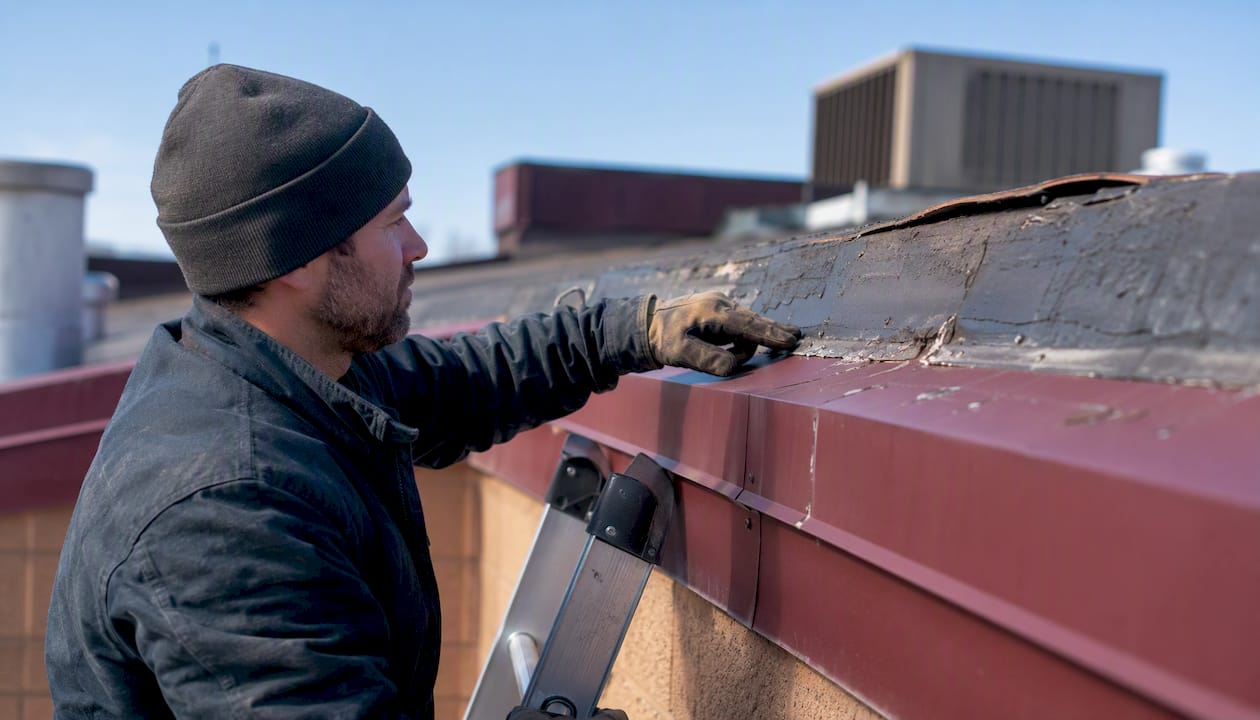
- Roofing: Walk the roof after every major storm to check for lifted flashing, pooling water, or displaced membrane. A professional roof survey every fall is the single highest-value inspection on most commercial buildings. Understanding why commercial roofs fail prematurely helps you know exactly what to look for.
- Gutters: Clogged gutters cause fascia rot, foundation seepage, and interior water damage. Clean twice yearly minimum; three times in heavy-canopy locations.
- Life-safety: Monthly detector tests and quarterly extinguisher checks are the floor, not the ceiling.
Climate and building-age adjustments: Coastal properties face accelerated corrosion on metal components and need more frequent exterior inspections. Freeze-prone climates require fall pipe insulation checks and spring thaw inspections for any cracking or heaving. Buildings over 30 years old should step up roof and plumbing inspection frequency by one tier across the board.
How to run inspections and build documentation that actually protects you
A completed inspection is only as useful as the record it leaves behind. Undocumented inspections do not exist in an insurance claim or a capital planning meeting.
Minimum log fields for every inspection:
- Date and time of inspection
- Inspector name and role
- Building location and specific area (e.g., “Roof, northwest quadrant”)
- Asset or system inspected
- Condition rating (Good / Fair / Needs Attention / Urgent)
- Immediate action required (Yes/No, and what)
- Estimated repair cost
- Invoice reference number (once work is completed)
- Photo file names or links
Photo standards that hold up under scrutiny:
- Frame the full system first, then close-up on the defect.
- Include a scale reference (a tape measure, a coin, or a hand) in close-up shots.
- Timestamp every photo through your phone or camera settings.
- Take a “reference shot” from a fixed point (a door, a corner) so future inspectors can match the angle exactly.
- Always shoot before and after any repair.
Documented maintenance logs with photos and invoices protect you in three specific situations: insurance claims (proof of pre-loss condition), capital planning (evidence for CapEx requests), and tenant disputes (timestamped condition records at move-in and move-out). A sample PPM schedule log might look like this:
Store logs in a cloud-based system with access controls. Paper binders in a maintenance closet are not a documentation strategy.
Work-order management and what to require from a CMMS
A work order is the unit of accountability in any maintenance program. Without a formal work-order workflow, tasks get lost, costs go untracked, and KPIs become guesswork.
The minimum work-order lifecycle:
- Request received (tenant portal, staff report, or automated sensor alert)
- Triage and priority assigned (Emergency / Urgent / Routine / Planned)
- Assigned to technician or vendor
- Work performed
- Closed with photos, invoice, and completion notes
- KPI entry (actual vs. estimated cost, response time, vendor rating)
Moving from spreadsheets to a CMMS produces measurable gains in efficiency, reporting accuracy, and cost control. When evaluating platforms, require these features:
- PM scheduling with recurring task templates
- Asset register with location, age, warranty, and service history
- Mobile app for field technicians (photo upload, close-out on-site)
- Vendor portal for work-order assignment and invoice submission
- Automated reminders for upcoming PMs and overdue tasks
- Reporting dashboard with KPI tracking (PM completion rate, response time, cost per asset)
- API or integration capability with accounting software
The CMMS enforces compliance by making it impossible to “forget” a scheduled task. It also simplifies seasonal scheduling: configure spring and fall PM templates once, and the system generates the work orders automatically each year. For CapEx forecasting, the asset register and service history give you the data to project when major replacements are coming.
Pro Tip: Build PM templates directly from OEM service manuals and local climate requirements. An HVAC manufacturer’s recommended service interval is the floor; a Connecticut winter may push you to service heating systems more frequently than the manual suggests.
How to source, vet, and manage vendors without losing control
Your vendor network is the execution layer of your maintenance program. A weak vendor relationship costs more than a higher hourly rate.
Vendor qualification checklist before awarding any work:
- Current contractor’s license verified with the state licensing board
- General liability and workers’ compensation insurance certificates on file (name your entity as additional insured)
- Minimum three references from comparable commercial properties
- Written response-time SLA for emergency and routine calls
- Clear written scope of work before any project starts
- Invoice terms and warranty language agreed in writing
Understanding commercial contractor licensing requirements in your state is the first filter. A contractor who cannot produce a current license and insurance certificate should not be on your approved vendor list, regardless of price.
Questions that surface hidden costs during bidding:
- What is included in the base price, and what triggers a change order?
- Who supplies materials, and what is the markup?
- What is the warranty on labor, and how are warranty calls handled?
- What is your typical crew size for this scope?
Vendor performance scoring keeps your roster honest. After each completed work order, rate the vendor on response time, quality, and invoice accuracy. Review scores quarterly. Vendors who consistently score below your threshold get a performance conversation before they get replaced.
On consolidation: a single vendor handling HVAC, plumbing, and electrical is convenient but creates dependency. Keep specialized contractors for complex systems and use a generalist for routine tasks. The right balance depends on your portfolio size and the complexity of your assets. For contract negotiation guidance, how to negotiate a commercial contractor contract covers the key terms to protect yourself on scope, price, and warranty.
Budgeting, KPIs, and linking maintenance to capital planning
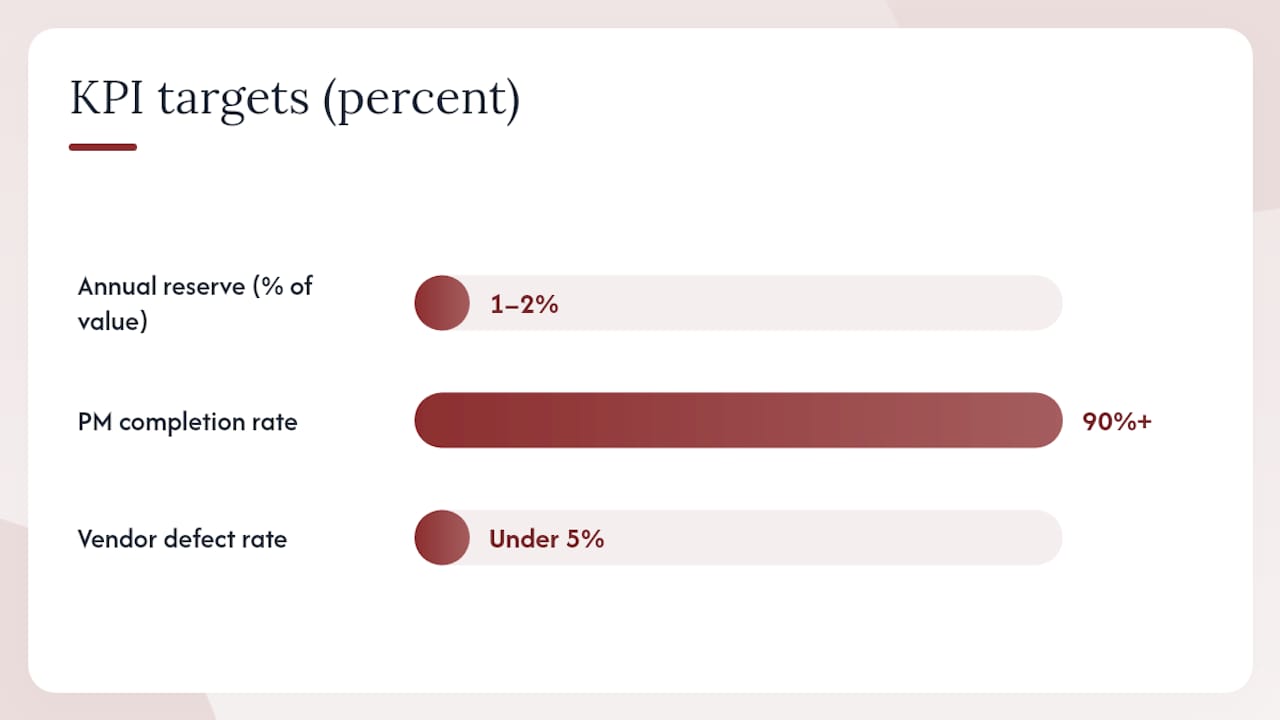
Budget rules of thumb give you a starting point, not a ceiling. The standard guidance is to reserve 1–2% of property value annually for maintenance and repairs. A $2 million commercial building should carry a $20,000–$40,000 annual maintenance budget. Older buildings and those with deferred maintenance backlogs should sit at the higher end or above it.
Structure your budget with a 60/40 split: roughly 60% allocated to predictable, scheduled PM costs and 40% held for reactive and unplanned repairs. Fund a separate capital reserve for major replacements (roof, HVAC, parking lot) on a 5–10 year horizon. Exterior work affects TCO and long-term asset value in ways that show up clearly in a CapEx model.
Core KPIs every property manager should track:
| KPI | What It Measures | Target Benchmark |
|---|---|---|
| PM completion rate | % of scheduled PMs completed on time | 90%+ |
| Mean time to repair (MTTR) | Average hours from work-order open to close | Varies by priority tier |
| Response time | Time from request to technician on-site | Emergency: 2–4 hrs; Routine: 24–48 hrs |
| Cost per square foot | Total maintenance spend divided by rentable area | Compare to IFMA benchmarks |
| Cost per asset | Maintenance spend per major asset | Tracks lifecycle cost |
| Vendor defect rate | % of completed work orders requiring a callback | Under 5% |
IFMA’s North America benchmarking report provides operational metrics that let you compare your cost per square foot against peer portfolios. That comparison is how you know whether your program is performing or just busy.
Converting maintenance logs into a CapEx plan is straightforward once your CMMS has 12–18 months of data. Pull the service history for each major asset, note the age and remaining warranty, and flag anything with a repair cost that has exceeded 30% of replacement value in the past two years. Those assets belong in your 5-year CapEx forecast. Warranty tracking matters here: a repair performed outside warranty terms is a cost you should have avoided.
Emergency response and safety compliance you cannot defer
Life-safety failures are not a maintenance category. They are a liability. When something goes wrong, the response sequence matters as much as the repair.
Emergency response flow:
- Step 1: Secure life-safety. Evacuate if needed. Shut off utilities only if trained and safe to do so.
- Step 2: Isolate the hazard. Contain the affected area. Post signage. Restrict access.
- Step 3: Engage your vendor. Call your emergency-tier contractor. Confirm ETA and scope.
- Step 4: Document immediately. Photograph the scene before any work begins. Note the time, conditions, and who was notified.
- Step 5: Notify stakeholders. Inform tenants, ownership, and your insurance carrier within the timeframes your policy requires.
Life-safety compliance checklist with minimum frequencies:
- Fire alarm system: monthly test of detectors and pull stations; annual full inspection by a licensed fire protection contractor
- Sprinkler system: quarterly visual inspection; annual flow test per NFPA 25
- Exit and emergency lighting: monthly 30-second function test; annual 90-minute full-duration test
- Fire extinguishers: monthly visual inspection; annual service by a certified technician
- Backup generators: monthly load test; annual full-load test with fuel system inspection
- Carbon monoxide detectors: monthly test; replace per manufacturer interval
Document every emergency response in your CMMS with photos, vendor invoices, and a written incident summary. That file is what your insurance carrier and the Authority Having Jurisdiction (AHJ) will ask for during an audit. Missing documentation is treated the same as missing maintenance.
Move-out and move-in best practices that protect your property and your tenants
Turnover is where deferred maintenance becomes visible and expensive. A structured punch list at every move-out prevents disputes and speeds the unit back to market.
Turnover punch list:
- Deep clean all surfaces, including HVAC vents and light fixtures
- Re-caulk around tubs, sinks, and windows where sealant has cracked or separated
- Test all smoke and CO detectors; replace batteries or units as needed
- Test all GFCIs and replace any that fail
- Service HVAC if the unit is within 60 days of its scheduled PM date
- Photograph every room from a fixed reference point before and after cleaning
- Re-key locks where required by lease terms or local ordinance
- Check and document any damage beyond normal wear and tear with timestamped photos
Tenant communication best practices:
- Acknowledge maintenance requests within 24 hours, even if the repair takes longer.
- Provide 24–48 hours’ written notice before vendor entry for non-emergency work.
- Share your seasonal PM calendar with tenants at lease signing so they know when HVAC service, gutter cleaning, and exterior inspections are scheduled. Tenants who understand the program cooperate with access requests instead of blocking them.
Budget $500–$2,000 per unit for a standard commercial turnover, depending on size and condition. Feed turnover findings back into your PM calendar: if every move-out reveals the same caulking failure, that item belongs on your annual PM list.
Technology and sustainability measures worth piloting now
You do not need a full IoT deployment to start capturing predictive maintenance benefits. A small pilot on your highest-criticality asset proves the concept before you commit budget.
A practical IoT pilot for HVAC:
Install vibration and temperature sensors on your largest rooftop unit. Connect them to a cloud monitoring platform that sends an anomaly alert when readings drift outside baseline. Practitioners report that predictive maintenance can flag imminent failures 7–14 days early, enabling condition-based service calls instead of emergency replacements. The pilot cost is a fraction of one emergency compressor swap.
Energy management tasks your maintenance team can own:
- Commission HVAC controls annually to verify setpoints match occupancy schedules
- Replace T12 and T8 fluorescent fixtures with LED during routine electrical PM rounds
- Inspect building envelope (windows, doors, roof penetrations) for air leakage every spring
- Install programmable or smart thermostats in zones with variable occupancy
Technology adoption checklist:
- Define one measurable outcome before the pilot starts (e.g., reduce HVAC emergency calls by 50% in 12 months)
- Choose one asset or one building, not the whole portfolio
- Assign one person to own the data and act on alerts
- Review results at 90 days before expanding
Pro Tip: Pair any new sensor or monitoring tool with a clear escalation rule: “If this alert fires, who does what within how many hours?” A sensor that generates alerts nobody acts on is worse than no sensor at all.
What RICS guidance on PPM means for U.S. property teams
The Royal Institution of Chartered Surveyors (RICS) publishes one of the most widely referenced frameworks for planned preventative maintenance, and its principles translate directly to U.S. commercial property operations.
RICS PPM guidance establishes that PPM programs should cover 5–10 year maintenance periods, be regularly reviewed, and be prepared by competent practitioners who can define scope and recommend specialist investigation where needed. That 5–10 year horizon is the planning window your CapEx model should match.
Practical steps RICS recommends that U.S. managers can adopt directly:
- Begin with a clear client instruction that defines the scope, budget parameters, and intended use of the PPM survey.
- Plan access carefully before the survey date. Inaccessible areas (concealed roof spaces, locked plant rooms) must be documented as such, with a note on the mitigation or the risk of not inspecting them.
- Where a system is beyond the competence of the surveyor, escalate to a specialist. A general property manager should not be making structural or fire-suppression compliance calls without qualified backup.
Review cadence matters. A PPM program written in 2022 and never updated does not reflect current asset conditions, new tenants, or code changes. RICS recommends regular review; in practice, an annual review of the program and a full survey update every three to five years is a reasonable standard for most commercial assets.
Pro Tip: When a RICS-style PPM survey flags a concealed system as “not inspected,” treat that as a risk item in your budget, not a blank line. Set aside a contingency for the day that system becomes accessible and needs attention.
A 90-day implementation plan to move from reactive to scheduled maintenance
Getting a baseline PM program running does not require months of planning. Six focused steps over 90 days get you from a reactive posture to a functioning scheduled program.
-
Weeks 1–2: Build your asset inventory. Walk every building and list every major system and piece of equipment. Record age, manufacturer, model, warranty status, and last known service date. Assign a criticality tier (Critical / Important / Routine) to each asset.
-
Weeks 3–4: Set up your CMMS baseline. Enter your asset inventory into the CMMS. Create location records for each building and floor. Configure user accounts for your team and key vendors.
-
Weeks 5–6: Schedule spring and fall PMs. Using the seasonal calendar from this guide, create recurring PM work orders for every critical and important asset. Assign vendors or internal staff. Set automated reminders 30 days before each due date.
-
Weeks 7–8: Onboard vendors and build PM templates. Confirm your vendor roster, collect current insurance certificates, and agree on response-time SLAs in writing. Build PM templates in the CMMS tied to OEM recommendations for each major system.
-
Weeks 9–10: Train your team. Walk every staff member through the work-order workflow: how to open a request, how to close a task with photos and an invoice, and how to escalate an emergency. Run one practice drill on the emergency response flow.
-
Weeks 11–12: Run your first PM audit. Pull a CMMS report on all PMs due in the past 30 days. Check completion rates, actual vs. estimated costs, and any overdue items. Identify gaps and adjust frequencies or assignments before the next cycle.
Deliverables at day 90: a complete asset register with criticality rankings, a CMMS with recurring PMs for all critical systems, confirmed seasonal bookings for spring service, and a maintenance reserves proposal for ownership review.
What contractors see that property managers often miss
After decades of working on commercial exteriors, a pattern shows up repeatedly: the repairs that cost the most are almost never the ones that were unforeseeable. They are the ones that were noticed and deferred. A small flashing separation that gets photographed and filed away becomes a $15,000 interior water damage claim 18 months later. A gutter that “just needs cleaning” backs up, saturates the fascia, and requires a full fascia and soffit replacement.
Clear scopes and consolidated scheduling make contractor work faster and cheaper for you. When a vendor arrives and the access point is locked, the work area is occupied, or the scope has changed since the bid, you pay for that confusion in time and change orders. Pre-approved materials lists, confirmed access windows, and a single point of contact on your side cut job time and reduce invoice disputes.
The managers who get the best results from their vendor relationships treat contractors as part of the program, not as emergency responders. They share the seasonal calendar, they batch tasks by location to reduce mobilization costs, and they pay invoices on time. Those managers get priority scheduling, honest assessments, and better pricing over time.
Jsignorexteriors supports your commercial exterior maintenance program
Exterior systems, roof, gutters, siding, and masonry, are the highest-consequence items on most commercial PM calendars. When they fail, the damage is rarely contained to the exterior.
Jsignorexteriors brings more than 30 years of commercial exterior experience to Connecticut property managers and owners. The services that fit directly into a PPM program include professional roof inspections and commercial roofing, commercial gutter system installation and cleaning, siding repair and replacement, and masonry assessment. Each service can be scheduled as a recurring seasonal PM, documented with photos and written reports, and tied to your CMMS work-order workflow.
For Connecticut commercial properties, Jsignorexteriors offers exterior assessments that identify current deficiencies, estimate repair costs, and provide the documentation your maintenance reserve planning requires. As a fully licensed and insured contractor, every project comes with clear written scopes, warranty terms, and the kind of consistent communication that keeps your PM calendar on track. Request a commercial exterior assessment or get a project quote at Jsignorexteriors.
Sources
The recommendations in this guide draw on the following industry sources. Each covers a distinct part of the commercial maintenance discipline.
- Planned preventative maintenance 1st edition (RICS)
- Commercial Property Maintenance Explained: Services, Schedules and Cost Control – NAI Global
- Rental Property Maintenance: Annual & Monthly Tasks | CapRateCity
- A preventive maintenance calendar that saves 4-7x what reactive repairs cost — DiscoveryMark
- Rental Property Maintenance: $4,200/Deferred Repair 2026
- IFMA releases new North America operations & maintenance benchmarking report
- Commercial Property Maintenance: Complete Guide for Property Managers – OxMaint