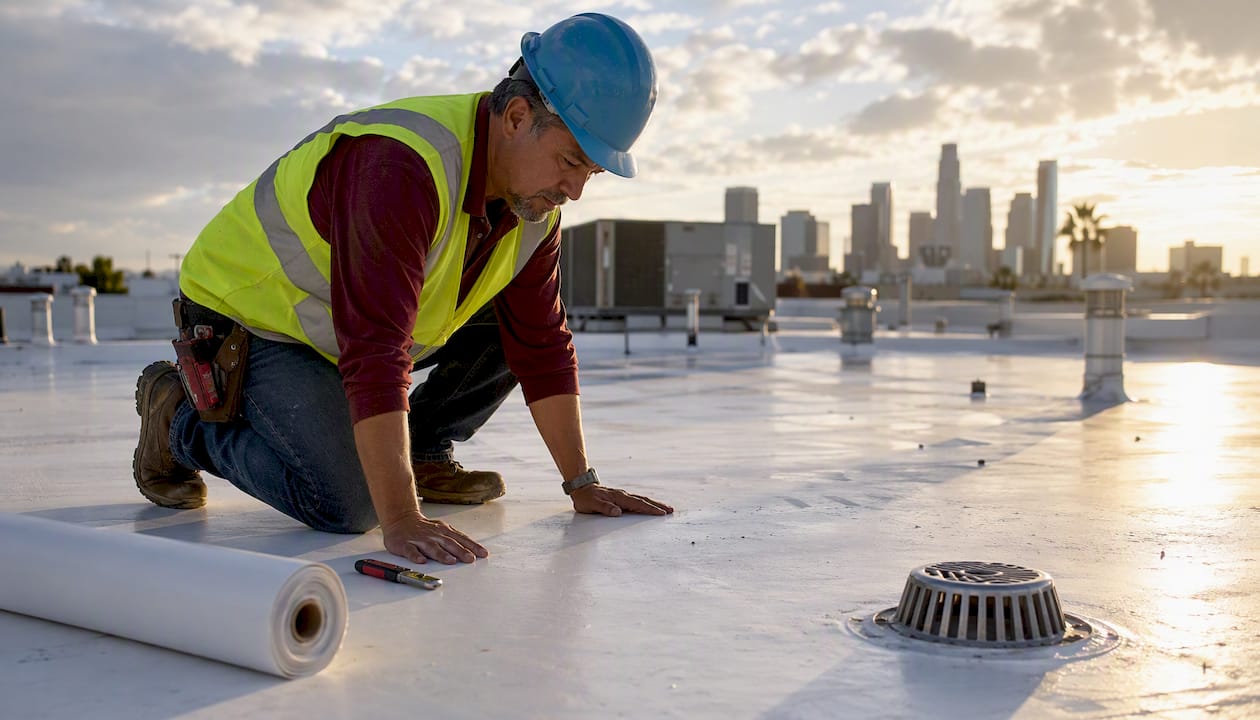
A roof membrane is the continuous, waterproof barrier that stands between your building and water intrusion on flat or low-slope roofs — and without it, even a well-built structure will fail from the inside out.
- Seams and penetrations are where membranes fail most often. Pipe boots, drain collars, HVAC curbs, and field seams are the primary leak points; the membrane material matters less than how those details are executed.
- Five material families cover most applications: Built-Up Roofing (BUR), modified bitumen, EPDM, TPO, and PVC each suit different climates, budgets, and rooftop uses.
- Design, installation, and maintenance together determine lifespan. A premium membrane installed poorly or never inspected will underperform a mid-grade membrane that is properly assembled and checked twice a year.
If your home has a flat porch roof, a low-slope addition, or you own a commercial building with a flat roof, this guide is written for you.
Table of Contents
- What does a roof membrane actually do?
- What are the main types of roofing membranes?
- What are the real benefits and limitations of membrane roofs?
- What does proper membrane installation actually involve?
- How long do roof membranes last, and what maintenance do they need?
- How do you choose the right membrane for your building?
- How Jsignorexteriors approaches membrane roofing projects
- How have roof membranes evolved over time?
- What is the environmental impact of different membrane types?
- How do membranes integrate with other roofing system components?
- Key Takeaways
- Why the assembly matters more than the brand name
- Jsignorexteriors can help you get the right membrane roof
- Useful sources and further reading
What does a roof membrane actually do?
A membrane roof is applied to roofs with a slope below 2:12, where water drains slowly rather than sheeting off quickly the way it does on a steep-pitch shingle roof. That slow drainage means the surface must be genuinely waterproof, not just water-resistant. The membrane creates that seal.
The typical assembly, from the structural deck upward, looks like this: deck, vapor retarder (critical in cold climates like Connecticut), rigid insulation, cover board, and then the membrane itself. Each layer has a job. The vapor retarder limits condensation inside the assembly. The insulation controls heat flow and, in a protected membrane roof, can actually sit above the membrane to shield it from thermal stress. The cover board protects the insulation from fastener pull-through and gives the membrane a firm, smooth substrate to bond to.
What makes flat roofs different from steep-slope roofs is how they handle water movement. A shingle roof sheds water in seconds. A flat roof may hold water for hours after a storm, especially if drains are undersized or partially blocked. The membrane must tolerate that ponding without degrading, which is why material selection and drainage design go hand in hand.
Seams, flashings at penetrations, and perimeter terminations are where the vast majority of membrane leaks originate — not in the membrane field itself. Getting those details right is more important than choosing between competing brand names.
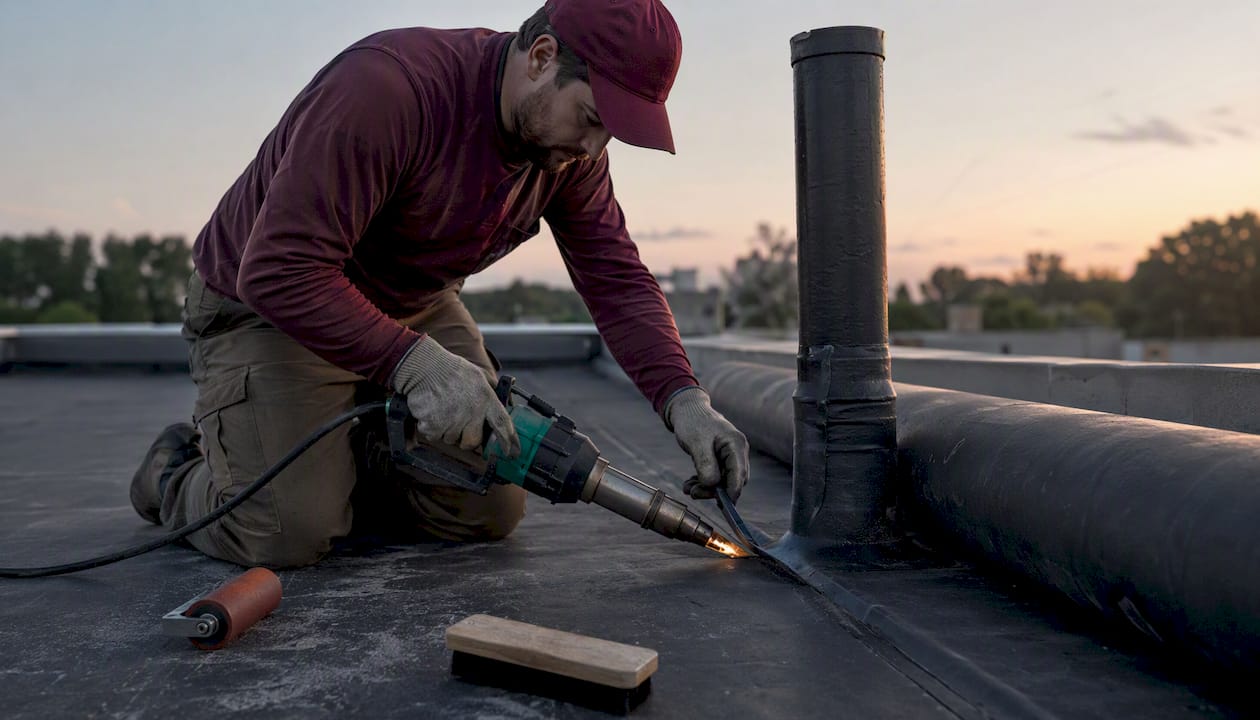
Penetrations are the hardest part of any flat roof to waterproof. Every pipe, vent, HVAC unit, and skylight that punches through the membrane creates a transition that must be sealed with a prefabricated boot or custom flashing. Thermal movement — the membrane expanding and contracting with temperature swings — puts stress on those transitions every day. A well-designed assembly accommodates that movement; a poorly detailed one cracks or separates at the seam within a few years.
Pro Tip: Ask your contractor to show you how each penetration will be flashed before work begins. If they cannot describe a specific method, that is a warning sign.
What are the main types of roofing membranes?
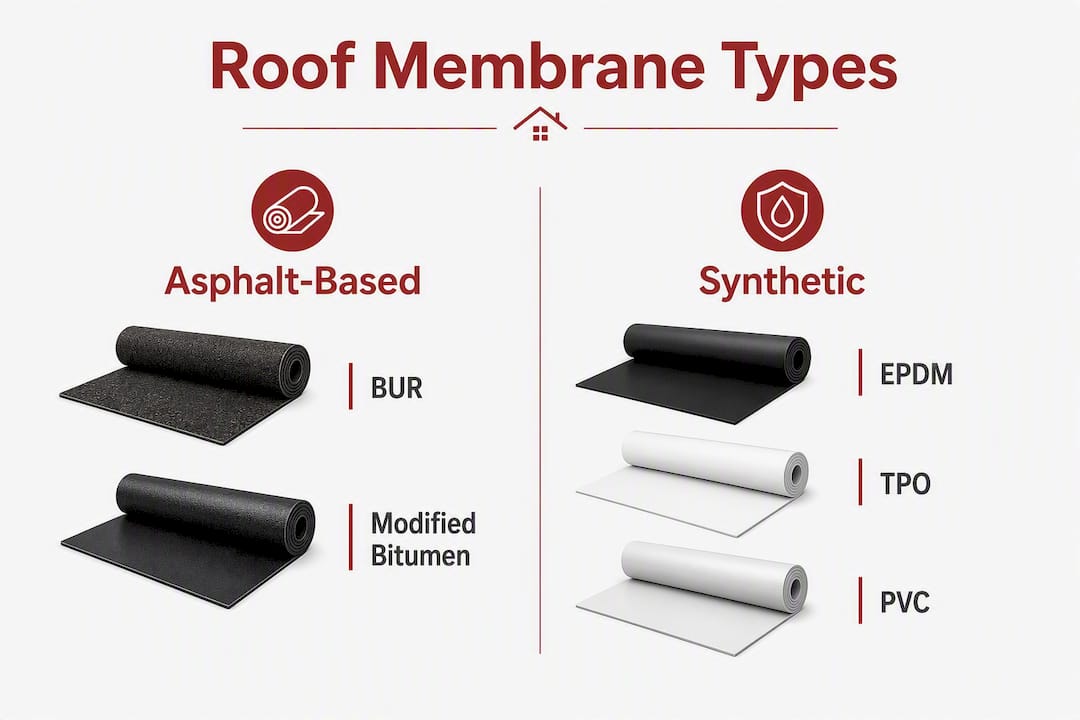
The five primary membrane families each suit different conditions. Climate, rooftop use, chemical exposure, and budget all factor into the right choice. TPO and EPDM are among the most common in modern U.S. applications, but that does not make them right for every building.
Built-Up Roofing (BUR)
BUR is the oldest modern flat-roof system, built from alternating layers of bitumen and reinforcing felts, then topped with aggregate or a cap sheet. Its multi-ply construction provides redundancy — if one layer is breached, the others hold. Seams are mopped with hot asphalt. Lifespan is generally long when proper maintenance is performed. BUR is heavy, requires skilled hot-work crews, and suits commercial buildings with structural capacity to handle the load. For a deeper look at this system, the BUR guide for property owners covers its construction in detail.
Modified bitumen
Modified bitumen modernizes the BUR concept by factory-engineering asphalt with polymers (APP or SBS) into rolls that can be torch-applied, hot-mopped, or self-adhered. On many retrofit and small residential flat-roof projects, modified bitumen remains popular because it can be installed by smaller crews without specialized welding equipment. Lifespan is typically several years when properly maintained. Torch-applied modified bitumen is a common choice for residential low-slope roofs and small commercial buildings throughout New England.
EPDM
EPDM (ethylene propylene diene monomer) is a synthetic rubber membrane, typically black, joined with adhesive or seam tape rather than heat welding. It performs well in cold climates because rubber stays flexible at low temperatures, making it a practical choice for Connecticut winters. Lifespan can be multiple decades with appropriate care. Its main limitation is that seam adhesives can degrade over time, so seam maintenance is a recurring task.
TPO
TPO (thermoplastic polyolefin) is a white or light-colored single-ply membrane heat-welded at seams. TPO is widely used as a reflective membrane with cool-roof benefits, and its heat-welded seams are often stronger than the sheet itself. It dominates new commercial construction for its combination of cost, reflectivity, and seam strength. Lifespan can reach multiple decades under good maintenance. TPO is a strong choice for commercial buildings where energy performance and low maintenance are priorities.
PVC
PVC (polyvinyl chloride) is another heat-welded thermoplastic, similar to TPO in seam method but with superior chemical and grease resistance. It is the preferred choice for restaurant rooftops, food-processing facilities, or any building where grease-laden exhaust contacts the membrane. Lifespan can reach multiple decades under good maintenance. PVC costs more than TPO but earns that premium in chemically demanding environments.
| Membrane | Typical Lifespan | Relative Installed Cost | Seam/Joint Method | Puncture/Traffic Durability | UV/Chemical Resistance & Reflectivity | Best Use Cases |
|---|---|---|---|---|---|---|
| BUR | 20–30 years | Moderate–High | Hot-mopped asphalt | High (multi-ply) | Moderate / Low reflectivity | Heavy commercial, high-traffic roofs |
| Modified Bitumen | 15 years | Low–Moderate | Torch-applied, hot-mop, or self-adhered | Moderate–High | Moderate / Low–Moderate reflectivity | Residential low-slope, small commercial |
| EPDM | 20–30 years | Low–Moderate | Adhesive or seam tape | Moderate | Good UV / Low reflectivity (black) | Cold climates, residential flat roofs |
| TPO | 20–30 years | Moderate | Heat-welded | Moderate | Excellent UV / High reflectivity (white) | Commercial new construction, energy-conscious owners |
| PVC | 20–30 years | Moderate–High | Heat-welded | Moderate–High | Excellent UV + chemical / High reflectivity | Restaurants, chemical exposure environments |
What are the real benefits and limitations of membrane roofs?
Benefits worth knowing
- Continuous waterproofing. Unlike shingle systems, a properly installed membrane has no overlapping gaps — it seals the entire deck surface, including around penetrations when detailed correctly.
- Energy performance. Reflective TPO and PVC membranes qualify as cool roofs, reducing heat gain and lowering cooling costs in summer.
- Redundancy in BUR systems. Multiple plies mean a single puncture or crack does not immediately cause a leak.
- Design flexibility. Membranes accommodate rooftop equipment, green roofs, and ballasted assemblies in ways that steep-slope systems cannot.
- Long service life. With proper installation and maintenance, most membrane families deliver 20 or more years of service.
Limitations and failure drivers
Common failure drivers include complex detailing at penetrations, vulnerability to punctures without a protection layer, seam sensitivity to installer skill, and problems caused by improper drainage and ponding. These are not theoretical risks — they show up in inspections regularly.
- Ponding water. Flat roofs that lack positive drainage hold water, which accelerates membrane degradation and adds structural load.
- Seam failures. Adhesive seams on EPDM and improperly welded seams on TPO/PVC are the most common source of leaks on single-ply roofs.
- Penetration flashing. Failure commonly occurs at flashings and penetrations because the field membrane can be installed correctly while flashing details are skimped; prefabricated boots and professional detailing reduce this risk significantly.
- Foot traffic damage. Membranes are not designed for regular foot traffic without walk pads or a protection layer.
- Condensation inside the assembly. Air intrusion from the building interior causes condensation within the roof assembly that can rot decks and degrade insulation, particularly in cold climates. A continuous air barrier is not optional in Connecticut.
Understanding why commercial roofs fail prematurely often comes down to these same issues: drainage neglect, poor flashing, and skipped cover boards.
What does proper membrane installation actually involve?
Proper installation and a systems approach — membrane plus insulation, cover board, flashings, drainage, and air/vapor control — are the major determinant of long-term roof performance. Here is what that looks like in practice.
- Deck inspection and preparation. The structural deck must be clean, dry, structurally sound, and free of rot or delamination before anything goes on top of it. Soft spots get replaced, not covered over.
- Vapor retarder placement. In cold climates, a vapor retarder goes directly above the deck to limit moisture migration from the warm interior into the cold insulation layer.
- Insulation selection and placement. Polyisocyanurate (polyiso) is the most common choice for flat roofs; tapered insulation creates positive slope toward drains where the deck itself is flat.
- Cover board installation. A cover board (typically half-inch gypsum or wood-fiber board) goes over the insulation to protect it from fastener pull-through and give the membrane a firm bonding surface.
- Seam method verification. For TPO and PVC, seams must be heat-welded to the manufacturer’s specified temperature and speed. For EPDM, adhesive coverage and seam tape application must meet manufacturer standards.
- Edge securement and termination. Perimeter edges, parapets, and gutters need mechanically fastened termination bars or metal edge details to prevent wind uplift and water infiltration at the boundary.
- Prefabricated boots for penetrations. Every pipe, vent, and conduit gets a factory-made boot rather than a field-fabricated patch wherever possible.
- Drainage confirmation. Drains must be set at the low point of the finished assembly, with the membrane clamped into the drain collar and the surrounding field sloping toward it.
Pro Tip: For TPO and PVC roofs, ask the installer to perform a seam probe test on completed welds before the job is signed off. A properly welded seam will not separate under a probe tool; a failed weld will open immediately.
Attachment method also matters: mechanically fastened systems introduce stress at fastener points and benefit from cover boards to distribute that load; fully adhered systems create a more uniform seal but require a smooth, compatible substrate and the right adhesive for the temperature at time of installation.
Common shortcuts that cause callbacks: skipping the cover board to save cost, using field-fabricated flashing at penetrations instead of prefabricated boots, and leaving exposed fastener plates on low-density insulation without a cover board to protect them.
How long do roof membranes last, and what maintenance do they need?
Manufacturer-quoted lifespans are achievable, but only with regular inspection and prompt repairs. Maintenance is not optional: regular inspections to catch small punctures or seam deterioration are key to achieving the decades-long lifespans manufacturers quote.
Recommended inspection schedule:
- Twice per year (spring and fall) as a baseline
- After any major storm, heavy snow load, or rooftop work
- Before and after any new rooftop equipment is installed
What to look for during an inspection:
- Standing water more than 48 hours after rain (ponding)
- Blisters, bubbles, or wrinkles in the membrane field
- Open or lifting seams
- Cracked, separated, or missing flashing at penetrations and perimeters
- Debris accumulation at drains
- Signs of foot traffic damage (scuffs, tears, compressed areas)
| Membrane | Typical Lifespan | Inspection Priority | Common Repairs |
|---|---|---|---|
| BUR | 20–30 years | Blisters, surface erosion | Flood coat reapplication, blister repair |
| Modified Bitumen | 15 years | Seam lifting, surface cracking | Torch-applied patches, re-flashing |
| EPDM | 20–30 years | Seam adhesive, shrinkage | Seam tape repair, patch adhesive |
| TPO | 20–30 years | Seam integrity, punctures | Heat-welded patches, drain re-clamping |
| PVC | 20–30 years | Seam integrity, chemical exposure | Heat-welded patches, flashing replacement |
Warranty documentation matters as much as the inspection itself. Most manufacturer warranties require proof of regular maintenance and inspections to remain valid. Keep dated records of every inspection, repair, and storm event. If a contractor performed the work, get a written report. That paper trail protects you when a warranty claim becomes necessary.
How do you choose the right membrane for your building?
The right membrane depends on your building’s specific conditions, not on which product a contractor happens to stock. Work through these criteria before you commit.
Decision criteria:
- Climate. Connecticut winters demand flexibility; EPDM and SBS-modified bitumen handle cold better than APP-modified bitumen.
- Rooftop use and traffic. Regular foot traffic requires walk pads or a protected membrane assembly. Equipment-heavy roofs need reinforced membrane or BUR.
- Number of penetrations. More penetrations mean more flashing details and more potential failure points; a simpler membrane with excellent prefabricated boot options reduces risk.
- Drainage and slope. If the deck is truly flat, tapered insulation is non-negotiable. Confirm the contractor’s drainage plan before signing anything.
- Chemical exposure. Restaurant or industrial rooftops need PVC.
- Energy goals. Reflective TPO or PVC reduces cooling loads; cool roofs can qualify for utility rebates in some programs.
- Budget. Modified bitumen is the most accessible entry point for residential projects; TPO offers the best value for most commercial new construction.
For Connecticut-specific guidance on matching materials to local climate and building types, the commercial roofing material comparison for Connecticut is a useful reference.
Questions to ask every contractor:
- Are your installers certified by the membrane manufacturer, and will the warranty be issued by the manufacturer or only by you?
- What seam method will you use, and how will you verify seam quality before the job closes?
- How will you create positive drainage — tapered insulation, crickets, or both?
- What cover board are you specifying, and why?
- How will each penetration be flashed — prefabricated boot or field-fabricated?
- Who inspects the completed roof, and will you provide a written inspection report?
Red flags to watch for:
- Vague warranty language with no manufacturer backing
- No written plan for seam testing or drainage
- Unwillingness to specify cover board or vapor retarder
- A proposal that skips tear-off when the existing assembly has multiple layers or moisture damage
For a full contractor selection checklist, the guide on how to choose a commercial roofing contractor in Connecticut covers the process step by step.
How Jsignorexteriors approaches membrane roofing projects
Before Jsignorexteriors proposes a membrane system, the pre-install inspection covers more than just the surface. The process includes:
- Deck condition assessment. Soft spots, rot, delamination, and prior water damage get documented before any new assembly goes down.
- Review of leak history. Where water has entered before tells you where the assembly failed; that history shapes the detailing plan.
- Rooftop equipment inventory. Every HVAC unit, exhaust vent, and conduit is mapped so flashing details can be specified in advance, not improvised on the day.
- Drain capacity check. Undersized or partially blocked drains are a primary cause of ponding; Jsignorexteriors confirms drain size and condition as part of the estimate.
The assembly preference at Jsignorexteriors reflects what the evidence supports: cover boards on every project, positive drainage through tapered insulation where the deck is flat, heat-welded seams on TPO and PVC, and prefabricated boots at every penetration. These are not upsells — they are the details that separate a longer-lasting roof from one needing early callbacks.
A membrane roof is only as good as its weakest detail. Getting the field membrane right while cutting corners on flashing or drainage is how a new roof leaks within two years. The assembly has to work as a system, every time.
Jsignorexteriors is a family-owned, fully licensed and insured contractor with more than 30 years of experience serving homeowners and businesses throughout Connecticut. That experience shows up in the specifics: knowing which membrane families perform in New England winters, understanding how Connecticut’s freeze-thaw cycles stress seams and flashings, and delivering projects on time and within budget without compromising on the details that matter.
How have roof membranes evolved over time?
The history of membrane roofing tracks closely with the history of flat commercial construction. Built-Up Roofing, using coal tar pitch and felts, was the dominant flat-roof system from the late 19th century through most of the 20th. It worked, but it was labor-intensive, required hot-work crews, and was sensitive to temperature during installation.
Modified bitumen emerged in Europe in the 1960s and reached the U.S. market in the 1970s, offering the redundancy of BUR in a factory-engineered roll that could be torch-applied by smaller crews. That shift made flat-roof systems more accessible for residential and small commercial projects.
Single-ply membranes, including EPDM, TPO, and PVC, became commercially viable in the U.S. through the 1970s and 1980s. EPDM gained early traction for its flexibility and ease of installation. TPO and PVC followed as thermoplastic technology matured, bringing heat-welded seams that proved stronger and more durable than adhesive-bonded alternatives. By the 1990s and 2000s, TPO had become the dominant choice for new commercial construction, driven by its reflectivity, cost, and weld strength.
The most significant recent development is the protected membrane roof (PMR) configuration, where insulation is placed above the membrane rather than below it. Protected membrane roofs can extend service life and support overburden such as ballast or green roofs, while reducing membrane thermal stress. Green roofs and rooftop gardens, once rare, are now a practical option for commercial buildings using PMR assemblies.
What is the environmental impact of different membrane types?
Membrane choice has real sustainability implications, and they are not always obvious.
TPO and PVC are both thermoplastics, which means they can theoretically be recycled at end of life. TPO’s white surface reflects solar radiation, reducing urban heat island effect and lowering building cooling loads, which is why it qualifies as a cool roof under U.S. Department of Energy guidelines. PVC has a more complex environmental profile: it contains plasticizers and chlorine, and its manufacturing and disposal raise concerns that some building certification programs flag.
EPDM is a synthetic rubber derived from petroleum. Black EPDM absorbs heat, which can increase cooling loads in warm climates, though white-coated EPDM is available. EPDM is durable and long-lasting, which limits replacement frequency and the associated waste.
BUR and modified bitumen are asphalt-based systems. Asphalt production is energy-intensive, and torch-applied modified bitumen generates fumes during installation. However, both systems are well-understood, widely recyclable in asphalt reclamation programs, and their long service lives reduce replacement frequency.
The most sustainable membrane is often the one that lasts longest with the least maintenance, which brings the argument back to proper installation and assembly. A 30-year roof replaced once produces less waste than a 15-year roof replaced twice, regardless of material.
How do membranes integrate with other roofing system components?
A membrane does not perform in isolation. Its compatibility with the substrate, insulation, fasteners, and drainage system determines whether the assembly functions as designed.
Substrate compatibility is the starting point. TPO and PVC adhered systems require a smooth, clean cover board; they do not bond reliably to rough or contaminated surfaces. EPDM adhesives are sensitive to temperature and surface moisture. BUR requires a structurally sound deck that can handle the weight of multiple plies and aggregate.
Insulation compatibility affects both thermal performance and membrane longevity. Polyiso is the standard choice for most flat-roof assemblies because of its high R-value per inch, but it loses effective R-value at very low temperatures. In cold climates, some contractors specify a layer of EPS or XPS below the polyiso to maintain performance. In a protected membrane assembly, extruded polystyrene (XPS) is the standard insulation because it resists moisture absorption when placed above the membrane.
Fastener and cover board compatibility matters most for mechanically fastened systems. Fasteners must be long enough to reach the structural deck and rated for the wind uplift zone. Cover boards distribute fastener loads and protect insulation from compression; skipping them on low-density insulation leads to fastener pull-through and membrane stress.
Drainage integration ties the whole assembly together. Roof drains must be set at the correct height relative to the finished membrane surface, with the drain collar clamped to the membrane and the surrounding field sloped toward the drain. Overflow drains or scuppers are a code requirement in many jurisdictions and a practical necessity on any flat roof. Proper roof flashing at parapet walls and transitions completes the perimeter seal and prevents water from migrating under the membrane edge.
For torch-applied modified bitumen and its compatibility with replacement assemblies, the torch-down roof replacement overview covers substrate and overlay considerations in detail.
Key Takeaways
A roof membrane’s long-term performance depends on the full assembly, not the membrane sheet alone — seams, flashings, drainage, and cover boards are where roofs succeed or fail.
| Point | Details |
|---|---|
| Membrane role | The membrane is the continuous waterproof barrier on flat/low-slope roofs; seams and penetrations are its primary failure points. |
| Material families | BUR, modified bitumen, EPDM, TPO, and PVC each suit different climates, budgets, and rooftop uses. |
| Assembly matters | Cover board, tapered insulation, vapor retarder, and proper drainage are as important as the membrane itself. |
| Maintenance is required | Biannual inspections and prompt repairs are necessary to reach the 20–30 year lifespans manufacturers quote. |
| Jsignorexteriors | With 30+ years of Connecticut experience, Jsignorexteriors specifies full assemblies, heat-welded seams, and prefabricated boots on every membrane project. |
Why the assembly matters more than the brand name
Most conversations about flat roofs get stuck on material choice. Homeowners and business owners ask “should I get TPO or EPDM?” when the more important question is “how will the seams, flashings, and drainage be handled?” The membrane brand is almost never what fails. What fails is the flashing at the HVAC curb that was field-fabricated in a hurry, or the drain that was set a quarter-inch too high so water never fully evacuates, or the seam that was welded at the wrong temperature on a cold morning.
Connecticut’s climate makes this especially clear. Freeze-thaw cycles stress every transition point in a roof assembly. A seam or flashing that would hold for years in a mild climate can open within two seasons here. That is why the assembly approach — specifying cover boards, requiring prefabricated boots, confirming positive drainage before installation begins — is not a preference. It is what the local conditions demand.
If you are planning a flat or low-slope roof project in Connecticut, the questions to bring to your contractor are not about brand names. They are about seam testing, drainage strategy, and what happens at every penetration. Those answers tell you more about the roof’s future performance than any product specification sheet.
Jsignorexteriors can help you get the right membrane roof
Jsignorexteriors brings more than 30 years of Connecticut roofing experience to every flat and low-slope project, from residential additions to commercial buildings. The estimate process starts with a full on-site inspection: deck condition, existing drainage, rooftop equipment, and any history of leaks. You get a written scope that specifies the membrane type, insulation, cover board, seam method, and flashing approach, not a vague proposal that leaves the details open.
Services cover the full assembly: membrane installation and replacement, flashing and penetration detailing, insulation and cover board upgrades, and gutter integration for proper perimeter drainage. Whether you need a repair on an existing flat roof or a complete replacement, Jsignorexteriors delivers the kind of documented, warranted work that holds up through New England winters.
Ready to get a clear picture of what your roof needs? Request a roofing estimate in Connecticut or explore the full range of roofing services to see how Jsignorexteriors can help.
Useful sources and further reading
- U.S. Department of Energy — Cool Roofs: Explains reflective roofing benefits, energy savings, and cool-roof qualification criteria.
- Wikipedia — Membrane Roofing: A broad technical overview of membrane types, materials, and applications, useful for background context.
- RCABC Roofing Practices Manual — Roof Membranes: Detailed technical guidance on membrane composition, design considerations, and manufacturer specifications.
- Jsignorexteriors — Types of Commercial Roofing Systems: Connecticut-focused overview of membrane systems and their commercial applications.