

Commercial contractor licensing is the legal credential that authorizes contractors to perform construction work on commercial properties, and in Connecticut, operating without it carries serious legal and financial consequences. The role of contractor licensing in commercial projects goes far beyond a formality. It verifies technical competence, protects business owners from liability, and determines whether a contractor can legally bid, pull permits, or enforce payment through the courts. Whether you are a contractor building your business or a property owner hiring one, understanding Connecticut’s licensing framework is not optional. It is the foundation of every compliant, successful commercial project.
What is the role of contractor licensing in commercial work?
Commercial contractor licensing is the state-authorized credential that grants contractors legal permission to contract for and perform construction on commercial properties. In Connecticut, this credential is tied directly to your ability to bid on projects, pull permits, and collect payment. Without it, none of those rights exist in a legally enforceable way.
Commercial licensing acts as a gatekeeping mechanism that protects consumers and maintains construction standards across jurisdictions. That means it is not just about paperwork. It is about proving you have the skills, insurance, and financial backing to complete a project responsibly.
Connecticut requires state-level licensing for commercial contractors, and the state mandates liability coverage of $500,000 to $1,000,000 or more depending on the scope of work. This is a higher bar than many contractors expect when they first enter the commercial market. Knowing this upfront saves you from costly surprises during the bidding process.

What legal requirements and penalties apply in connecticut?
Connecticut commercial contractors must meet specific requirements before they can legally operate. These include documented work experience, passing a trade or business law exam, maintaining general liability insurance, and securing a surety bond. The exact thresholds depend on the license classification you pursue.
The consequences of skipping this process are severe:
- Fines: Violations carry fines ranging from $500 to $10,000 per offense, and some states impose daily fines until the contractor comes into compliance.
- Criminal liability: Unlicensed contracting can result in criminal charges, not just civil penalties.
- Contract unenforceability: Courts in many states void contracts performed by unlicensed contractors, meaning clients can legally refuse to pay.
- No mechanics lien rights: Without a valid license, you cannot file a mechanics lien to recover unpaid amounts. That is a total loss of your legal leverage.
- Bid disqualification: Commercial contractors must hold proper licensure before bidding. Retroactive licenses are generally not permitted once a contract is executed.
Connecticut follows state-level licensing rules, which means local municipalities cannot substitute for state credentials. Some cities add permit requirements on top of state licensing, so you need to verify both layers before starting any project.
Pro Tip: Set a calendar reminder 90 days before your license renewal date. Lapsed licenses can void active contracts and trigger fines, even if the underlying work is solid.
How does licensing impact project quality and client confidence?
Licensed contractors bring verified experience, insurance, and bonding to every project. That combination protects commercial clients from performance failures and liability exposure in ways that an unlicensed contractor simply cannot match.
Selecting a contractor based on price alone is risky without considering licensing and qualifications. A low bid from an unlicensed contractor can result in failed inspections, stop-work orders, and repair costs that far exceed the original savings. Business owners in Connecticut have seen projects stall for weeks because an unlicensed subcontractor pulled work that required a licensed trade professional.
Here is what licensing actually signals to a commercial client:
- Verified competence: The contractor passed a state-recognized exam and demonstrated relevant field experience.
- Financial accountability: Surety bonds protect clients if the contractor defaults or abandons a project.
- Insurance coverage: General liability and workers’ compensation coverage protect the property owner from third-party claims.
- Regulatory compliance: A licensed contractor understands permit requirements and code standards, reducing the risk of failed inspections.
- Legal enforceability: Both parties can enforce the contract in court, which creates a more professional and accountable working relationship.
“Licensed contractors have verified experience, insurance, and bonding, providing credibility and protecting projects from performance and liability risks.” — Licensed Contractors: Why It Matters
For business owners evaluating contractors, ask to see the license number, verify it through Connecticut’s Department of Consumer Protection, and confirm that insurance certificates name your property as an additional insured. These three steps take less than 30 minutes and can prevent months of legal headaches. You can also review how licensed expertise applies to complex commercial projects like flat roofing to understand what credentials actually mean in practice.
What are the common commercial contractor license classifications?
Connecticut recognizes several license classifications for commercial contractors, and each one authorizes a different scope of work. Confusing them is one of the most common and costly mistakes new contractors make.
| License Type | Scope of Work | Exam Required | Minimum Insurance |
|---|---|---|---|
| General Commercial Contractor | Full project oversight, structural work | Business law + trade exam | $500,000–$1,000,000 liability |
| Electrical Contractor | All electrical installations and systems | State electrical exam | $500,000 liability |
| Plumbing Contractor | Plumbing systems, fixtures, drainage | State plumbing exam | $500,000 liability |
| HVAC Contractor | Heating, ventilation, air conditioning | State mechanical exam | $500,000 liability |
| Specialty/Trade Contractor | Specific trades (roofing, masonry, etc.) | Trade-specific exam | Varies by classification |
The NASCLA Accredited Examination is accepted by 17 or more states and allows commercial general building contractors to bypass redundant individual state trade exams. Connecticut contractors expanding into other states should evaluate whether NASCLA acceptance applies to their target markets. Local business law exams and registration remain required even when NASCLA is accepted.
One distinction that trips up many contractors: a business license and a contractor license are not the same thing. A business license allows you to operate legally as a business entity. A contractor license authorizes you to perform construction work and pull permits. Holding only a business license leaves you without the legal authority to contract for commercial construction, even if your company is fully registered with the state.
Subcontractors also face registration requirements separate from full contractor licensing. Working as an unregistered subcontractor on a licensed general contractor’s project still exposes you to penalties if your specific trade requires its own credential.
Pro Tip: Before signing any subcontractor agreement, verify that both your license and the general contractor’s license are active and cover the specific scope of work in the contract. Mismatched classifications create liability gaps that neither party wants to discover mid-project.
How do you meet connecticut’s commercial licensing requirements?
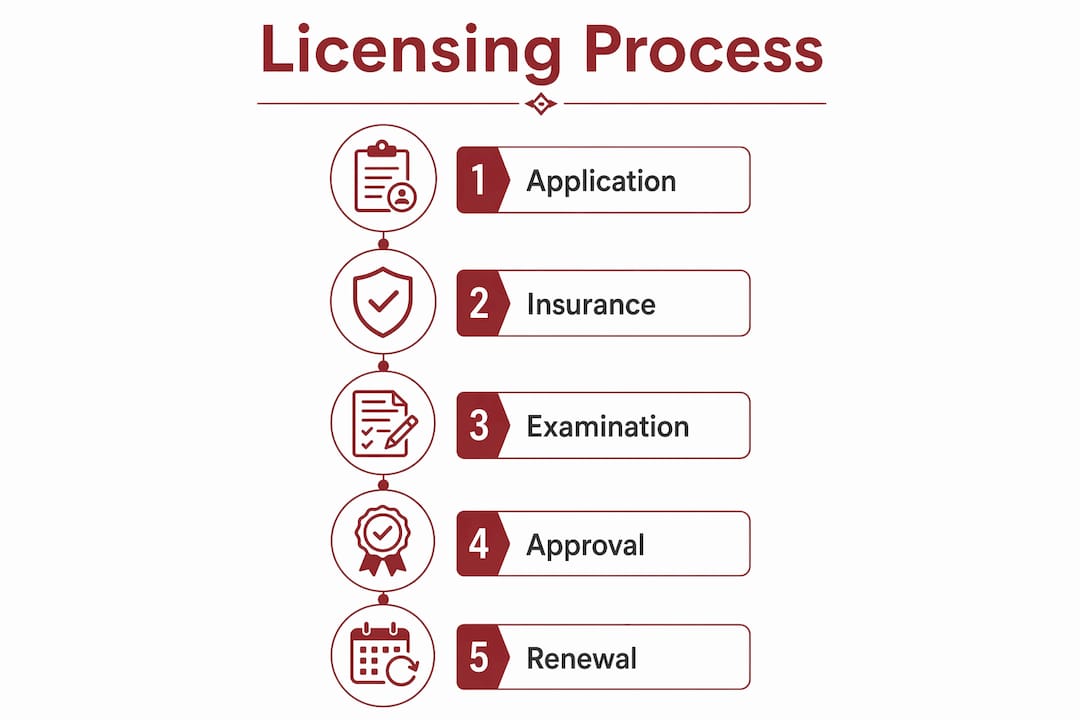
Getting licensed in Connecticut requires a clear sequence of steps. Skipping any one of them delays your ability to legally bid and work on commercial projects.
- Determine your license classification. Identify whether you need a general commercial contractor license or a specialty trade license based on the work you plan to perform.
- Document your experience. Most classifications require proof of field experience, typically three to five years in the relevant trade. Gather employment records, project documentation, and references before applying.
- Pass the required exam. Connecticut requires a trade exam and, in most cases, a business law exam. Study materials are available through the Connecticut Department of Consumer Protection and approved prep providers.
- Secure your surety bond. Surety bonds typically range from $5,000 to $25,000. The amount depends on your license type and project scope.
- Obtain general liability insurance. Coverage minimums run from $500,000 to $1,000,000. Workers’ compensation is also required if you have employees.
- Submit your application. File with the Connecticut Department of Consumer Protection along with all supporting documents, fees, and proof of insurance and bonding.
- Register locally if required. Some Connecticut municipalities require additional local registration or permits on top of the state license. Check with your local building department before starting any project.
Startup costs for licensing and insurance typically run $2,500 to $8,000, covering application fees, surety bonds, and insurance premiums. Many first-time commercial contractors underestimate this figure and find themselves undercapitalized before their first project begins. Budget for it as a fixed cost of market entry, not an afterthought.
For business owners hiring contractors, verify license status directly through the Connecticut Department of Consumer Protection’s online lookup tool before signing any contract. Confirm that the license covers the specific work being performed, not just a related trade.
Key takeaways
Commercial contractor licensing in Connecticut is a legal requirement that determines your right to bid, work, collect payment, and enforce contracts on commercial projects.
| Point | Details |
|---|---|
| Licensing is a legal prerequisite | Without a valid license, contracts can be voided and payment legally refused by clients. |
| Penalties are significant | Fines range from $500 to $10,000 per violation, with criminal liability possible for repeat offenses. |
| Business license is not enough | A contractor license is required to pull permits and perform construction work, separate from business registration. |
| Startup costs require planning | Budget $2,500 to $8,000 for licensing, bonding, and insurance before your first commercial project. |
| Verify before you hire | Business owners should confirm license status, insurance, and bond coverage before signing any contract. |
What i’ve learned watching unlicensed work play out on real projects
I have seen the consequences of unlicensed contracting up close, and they are never minor. A contractor loses a mechanics lien claim and walks away from a $40,000 project with nothing. A business owner discovers mid-construction that their contractor’s license does not cover the trade work being performed, and the project stops cold while they scramble to find a replacement.
The pattern is always the same. Someone tried to save time or money at the front end and paid far more at the back end. Licensing is not bureaucratic friction. It is the structure that makes commercial construction predictable and enforceable for everyone involved.
What I tell contractors starting out: treat your licensing and insurance costs as your first capital investment, not an obstacle. The $2,500 to $8,000 you spend upfront is the price of admission to a market where projects are larger, margins are better, and clients are more serious. It is worth every dollar.
For business owners, I would push back on the instinct to evaluate contractors primarily on price. A licensed contractor with verified credentials is not more expensive. An unlicensed contractor who creates a failed inspection, a stop-work order, or an unenforceable contract is far more expensive. The license is your first filter, not your last.
— Adam
Work with a licensed connecticut commercial contractor
If you are a Connecticut business owner looking for a contractor who carries the right credentials, Jsignorexteriors is fully licensed and insured with more than 30 years of experience serving commercial and residential clients throughout the state.
Jsignorexteriors handles roofing, siding, gutters, windows, masonry, and exterior remodeling with a commitment to permits, compliance, and quality craftsmanship on every project. Every job is backed by proper licensing, bonding, and insurance so you never have to wonder whether your contractor meets Connecticut’s commercial requirements. Explore licensed roofing services in Connecticut or contact Jsignorexteriors directly to discuss your commercial project and get a straightforward estimate from a team that takes compliance as seriously as craftsmanship.
FAQ
What happens if a contractor works without a license in CT?
Operating without a required license exposes contractors to fines up to $10,000 per violation, potential criminal charges, and the inability to file mechanics liens to recover unpaid amounts. Courts can also void the contract entirely, leaving the contractor with no legal claim to payment.
Is a business license the same as a contractor license?
No. A business license allows you to operate as a legal entity, while a contractor license specifically authorizes construction work and the ability to pull permits. Holding only a business license does not give you the legal authority to perform commercial construction in Connecticut.
How much does it cost to get a commercial contractor license in CT?
Startup costs for licensing, bonding, and insurance typically range from $2,500 to $8,000. This includes application fees, surety bonds ranging from $5,000 to $25,000, and general liability insurance with minimum coverage of $500,000 to $1,000,000.
Can a contractor get licensed after signing a contract?
Retroactive licensing is generally not permitted once a contract is executed. Contractors must hold a valid license before bidding on or signing commercial contracts, or they risk disqualification and legal penalties.
What should a business owner verify before hiring a commercial contractor?
Confirm the contractor’s license number through the Connecticut Department of Consumer Protection, verify that the license covers the specific scope of work, and request insurance certificates that name your property as an additional insured.