
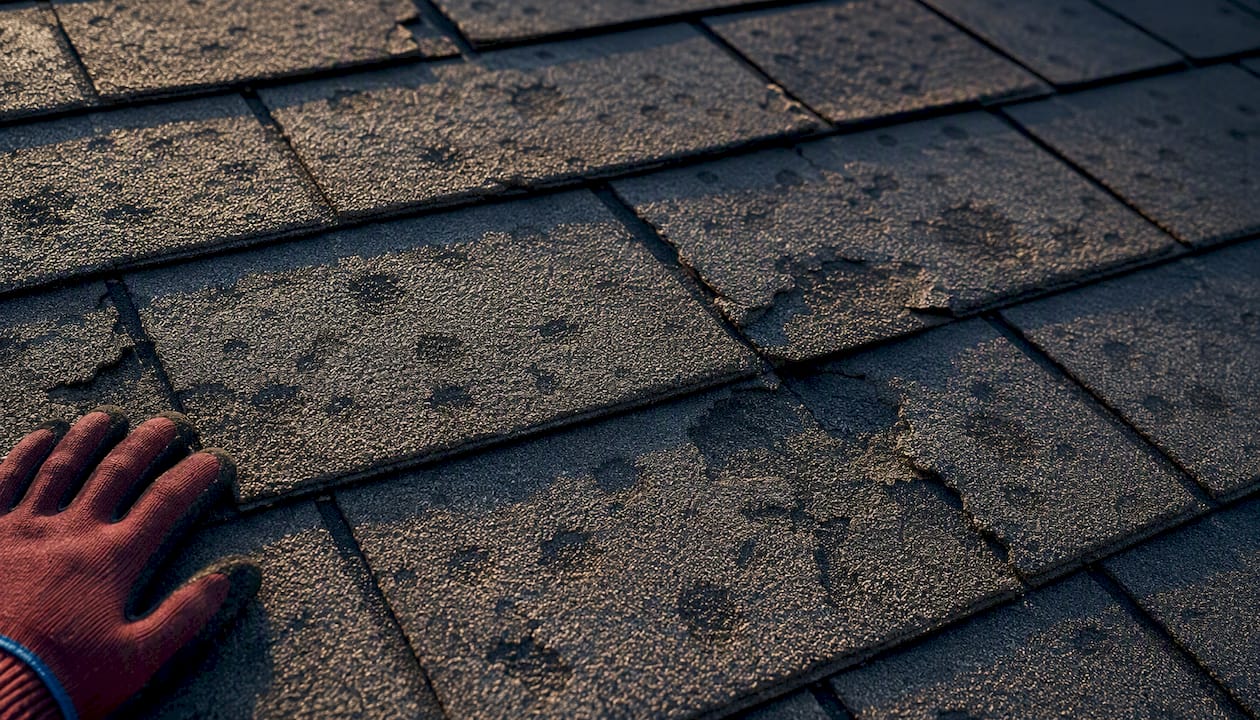
The clearest signs of hail damage are random circular spots where granules are missing, soft bruised spots you can feel with your thumb, dents on vents and metal flashing, and heavy granule buildup in your gutters. If you spot any of these, photograph them from the ground, check your AC unit and vehicles for matching dents, then schedule a professional inspection or call your insurer before doing any repairs yourself.
TL;DR:
- Hail damage signs include soft bruised spots, granule loss, and dents on metal or vents, which require close inspection or professional assessment to confirm.
- Ground-level evidence such as gravel buildup in gutters and matching dents on property can reliably indicate roof impact, reducing the need to climb for visual confirmation.
- A soft, palpable bruise on shingles often signifies internal fracture and shortens roof lifespan, especially on older or weathered shingles after repeated small-hail exposure.
- Immediate inspections are warranted if multiple impact points, cracked tiles, or active leaks are present, with thorough documentation needed for insurance claims.
- Hail size thresholds are approximate, around 1 inch for older shingles and larger for other materials, but repeated small hail impacts can cause hidden damage over time.
Table of Contents
- Hail Damage Roof Signs by Material: What to Look For
- Ground-Level Checks: Signs of Roof Hail Damage You Can Spot Safely
- How to Confirm Hail Damage Up Close
- When to Call a Roofing Pro or Your Insurance Company
- Documenting Hail Damage for Your Insurance Claim
- Seasonal Patterns: When Hail Damage Is Most Likely
- Common Myths About Hail Damage on Roofs
- A Roofer’s Honest Take on Hail Damage Claims
- Sources
- FAQ
Hail Damage Roof Signs by Material: What to Look For
Hail doesn’t treat every roofing material the same way, and knowing what to expect from yours narrows your search considerably.
Asphalt and composition shingles show the most common hail damage roof signs, but also the easiest to miss. Look for circular, dark spots where the protective granules have been knocked loose, exposing the black asphalt mat underneath. Small divots or dents in the shingle surface, torn tabs, and cracked or chipped edges near the bottom of a slope are also classic markers. The trickiest sign is a bruise, a soft spot in the shingle that looks fine from a distance but has a fractured mat underneath. You often can’t see a bruise. You have to feel for it.
Metal roofing hides damage differently. Hail leaves dents and dings, sometimes accompanied by scouring or chipped paint where the coating cracked on impact. Dents on metal can be subtle in direct sunlight, so run a piece of chalk lightly across the surface or check the panels at a raking angle, early morning or late afternoon light works best, to make dimples cast shadows.
Tile and slate roofs tend to announce damage loudly. Cracked, fractured, or missing tiles are usually visible without climbing anything, and a single cracked tile is often enough to justify a repair call immediately.
Wood shakes split, crack, or splinter under hail impact, and brittle, sun-damaged wood cracks far more easily than shakes that have been properly maintained.
Age changes the equation for every material. Laboratory testing on asphalt shingles found that repeated exposure to sub-severe (smaller) hail, combined with natural weathering, produced dramatically higher granule loss and left those shingles roughly ten times more vulnerable to a future large-hail event compared to new shingles. A roof that took a beating from small hail three years ago may fail catastrophically in a storm that a newer roof would shrug off.
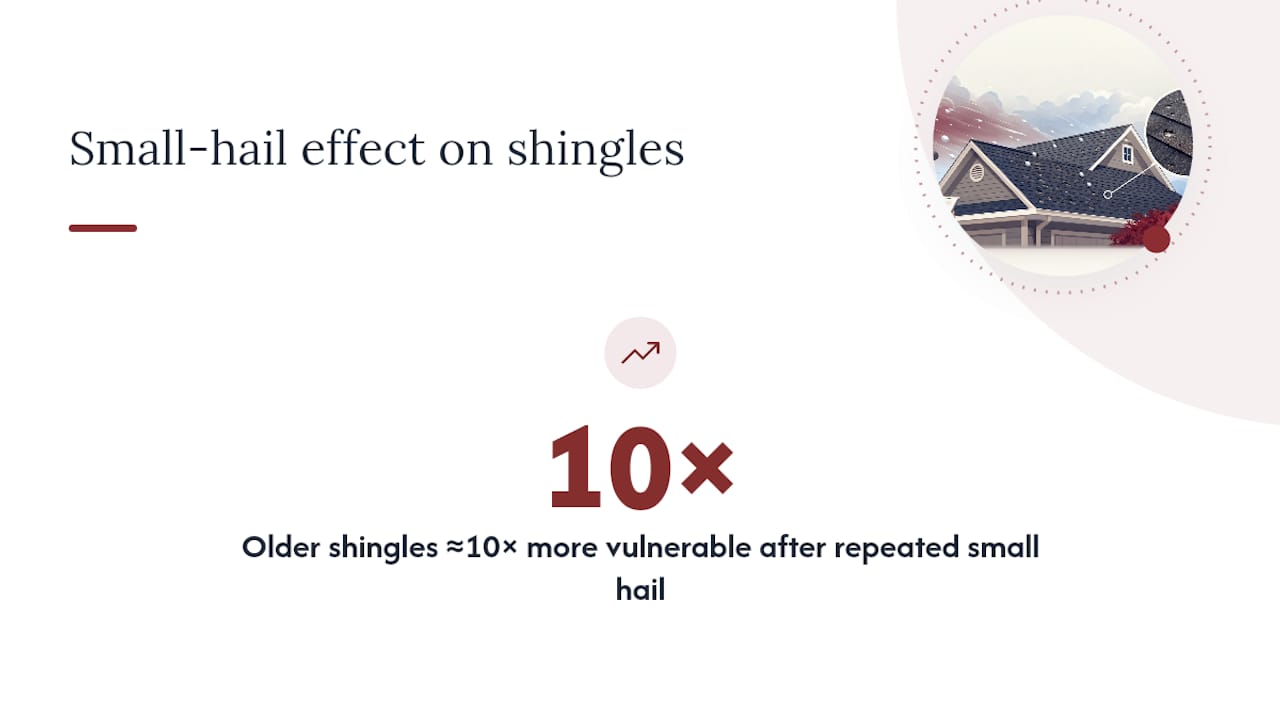
Pro Tip: If your roof is older than 10 years, treat even a “minor” hailstorm as a reason to inspect it closely. Cumulative small impacts weaken shingles long before they look obviously damaged.
Ground-Level Checks: Signs of Roof Hail Damage You Can Spot Safely
You don’t need to climb a ladder to gather strong evidence of a hail strike. Several reliable clues sit at eye level or below.
- Check your gutters and downspouts. Heavy granule buildup, that gritty, sand-like residue, is one of the most reliable ground-level indicators that a roof has taken hail hits, and dents in the gutter troughs themselves confirm impact force.
- Look at vents, flashing, chimney caps, and fascia boards from the driveway or yard. Dented or dinged metal in these spots often shows up clearly even from ground level.
- Inspect your car, your AC condenser fins, your fence, and vinyl siding. Matching dents or divots on these surfaces mean the hail hit hard enough to damage your roof too.
- Cross-check the timing. NOAA’s Storm Prediction Center keeps severe weather event summaries that can confirm a hail event actually passed through your area on a given date, useful backup when you’re building a claim file.
How to Confirm Hail Damage Up Close
Once ground checks point to hail activity, a closer look tells you what you’re really dealing with.
The thumb test is the fastest way to find a bruise. Press firmly on suspicious shingle spots. If the surface gives slightly, feels soft, or dimples under pressure, that’s a bruise, meaning the shingle mat has fractured internally even though the surface looks intact. Haag Engineering’s research on composition shingles defines this kind of impact fracture as functional damage because it shortens the shingle’s expected service life, even without a visible puncture.
- Only climb a ladder if the roof is dry, stable, and you’re confident on your footing.
- Skip the ladder entirely on steep pitches or wet surfaces, hire a roofer or a drone inspector instead.
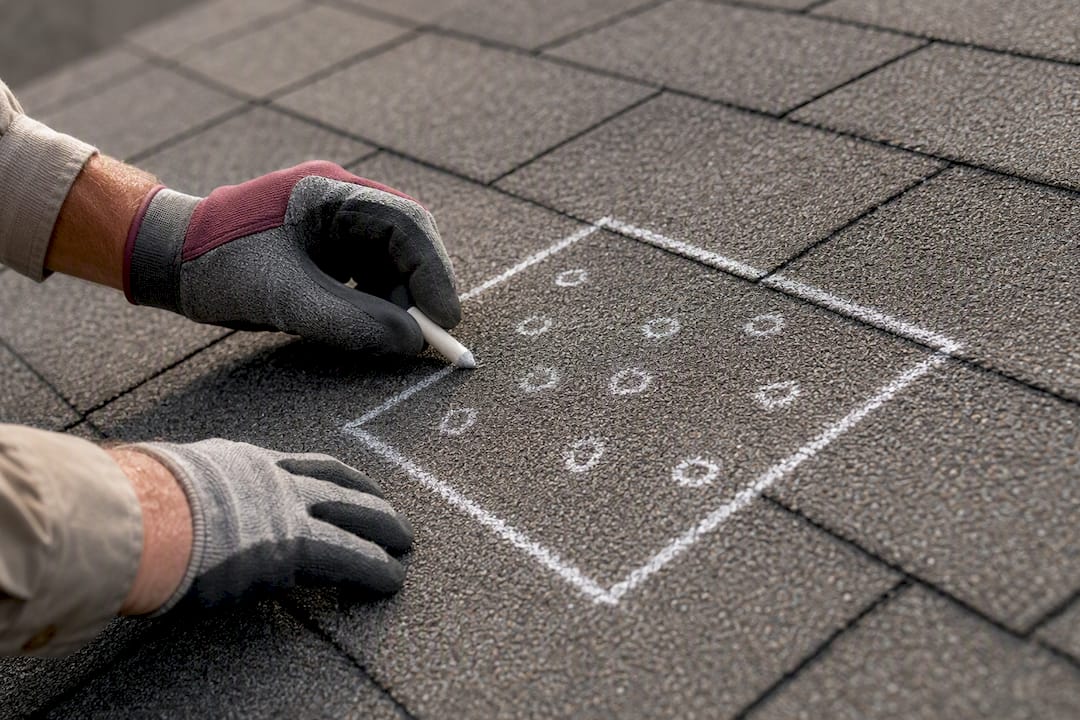
- Ask any professional you hire whether they use test squares, a method of counting hail hits within a marked section of roof, since adjusters frequently rely on these counts to decide between repair and full replacement.
- Ask for photos of any reinforcement fractures found, not just surface marks.
Pro Tip: A bruise you can feel but not see is exactly the kind of damage insurance adjusters are trained to look for. Don’t dismiss a soft spot just because the shingle looks fine.
When to Call a Roofing Pro or Your Insurance Company
Some findings mean “monitor it.” Others mean “call today.” Fractured or cracked shingles, more than a handful of confirmed impact points, broken tile, active leaks, or matching damage on your car and AC unit all justify an immediate professional inspection or insurance claim.
Before you make that call, gather:
- Close-up and wide-angle photos of every suspected damage point.
- Storm date, time, and location details, cross-referenced against local storm reports.
- Notes on any interior leaks, water stains, or drips you’ve noticed since the storm.
- A list of other damaged property (fencing, siding, windows) to give the adjuster a fuller picture.
Two insurance terms matter here: your deductible (what you pay out of pocket) and the difference between ACV (actual cash value, which factors in depreciation) and RCV (replacement cost value, which does not). Homeowner guidance from state insurance offices also recommends listing every damaged item on the property before the adjuster arrives, since a fuller damage picture strengthens the claim. One more thing: don’t sign a repair contract before the adjuster documents the damage, unless you’re dealing with an active leak that needs emergency tarping.
Documenting Hail Damage for Your Insurance Claim
A methodical photo record turns a vague “I think we got hit by hail” into a claim an adjuster can approve quickly.
- Stay safe first. Never climb a wet, steep, or unstable roof. Ground photos and a drone, if you have access to one, are safer and often just as useful.
- Shoot wide first. Capture each roof slope from a distance so the adjuster sees overall patterns, not just isolated spots.
- Move to close-ups. Photograph individual impacted shingles, cracked tiles, or dented metal with something for scale, a coin or tape measure works fine.
- Document supporting evidence. Gutters full of granules, dented AC fins, pockmarked vehicles, and damaged fencing all belong in the file.
- Label everything. Use a simple naming convention like “date_location_area” (e.g., “0512_northslope_closeup1”) so nothing gets lost or mixed up later.
- Request a written inspection report from a licensed roofer to attach to your claim, adjusters respond faster to documentation backed by a professional opinion.
Seasonal Patterns: When Hail Damage Is Most Likely
Hail season isn’t uniform across the country, and knowing your region’s pattern helps you know when to be extra watchful. Spring and early summer bring the highest hail frequency across most of the central and eastern United States, when warm, moist air collides with cooler upper atmosphere conditions to build the strong thunderstorms that produce hail. Storms tend to cluster in late afternoon and early evening, when daytime heating peaks.
Some regions see hail far more often than others simply because of geography and prevailing weather patterns, which is why the same storm system can leave one neighborhood untouched and another littered with dented siding. If you live somewhere prone to frequent hail activity, a seasonal roof check right after storm season, rather than waiting until you notice a leak, catches damage while it’s still fresh enough to document clearly.
Homeowners in states with active spring storm patterns also tend to see insurance claims spike in a predictable window each year, which is worth knowing if you’re timing a roof replacement or repair around your budget. Scheduling an inspection before storm season peaks, rather than after, gives you a baseline understanding of your roof’s current condition, so any new damage is obvious by comparison. That baseline matters even more if your roof is already older, since aging shingles and repeated small hail hits compound each other over time, as the shingle testing referenced earlier makes clear.
Common Myths About Hail Damage on Roofs
Myth: “If I can’t see damage, there isn’t any.” Bruises, the soft spots created by fractured shingle mats, often show no visible surface marks at all. That’s exactly why the thumb test matters more than a quick glance from the ground.
Myth: “Small hail can’t hurt my roof.” Lab testing tells a different story. Shingles exposed to repeated sub-severe hail plus normal weathering lost significantly more granules and became far more susceptible to damage from a later, larger storm. Small hail is a slow-building risk, not a non-issue.
Myth: “My insurance will obviously deny a claim for old damage.” Timing matters, but a well-documented claim with dated photos, storm reports, and a professional inspection report stands a much better chance regardless of roof age.
Myth: “Any roofer can accurately assess hail damage.” Distinguishing hail damage from normal wear, mechanical damage, or manufacturing defects takes training. Adjusters and experienced inspectors often use test squares and impact counts specifically because visual assessment alone is unreliable, especially on aging asphalt shingles.
Myth: “If my neighbor’s roof got replaced, mine must need it too.” Roof age, slope orientation, material, and even the direction hail was blowing all affect whether two roofs on the same street sustain comparable damage.
A Roofer’s Honest Take on Hail Damage Claims
Most homeowners either overreact to cosmetic marks or underreact to real functional damage, and both mistakes cost money. The lab research on sub-severe hail changes how seriously small storms should be taken, especially on roofs past the ten-year mark. Experienced roofing inspectors in Connecticut say the thumb test and a careful gutter check catch more real damage than most people expect. If you’re unsure what you’re looking at, a licensed roofing inspection settles the question faster than guessing.
— Adam
Sources
This article draws on Haag Engineering’s white paper on hail damage to composition shingles, which defines functional damage and the bruise test used by many inspectors, and Frontiers’ 2025 research on how sub-severe hail and weathering compound shingle vulnerability. Insurer guidance from Travelers and Progressive informed the practical sign lists and hail-size thresholds, while Fixr’s homeowner guide and Nebraska’s Department of Insurance supplied the ground-level and documentation checklists. If you’re weighing a sale after storm damage, this guide on handling roof damage before selling a house is also worth a look.
- Sub-severe hail: the missing piece in assessing asphalt shingle risk in North America
- A White Paper: Hail Damage to Composition Shingles (Haag Engineering)
- How to Find Hail Damage on Roofs (Fixr)
FAQ
Will Insurance Pay for Hail Damage to My Roof?
Most homeowner policies cover hail damage as a covered peril, but coverage depends on your specific policy, your deductible, and whether the damage is documented as functional rather than purely cosmetic.
Should I Replace My Roof After Hail Damage?
Not always. Isolated dents or minor granule loss may only need spot repairs, but fractured shingles, multiple confirmed impact points, or an older roof with cumulative weathering often point toward full replacement, a licensed inspection is the only way to know for sure.
How Big Does Hail Have to Be to Damage a Roof?
There’s no single universal size. Industry guidance places typical damage thresholds around 1 inch for lightweight or aged shingles and 1.25 to 1.5 inches for many other aged roofing materials, but repeated smaller hail can cause hidden damage over time regardless of a single storm’s hailstone size.
Can Hail Damage Cause a Roof Leak Later If I Ignore It?
Yes. Untreated bruises and fractures compromise the shingle mat’s ability to shed water, and that weakness typically shows up as a leak months or even years after the original storm.
What’s the Difference Between Hail Damage and Normal Wind or Storm Damage?
Hail damage typically shows up as random, circular impact points scattered across a slope, while wind damage tends to show as lifted, torn, or missing shingles concentrated along edges and ridges where wind uplift is strongest.