

Evaluating commercial remodeling bids is the process of analyzing contractor proposals to compare scope, costs, contingencies, and risk factors accurately for informed decision-making. For Connecticut business owners and property managers, the lowest bid rarely represents the lowest actual project cost. Bid spreads of 20–40% are common across commercial trades, and that gap almost always traces back to varying scope inclusions, exclusions, and allowances. Knowing how to assess renovation proposals at the line-item level protects your budget and prevents costly surprises during construction.
What key elements should you review in a commercial remodeling bid?
A commercial remodeling bid is a formal contractor proposal that breaks down labor, materials, general conditions, overhead, and profit for a defined scope of work. Reviewing each element separately tells you far more than the total price alone.
Scope of work is the most critical section. It defines exactly what the contractor will and will not do. Vague scope language like “demo and replace as needed” creates room for change orders later. Demand line-item detail for every trade involved.

Exclusions are items the contractor explicitly will not cover. They directly affect total project cost and shift risk to you as the owner. Assigning dollar values to exclusions across competing bids is the only way to produce a fair comparison.
Allowances are placeholder amounts for materials or work not yet fully specified. They are common hiding spots for artificially low bids. Unspecified allowances can mask real project costs and shift financial risk directly to you.
Contingency is the budget reserve for unforeseen conditions. Standard projects call for 10–15% contingency, while older properties or gut renovations require 20–30% contingency due to hidden conditions discovered during demolition. A bid with less than 3% contingency on a complex project is a red flag.
General conditions, overhead, and profit are legitimate line items in every commercial bid. General conditions cover site supervision, temporary utilities, and project management costs. Overhead and profit margins typically run 10–20% of direct costs on commercial work. Seeing these itemized confirms the contractor is pricing transparently.
Pro Tip: Ask every bidder to use the same bid form or template. Standardizing the format before bids come in cuts your review time significantly and makes scope gaps obvious at a glance.
How do you normalize and compare remodeling bids fairly?
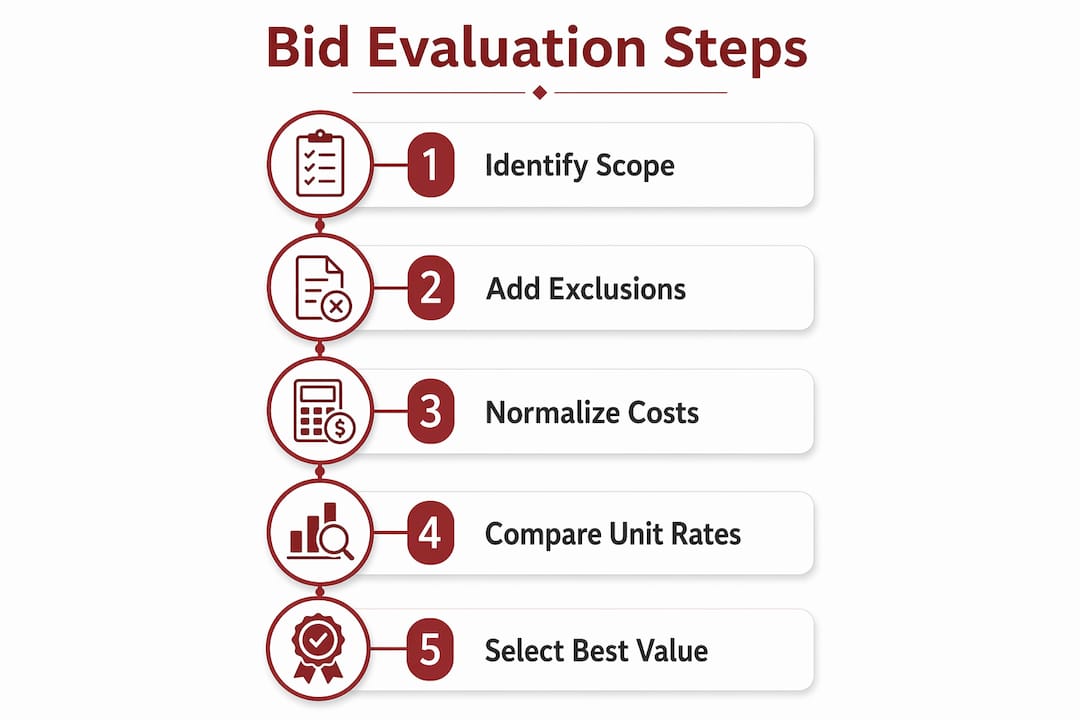
Bid normalization, also called bid leveling, is the process of adjusting competing proposals to a consistent basis so you compare the same scope at the same level of detail. Skipping this step is the single most common mistake property managers make when choosing remodeling contractors.
The normalization process works in four steps:
- Map each bid to your original scope. List every scope item from your project documents. Mark which items each contractor included, excluded, or priced as an allowance. Gaps become immediately visible.
- Convert lump sums to unit rates. Converting lump-sum costs to unit rates like dollars per square foot or dollars per linear foot eliminates noise from total figures and reveals true pricing differences. A roofing bid of $180,000 on 12,000 square feet costs $15 per square foot. That number is far easier to benchmark than the lump sum.
- Assign costs to exclusions. Get independent pricing for any item one contractor excluded but others included. Add that cost to the excluding contractor’s total before comparing final numbers.
- Flag outliers and investigate. A bid significantly lower than the others almost always indicates missed scope or pricing errors. Schedule a scope-leveling meeting with that contractor before making any award decision.
The table below shows how normalization changes the apparent ranking of three hypothetical bids on a commercial siding project:
| Contractor | Raw Bid Total | Exclusions Added | Normalized Total | Unit Rate ($/sq ft) |
|---|---|---|---|---|
| Contractor A | $95,000 | $12,000 | $107,000 | $17.83 |
| Contractor B | $104,500 | $2,000 | $106,500 | $17.75 |
| Contractor C | $112,000 | $0 | $112,000 | $18.67 |
Contractor A looked cheapest at first glance. After adding excluded scope, Contractor B is actually the better value at a nearly identical normalized total and unit rate.
Pro Tip: A simple spreadsheet works well for bid leveling on smaller projects. For projects over $500,000, dedicated construction cost management software gives you version control and audit trails that protect you if disputes arise later.
What qualifications and risk factors should you verify beyond price?
Successful property managers treat bid evaluation as risk management, not just price comparison. Verifying licensing, insurance, and quality assurance protocols alongside cost breakdowns is the standard practice for reducing schedule and budget risk.
Check these non-price factors for every bidder:
- Connecticut contractor licensing. Connecticut requires contractors to hold a valid Home Improvement Contractor (HIC) registration or a specialty trade license depending on the work. Confirm the license number is current and matches the scope. A guide to Connecticut contractor licensing explains the specific requirements by trade.
- General liability and workers’ compensation insurance. Request certificates of insurance naming your business as an additional insured. Minimum coverage levels for commercial work in Connecticut typically start at $1,000,000 per occurrence for general liability.
- Relevant project experience. A contractor with strong residential experience is not automatically qualified for commercial work. Ask for references from projects of similar type, size, and complexity completed within the last three years.
- Warranty terms. Workmanship warranties on commercial projects commonly run one to two years. Material warranties depend on the manufacturer. Confirm both are documented in writing before award.
- Change order procedures. The bid should define how changes are priced and approved. Open-ended change order language is a budget risk. Look for a defined markup rate on labor and materials for changes.
- Addenda acknowledgment. If you issued any clarifications or revisions during the bid period, confirm each contractor acknowledged them in writing. A contractor who missed an addendum may have priced a different scope entirely.
- Scheduling assumptions. Check whether the bid includes realistic start and completion dates. Unrealistic schedules often lead to coordination costs and delays that affect your business operations.
How do you use evaluation results to avoid budget overruns?
The evaluation process produces a ranked list of bids, but the work does not stop there. Interpreting results correctly and negotiating contract terms before award prevents the most common sources of budget overruns.
Watch for these red flags in the final evaluation:
- A contingency below 3% on any project with incomplete design documents signals a risky bid.
- Large exclusion lists paired with a low total price almost always mean the contractor plans to recover margin through change orders.
- Allowances that are significantly lower than market rates for the specified materials indicate the contractor has not priced the actual product.
“The biggest budget surprises on commercial projects don’t come from the bid you chose. They come from the scope you didn’t reconcile before you signed the contract. Every dollar of unresolved exclusion is a future change order waiting to happen.”
Negotiate allowance amounts before signing. Ask each finalist to provide material specifications and supplier quotes supporting their allowance figures. Applying consistent material benchmarks across all bids reveals which contractors priced realistically and which used placeholder numbers to win the job.
Document your evaluation rationale in writing. A scope-leveling summary that explains why you selected a particular contractor protects you if the award is questioned later. It also gives the winning contractor a clear record of what was included in the price.
One often-overlooked cost category is owner-side expenses. Permit fees, engineering reviews, hazardous material testing, and project management fees do not appear in contractor bids. On a $5,000,000 project, these owner costs can total $300,000–$600,000. Build them into your budget before you compare bids to your overall project budget.
Finally, balance price with reliability. A contractor who has delivered similar projects on time and within budget in Connecticut is worth a modest premium over an unknown bidder with a lower number. Hiring an exterior remodeling contractor in Connecticut involves checking references and verifying past performance, not just reviewing the bid document.
Key Takeaways
Accurately evaluating commercial remodeling bids requires normalizing scope, verifying qualifications, and budgeting for owner-side costs before comparing any totals.
| Point | Details |
|---|---|
| Normalize before comparing | Convert lump sums to unit rates and assign costs to exclusions before ranking bids. |
| Allowances hide real costs | Require material specs and apply consistent benchmarks to reveal true allowance values. |
| Contingency signals risk | Standard projects need 10–15% contingency; gut renovations need 20–30%. |
| Verify qualifications | Confirm Connecticut licensing, insurance, experience, and warranty terms for every bidder. |
| Budget owner-side costs | Permit fees, engineering, and testing can add hundreds of thousands to a project’s true cost. |
What I’ve learned from years of watching bids go wrong
I’ve reviewed enough commercial bids in Connecticut to know that the evaluation process trips up even experienced property managers. The most consistent mistake is comparing headline totals before doing any scope reconciliation. You end up selecting a contractor based on a number that doesn’t reflect the actual project.
The single most effective thing you can do before bids go out is run a formal RFI period. A structured RFI process tightens bid spreads and reduces post-award disputes because every contractor prices the exact same scope. It takes an extra week upfront and saves months of conflict later.
I’ve also seen owners chase the lowest contingency as a sign of contractor confidence. That’s backwards. A contractor who bids 2% contingency on a 1960s commercial building in Hartford is either inexperienced or optimistic to a dangerous degree. Older Connecticut buildings routinely hide asbestos, outdated electrical, and structural surprises behind finished walls. Adequate contingency is not padding. It’s honest pricing.
The best bids I’ve seen come from contractors who ask the most questions during the bid period. That curiosity signals they’ve actually read the documents and are pricing what’s there, not what they assumed.
— Adam
Jsignorexteriors helps Connecticut businesses get remodeling right
Connecticut business owners and property managers working through a commercial remodeling project have a lot to manage before a single nail goes in. Jsignorexteriors brings more than 30 years of experience to commercial exterior projects across Connecticut, including roofing, siding, gutters, windows, and masonry.
Jsignorexteriors provides transparent, line-item pricing so you can compare proposals with confidence. The team works with property managers to clarify scope, explain exclusions, and deliver projects on time and within budget. Whether you need a Connecticut roofing contractor for a commercial roof replacement or a full exterior remodel, Jsignorexteriors is fully licensed and insured to handle the work. Contact Jsignorexteriors to request a detailed commercial bid and see exactly what your project includes.
FAQ
What does it mean to evaluate commercial remodeling bids?
Evaluating commercial remodeling bids means analyzing contractor proposals to compare scope, pricing, exclusions, contingencies, and qualifications on a consistent basis. The goal is to identify the bid that represents the best value, not just the lowest total price.
Why do commercial bids vary so much in price?
Bid price spreads of 20–40% are common in commercial remodeling because contractors include different scope items, use different allowance amounts, and carry different contingency levels. Normalizing bids to the same scope is the only way to make a fair comparison.
What contingency percentage should a commercial remodeling bid include?
Standard commercial projects should carry 10–15% contingency. Older buildings or gut renovations require 20–30% contingency to account for unforeseen conditions. A bid with less than 3% contingency on a complex project carries significant budget risk.
How do I verify a contractor’s qualifications in Connecticut?
Confirm the contractor holds a current Connecticut Home Improvement Contractor registration or the applicable trade license, carries general liability and workers’ compensation insurance, and can provide references from comparable commercial projects completed recently.
What are allowances in a commercial bid and why do they matter?
Allowances are placeholder dollar amounts for materials or work not yet fully specified. They matter because a contractor can submit a low bid by using unrealistically low allowances, then recover the difference through change orders once the actual materials are selected.